Conduct rule management software
from the complaint to the cleared fine.
Log a breach of the scheme conduct rules, run it through a warning, then a penalty, then a fine, charge the fine straight to the owner account, and keep the whole record ready for CSOS — on the same Regalis instance that runs your levy roll. Distinct from CSOS registration and levies; built to work alongside them. Informational only, not legal advice.
- Offence categories per scheme
- Warning → penalty → fine
- Fine charged to owner account
- CSOS-ready record
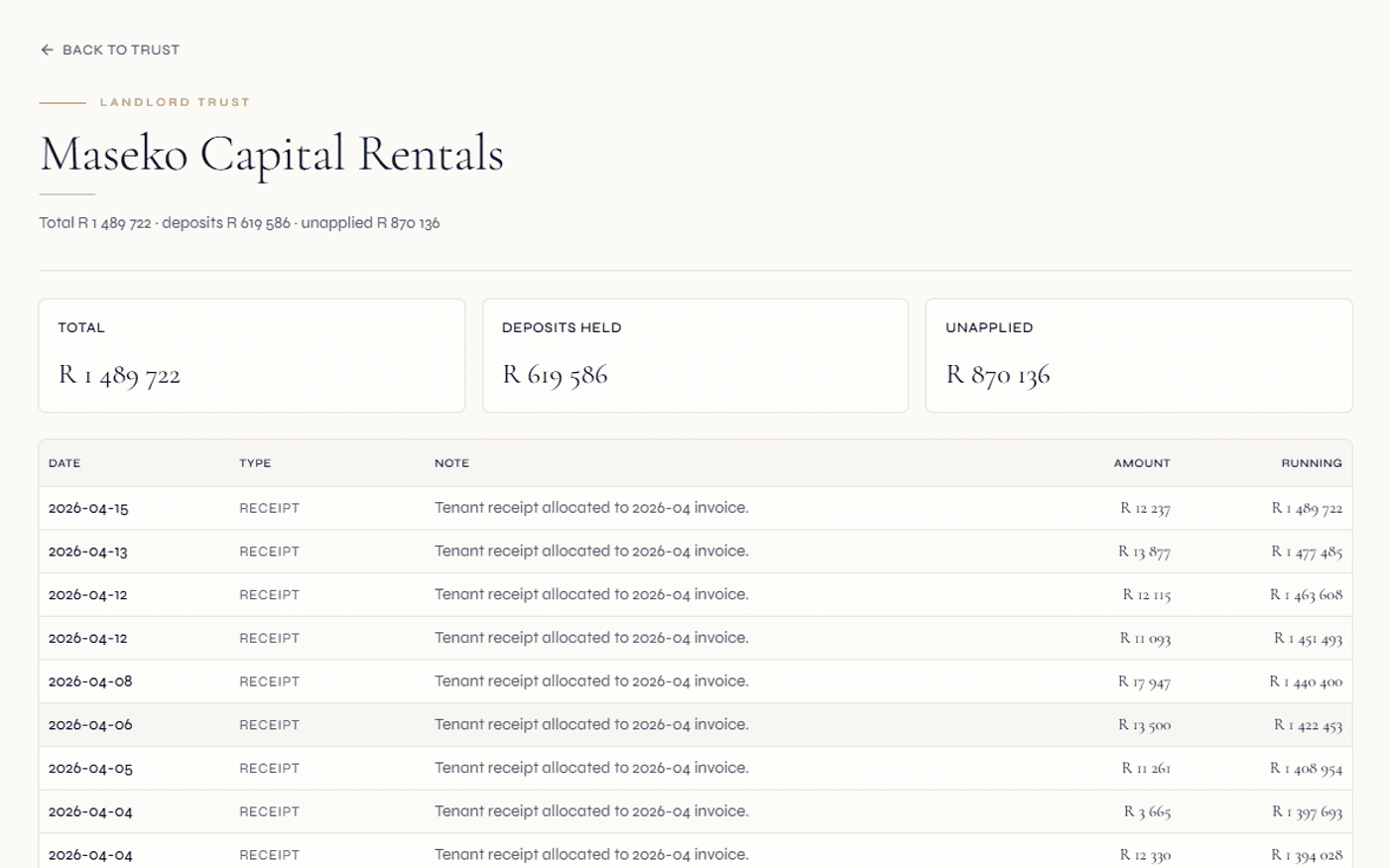
Each scheme sets its own offence categories so the enforcement path matches the conduct rules the trustees adopted.
Warning, then penalty, then fine — each step dated, evidenced and recorded so the progression is defensible.
The fine is charged straight to the owner's account and ages into arrears alongside the levy — no separate fines spreadsheet.
Logging the complaint is the easy part. Holding the record together through the escalation is the hard part.
In most schemes the conduct side lives in three disconnected places: a complaint sits in an inbox, a warning letter sits in a folder, and the fine — if it is ever issued — ends up as a manual line on a spreadsheet that nobody reconciles against the levy account. When the owner disputes the fine, or the matter escalates to the Community Schemes Ombud, the managing agent has to rebuild the story from memory and scattered documents.
Regalis treats the offence as a record on the scheme property, next to the levy roll, the owners and the trustees. A logged breach of the conduct rules carries its category, its escalation history, the notices that went out and the supporting documents. As the matter advances through a warning, then a penalty, then a fine, every step is captured in sequence. The fine is charged automatically to the owner's account, so it lands on the same statement as the levy and clears through the same ledger.
The point is continuity. The complaint, the warnings, the fine and the payment are one thread on one record. When trustees ask "what happened with unit 14?" or when CSOS asks for the history, the answer is a single view — not an afternoon of searching inboxes.
Read the full guide
What scattered conduct enforcement costs a scheme
- Complaints sit in an inbox; warning letters sit in a folder; fines sit on a spreadsheet — three places, no single thread.
- Fines never make it onto the owner statement, so they are forgotten, never collected, and never reconciled against the levy account.
- When an owner disputes a fine, the trustees cannot show the warning that preceded it or the rule that was broken.
- Offence categories are inconsistent — the same breach is handled differently by different managers, undermining any defence.
- A matter escalates to the Community Schemes Ombud and the evidence pack has to be rebuilt from memory and scattered files.
- There is no record of who advanced the matter, when, or on what basis — the escalation is undocumented.
What a connected enforcement record gives you
- The complaint, the warning, the penalty and the fine are one thread on the scheme record.
- The fine is charged straight to the owner account and ages into arrears like any other balance — collected, not forgotten.
- Every escalation step is dated and evidenced, so a disputed fine is backed by the warning and the rule it followed.
- Offence categories are set per scheme, so the same breach is handled the same way every time.
- The evidence pack for CSOS is already gathered — communications, notices, documents and payments in one place.
- The escalation history shows who advanced the matter and when, with supporting documents attached at each step.
From the first complaint to the cleared fine.
Log the offence against the conduct rules
Capture the breach on the scheme record — the unit, the owner, the offence category and the supporting evidence. Because offence categories are set per scheme, the matter is filed against the conduct rule the trustees actually adopted, not a generic label.
- Offence categories defined per scheme
- Linked to the unit, owner and conduct rules document
- Photographs, complaints and notes attached
Issue the warning, then the penalty
Advance the matter along the agreed path. A warning goes out first; if the breach continues, a penalty follows. Each step is dated and captured with the notice that was sent, so the progression is recorded in sequence rather than reconstructed afterwards.
- Warning issued and recorded
- Penalty step captured with its notice
- Scheme-scoped notice sent by email or SMS
Issue the fine and charge the owner account
When the escalation reaches a fine, issuing it charges the amount automatically to the owner's account. The fine appears on the owner's statement next to their levy balance, ages into the arrears bands, and is visible to the owner on their portal and to the trustees on the scheme roll.
- Fine charged automatically to the owner account
- Appears on the owner statement with the levy
- Ages into the arrears bands like any balance
Collect, clear and keep the record for CSOS
The fine clears through the same ledger as the levy when it is paid. The full offence record — category, escalation history, notices, documents and payment status — stays on the scheme property, ready to hand to trustees, an auditor or the Community Schemes Ombud.
- Fine clears through the unified ledger
- Full escalation and payment history retained
- Evidence pack ready for a CSOS request
A complete offence and fine toolkit, on the scheme record.
Conduct rule enforcement is part of the scheme-mode property — it shares the same owners, ledger, documents and notification engine as the levy roll, so the enforcement record never lives apart from the money record.
Offence categories per scheme
Each scheme defines its own offence categories — noise, parking, pets, unauthorised alterations, common-property breaches — so the enforcement path matches the conduct rules that scheme adopted.
Warning → penalty → fine escalation
A logged offence advances along a warning, then a penalty, then a fine. The managing agent controls when to escalate, and each step is dated and captured in sequence.
Fine charged to the owner account
Issuing a fine charges it automatically to the owner's account. It lands on the same statement as the levy, ages into arrears and clears through the unified ledger.
Evidence and notices
Photographs, complaints, prior warnings and the notices that went out attach to the offence, so the escalation is backed by documents rather than recollection.
Conduct rules on the record
The scheme's conduct rules and management rules attach to the property as retention-aware documents, so the current version is always linked to the matters it governs.
Owner and trustee visibility
Owners see their charged fines on the portal statement; trustees see the offence record on the scheme. One source, two appropriate views.
Scheme-scoped notices
Send the warning or the fine notice to the right audience — a single unit, owners in arrears, a phase — by email or SMS through the same notification engine as levy reminders.
Arrears integration
Because the fine ages through the same arrears bands as the levy, an owner's total exposure — levy plus fines — shows on one roll, not two reconciliations.
CSOS-ready evidence pack
The offence history sits next to the communications, payments and approvals on the scheme record, so a Community Schemes Ombud request is answered from one place.
Conduct rules sit under the STSMA and the scheme's own rules — Regalis is built to support the enforcement, not to replace your attorney.
A community scheme enforces conduct through the rules it has adopted. For sectional title schemes the Sectional Titles Schemes Management Act (STSMA, 2011) frames the conduct and management rules and how they bind owners and occupiers; Homeowners Associations enforce through their constitution and estate rules. The Community Schemes Ombud Service Act (CSOS, 2011) establishes the body that resolves disputes — including conduct disputes — and takes custody of the scheme's governance documentation.
Regalis is built to support the enforcement workflow around those rules. Offence categories are set per scheme so the enforcement path reflects the rules that scheme actually adopted. The escalation is recorded step by step. Fines flow onto the owner account through the same trust-aware ledger as the levy, with clean separation and a clear audit trail. None of this is a substitute for advice from your attorney or your registered managing agent on whether a particular fine is validly imposed under your rules.
What the platform gives you is the record. When a conduct matter is raised, escalated, fined or disputed, the history — the rule, the warnings, the notices, the documents and the payment — is gathered on one operating record. That is what stands up when trustees ask, when an auditor reviews, or when the matter lands at the Community Schemes Ombud.
Continue exploring how Regalis handles the rest of the rental operation.
CSOS compliance
The other side of governance — CSOS registration capture, CSOS levy obligations, dispute reference tracking and the per-scheme compliance planner.
Read moreCommunity schemes management
The full scheme platform — levy roll, trustee multi-sig approvals, reserve fund segregation, transfers and conduct rule offences, integrated with rentals.
Read moreCommunity scheme management
How HOA, body corporate, sectional title and share block schemes run on one platform alongside your rental book.
Read moreCommon questions
Common questions about conduct rule management.
What is conduct rule management software?+
It is the part of the scheme platform that handles the enforcement side of governance: logging a breach of the scheme's conduct rules, working it through a warning, then a penalty, then a fine, and recording every step so the trustees and the managing agent have a defensible trail. On Regalis it lives on the scheme property itself — the same record that holds the levy roll, owners, trustees and documents — so an offence, the warning that follows and the fine that lands on the owner's account all sit in one place. This page is informational only, not legal advice.
How is this different from CSOS compliance?+
They sit next to each other but do different jobs. CSOS compliance is about registration, the CSOS levy obligation, governance documents and dispute references — the statutory shape of the scheme. Conduct rule management is the day-to-day enforcement of the scheme's own conduct rules: who broke which rule, what warning went out, what fine was issued, and whether it was paid. When a conduct matter escalates to the Community Schemes Ombud, the record this module builds becomes the evidence pack. See the CSOS compliance page for the registration and levy side.
How does the warning-to-penalty-to-fine escalation work?+
Offence categories are set per scheme, so a noise complaint, a parking breach and an unauthorised alteration each follow the path the trustees agreed. A logged offence can move along a warning, then a penalty, then a fine escalation. The managing agent decides when to advance a matter, and each step is captured with its date, the notice that went out and any supporting documents — photographs, complaints, prior warnings — so the progression is never reconstructed from memory.
Does the fine get charged to the owner account?+
Yes. When a fine is issued it is charged automatically to the owner's account, so it appears on their statement alongside the levy and any other amounts owing. There is no separate fines spreadsheet to reconcile — the fine flows through the same ledger as the levy roll, ages into the arrears bands like any other balance, and clears when it is paid. The owner sees it on their portal statement; the trustees see it on the scheme roll.
What record does it keep for CSOS?+
Every offence carries its category, its escalation history, the notices issued, the supporting documents and the eventual fine and payment status. Because all of that lives on the scheme record next to the communications, payments and approvals, the history is gathered in one place rather than spread across inboxes and folders. If a conduct matter is lodged at the Community Schemes Ombud, the supporting evidence is organised and ready to hand over.
Can owners see their own offences and fines?+
An owner sees the fines that have been charged to their account on their portal statement, in the same view as their levy balance. The internal offence log — categories, escalation steps, trustee notes and supporting documents — is the managing agent and trustee working surface. Scheme-scoped notices let you send the warning or the fine notice through the same email and SMS channels the platform already uses for levy reminders (WhatsApp channel coming soon).
Is this only for sectional title, or also HOAs and body corporates?+
It works across the scheme types the platform supports — Homeowners Associations, body corporates, sectional title and share block. Each scheme sets its own offence categories and its own conduct rules document, so an estate HOA enforcing architectural rules and a body corporate enforcing common-property conduct each run the enforcement path that fits their rules. The conduct rules document itself is attached to the scheme property as a retention-aware record.
See everything built for you — explore the estates hub
Stop reconstructing the story after the fact.
One thread, complaint to cleared fine.
Walk through the offence log, the warning-to-penalty-to-fine escalation, the fine charged to the owner account and the CSOS-ready evidence pack with someone from the team.