Community schemes management
software for South Africa.
HOA, sectional title, body corporate — on one platform. Run Homeowners Associations, Body Corporates, Sectional Title and Share Block schemes alongside your rentals on the same Regalis instance. Levy roll, trustee multi-sig approvals, reserve fund segregation, conduct rule offences, transfers and CSOS-aligned compliance — fully integrated, never a parallel product.
- CSOS-aligned
- STSMA reserve fund
- Trustee multi-sig
- Integrated with rentals
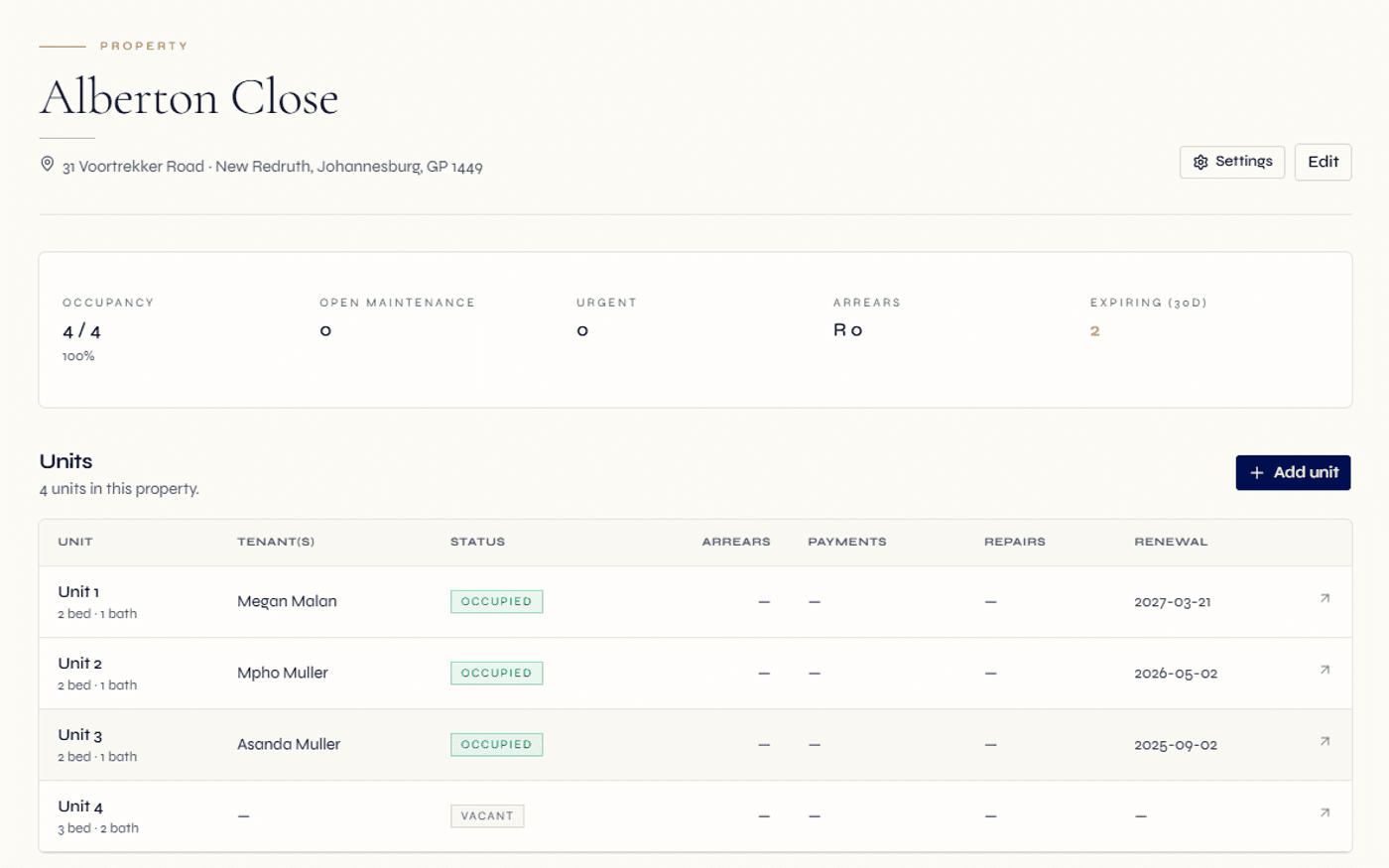
HOA, Body Corporate, Sectional Title, Share Block — all supported as a Property mode.
A managing agent firm runs both books on one Regalis instance — the same finance hub, trust ledger and team directory.
Reserve fund segregation built into the chart of accounts, structured to support reserve-fund reporting at audit time.
Shipped recently — closing the feature gap with the leading SA scheme platform.
Recent shipping has closed the gap with the leading South African scheme platform across the day-to-day workflows community-scheme managing agents rely on. Three of the most impactful additions below; the full surface is documented across the dedicated solution pages.
AGM & meetings workflow
AGMs structured to align with STSMA — participation-quota-weighted voting that applies the special-resolution thresholds for you, owner self-RSVP, pre-filled proxy forms per owner with the STSMA Reg. 20 witness blocks, and round-robin resolutions. Builds an evidence pack to help you prepare for CSOS.
Scheme health scorecard
Composite 0-100 score per scheme across six weighted components — compliance, arrears, reserve fund, offences, AGM cadence, budget adherence. Per-org tunable weights, 12-month trend, radar breakdown. Trustee-facing on the portal.
Bulk operations
Multi-scheme bulk levy run (200 schemes in ~5 minutes with per-scheme isolation), supplier-payment batches with bank-CSV / ACB EFT payment-run exports on a 6-stage approval workflow, portfolio bank reconciliation across FNB / Standard / Nedbank / ABSA / Capitec.
Most schemes-management software is a different product. Ours is the same product, in a different mode.
Walk into the average managing-agent firm in South Africa and you will find two software stacks running side by side: one for their rental book, and one for their HOA / sectional-title / body-corporate book. Two logins, two charts of accounts, two trust ledgers, two notification systems, two POPIA centres, two team directories. Twice the cost, twice the integration debt, and zero ability to give the CEO a single firm-wide view.
Regalis treats a scheme as a property with scheme attributes switched on. The same properties list, the same finance hub, the same trust ledger, the same team directory. A managing agent firm running both rentals and HOAs has one operating record, not two. The principal opens any manager's profile and sees that manager's combined book — rental landlords, scheme owners, rental arrears, levy arrears, compliance items, transfers, approvals — in one place.
For agencies that have been wrestling with two stacks, the migration is more than convenience. It is a real reduction in audit cost (one chart of accounts, one ledger, one set of trust accounts), a real consolidation of POPIA exposure (one consent ledger, one DSR queue), and a real upgrade to firm-wide oversight (one set of monthly snapshots, one set of KPI dashboards).
Read the full guide
What managing two stacks costs you
- Two software subscriptions, two implementations, two annual support contracts.
- POPIA exposure doubled: two consent ledgers to keep current, two DSR queues to monitor, two retention policies to audit.
- Rental landlords and HOA owners cannot share a single profile — the same person who owns three rental units and serves on a body corporate trustee committee has two logins, two statement sets, two compliance footprints.
- CEO cannot answer "how is firm-wide arrears trending?" without reconciling two reports manually.
- New PMs have to be trained on two different platforms; intra-firm tooling discipline drifts.
- When a body corporate has investment units that are also being rented out, the rent flow and the levy flow live on different platforms entirely — reconciliation becomes spreadsheet work.
What integration gives you
- One platform subscription. One implementation. One support contract.
- One consent ledger, one DSR queue, one retention sweep, one IO surface. POPIA exposure halved.
- A person who owns rental units AND serves on a body corporate sees a unified profile across both contexts.
- The principal opens a firm-wide dashboard and sees combined arrears (rent + levy) on one chart.
- Managers learn one product. The team directory is the single source of truth.
- A body corporate unit being rented out shows both the owner panel and the active lease panel on one unit record — rent and levy flows reconcile cleanly.
From scheme onboarding to clean audit.
Switch the property to scheme mode
On the property, set the scheme details — scheme type, CSOS registration and financial-year start — and link the constitution, conduct rules and management rules. The property then opens up its compliance, offences, transfers and trustees sections automatically.
- Scheme type + CSOS registration
- Per-scheme financial-year anchor
- Constitution / conduct rules / management rules linked
Set the chart of accounts and the budget
Install the scheme-appropriate chart of accounts (income, expense, asset, liability, equity). Reserve-fund accounts are marked separately. Draft the annual budget — monthly amounts per line — and submit it for trustee approval. Actual-versus-budget reporting starts immediately.
- Layered chart of accounts with a reserve-fund marker
- Per-property account overrides
- Budget drafted, then approved
Run the levy roll monthly
At the start of every month the levy run raises an invoice per unit from the participation quota and the active budget. Special levies and reserve-fund top-ups layer in on demand. Pro-rata is worked out automatically when a transfer falls within the period.
- Automated monthly levy run
- Driven by participation quota
- Pro-rata on mid-month transfers
Collect, allocate, approve, report
Owner payments come in by EFT and allocate against the right levy invoice via owner-code matching, with manual proof-of-payment capture as the fallback. Supplier payments require N-of-M trustee approvals; once satisfied, the payment run exports in FNB / Standard Bank EFT CSV formats or an ACB-format file. Year-end runs the full close — trial balance, GL, actual-vs-budget, reserve-fund report.
- Trustee multi-sig approvals
- FNB / Standard Bank CSV or ACB-format export
- Per-scheme year-end close
A complete scheme management toolkit, integrated.
Scheme-mode property
Switch scheme mode on for any property — HOA, body corporate, sectional title, share block — and capture the CSOS registration and the scheme financial-year start.
Trustees register
Trustees join the property with a role (chair, treasurer, secretary, member) and appear in the firm-wide team directory with a Trustee badge.
Owner records
HOA owners are unified with the rental-side owner record. An owner who rents elsewhere is the same person across both contexts.
Levy roll
Live per-unit levy calculation from participation quota and the active budget. Base levies, special levies and reserve-fund top-ups all flow through the same monthly run.
Chart of accounts
Layered chart of accounts with reusable templates. Per-property overrides supported. Every money-touching record links to the right account for clean general-ledger reporting.
Reserve fund segregation
Designed to support STSMA s.3(1)(b). Reserve-fund accounts are marked in the chart of accounts; movements post to a dedicated reserve trust account. Reserve-fund reports filter on demand.
Budget + actual-vs-budget
Annual budget per property with monthly amounts per line. Actual-vs-budget reporting shows month-by-month, YTD, variance and percentage drift.
Trial balance + general ledger
Once the chart of accounts is installed, the trial balance and general ledger come automatically from the unified ledger. One source, two reports, both structured to support audit preparation.
Conduct rule offences
Warning, then penalty, then fine escalation paths, with offence categories set per property and the fine charged automatically to the owner's account when it is issued.
Transfers (conveyancing)
Transfer workflow from opened to complete, with conveyancer assignment, outstanding-amount gate, and a levy clearance certificate PDF when the balance is settled.
Trustee multi-sig approvals
Configurable N-of-M approval requirements per property (e.g. 2 of 3 trustees for payments above threshold). Per-trustee decisions captured with reasons and supporting docs.
CSOS compliance planner
Per-scheme compliance items created at the start of each financial year — AGM scheduling, CSOS levy submission, annual financial statements, reserve fund top-up. Supporting documents and an audit trail per item.
Cashbook + bank recon
A cashbook per bank account with a hide-allocated view, per-scheme matching rules (match by owner code), and CSV bank-statement import today, with a direct bank feed on the roadmap.
EFT batch export
Approved supplier payments batch into your bank's import format (FNB, Standard Bank, Nedbank, ABSA Business). No more line-by-line payments.
Recurring tasks
Garden maintenance, pool service, lift inspections — recurring tasks at monthly, quarterly or annual frequency, with the next work order created automatically when each one is due.
Scheme-scoped notices
Targeted audience selectors — all owners, trustees only, owners in arrears, a specific phase. Bulk SMS and email through the same notification engine (WhatsApp channel coming soon).
STSMA, CSOS, the Sectional Titles Act, the PPA — Regalis is built to support all of them.
South African community schemes operate under a layered regulatory stack. The Sectional Titles Schemes Management Act (STSMA, 2011) defines how a sectional title scheme is governed — including the requirement under section 3(1)(b) that a body corporate must establish and maintain an administrative fund AND a reserve fund. The Community Schemes Ombud Service Act (CSOS, 2011) establishes CSOS as the dispute-resolution and oversight body. The Sectional Titles Act of 1986 governs the title-deed side. The Property Practitioners Act (PPA, 2019) overlays the managing-agent registration and trust-account regime.
Regalis is built around each of those. Reserve fund segregation is built into the chart of accounts rather than left as an optional setting. The CSOS registration number is captured as a core detail on scheme-mode properties. Levy obligations and CSOS dispute references surface in the compliance planner. Trust accounts for schemes follow the same trust-accounting posture as rental deposits — clean separation, a structured ledger and a clear audit trail.
For managing agents migrating from a legacy stack, the practical effect is meaningful. Reserve fund reports run from inside the platform without spreadsheet rebuilds. AGM-time annual financial statements account for the segregated funds. When CSOS asks for documents, they are organised and ready to hand over. And when a dispute lands at the Community Schemes Ombud, the supporting evidence — communications, payments, notices, approvals — is gathered in one place.
Continue exploring how Regalis handles the rest of the rental operation.
AGM & meetings software
STSMA-aligned AGMs with PQ-weighted dual-gate voting, owner self-RSVP, pre-filled proxy PDFs, Round-Robin Resolutions per s.6(8).
Read moreScheme health scorecard
Composite 0-100 score across six weighted components. Per-org tunable weights, 12-month trend, radar breakdown — trustee-facing.
Read moreBulk operations
Multi-scheme bulk levy run, supplier-payment batches with bank-CSV / ACB EFT payment runs, portfolio bank reconciliation across 5 SA banks.
Read moreSectional title & body corporate
STSMA-aligned reserve fund segregation, trustee multi-sig, participation quotas, body corporate levies.
Read moreHOA management
Homeowners Association-specific workflows: estate levies, conduct rules, transfers, AGMs.
Read moreLevy collection
Structured levy arrears recovery — multi-channel reminders, CSOS-grade evidence trail.
Read moreCommon questions
Common questions about community schemes management.
Does Regalis manage community schemes (HOA, sectional title, body corporate, share block)?+
Yes. Community schemes is a fully integrated mode on the platform — not a separate product. The same properties list, finance hub, trust ledger and approvals queue serve both rental and scheme operations. Switch on the scheme details for a property and the relevant scheme tools appear.
How is community schemes different to rental management on the platform?+
Everything runs on one shared record. A scheme is a property with its scheme details switched on — the same units, owners, invoices, statements and trust accounts. Trustees are full team members. Levy runs use the same billing workflow as rent runs. One operating record, two operational modes.
Does Regalis handle the levy roll?+
Yes. The levy roll is calculated from each unit's participation quota and the active budget. Owners see their per-unit balances; trustees see the full roll with arrears bands. Special levies use the same calculation as a one-off charge against a chosen list of units.
How does the reserve fund segregation work?+
STSMA section 3(1)(b) calls for the reserve fund to be ring-fenced. Regalis is structured to support this in the chart of accounts — reserve-fund accounts are marked separately, and movements post to a dedicated scheme-reserve trust account. Reports filter to the reserve fund on demand to help you prepare for auditor handover.
What about trustee multi-sig approvals?+
For supplier payments and other governance actions, the platform supports N-of-M trustee approvals — for example "2 of 3 trustees must approve payments above R20 000". Each trustee decides via their portal; the decision trail captures who approved, who declined and the supporting documents.
Does it support transfers / conveyancing?+
Yes. The transfers module manages the end-of-ownership flow with reference number, erf, transfer date, sale price, conveyancer, seller and buyer details. On completion, ownership updates and the levy clearance certificate PDF is generated when outstanding amounts are settled.
Can it run AGM and trustee meetings?+
AGM minutes, the constitution, conduct rules and management rules attach to the property as retention-aware documents today. Structured meeting agendas, attendance capture, resolution tracking and action-item ownership are on the next-phase roadmap.
Is it CSOS aligned?+
Yes — it is designed to support your CSOS obligations. Each scheme-mode property captures its CSOS registration number. CSOS levy obligations, dispute reference tracking and the compliance planner appear in the property's compliance section. The published PAIA manual reflects the 2021 transfer of oversight to the Information Regulator.
Can a managing agent firm run rentals AND community schemes?+
Yes — that is the point. A firm with one CEO, ten property managers, sixty rental landlords and twelve HOAs runs everything on one Regalis. The CEO drills into any manager's profile and sees that person's combined book — rentals, schemes, arrears, approvals, compliance, transfers — without switching products.
See everything built for you — explore the estates hub
Stop running two software stacks.
One platform, both books.
Walk through the integrated rental + schemes surface, the levy roll, the trustee approvals workflow and the reserve-fund reporting with someone from the team.