Levy collection software
without the chasing.
Automated monthly levy runs, bank-notification and CSV bank-statement reconciliation, configurable collection statuses, multi-channel reminders, age analysis, a structured CSOS evidence trail and integrated owner statements. The same workflow discipline rentals get for rent arrears — applied to community schemes.
- Bank-statement reconciliation
- EFT payments
- Per-MA collection rules
- CSOS evidence pack
Reminders, retries and partial-payment receipts captured automatically on the owner ledger.
Incoming EFT payments matched to the right owner and invoice from bank payment notifications and CSV bank-statement imports.
Each managing agent firm defines its own status transitions, reminder cadences and escalation paths.
Levy arrears compound silently — and the body corporate carries the cost.
In residential rentals, late rent is the landlord's problem and the landlord pays attention to it. In community schemes, late levies are the body corporate's problem — and the body corporate is a collective entity managed by volunteer trustees and a contracted managing agent. The accountability shape is different. The trustees notice arrears when the special levy needs raising. The managing agent notices when the auditor flags it. The owners notice when their levies go up to cover someone else's shortfall.
The practical consequence is that levy arrears get less day-to-day attention than rent arrears. The reminder might go out a month late. An owner's EFT might sit unreconciled. The conduct rule fine might not be charged. By the time anyone notices the 90-day-overdue owner, the recoverable evidence trail is fragmented across emails, WhatsApp messages and spreadsheet rows.
Regalis was built to keep levy collection deterministic. The reminder cadence runs whether or not anyone is watching. Bank-statement reconciliation runs automatically. The age analysis updates the moment an invoice goes overdue. When the body corporate eventually goes to CSOS or to attorneys, the evidence pack is one click away from the same record the managing agent has been operating on.
Read the full guide
How levy collection usually fails
- Owner is 30 days overdue; nobody sends a reminder because the spreadsheet age-bucket has not been refreshed.
- An owner's EFT lands unreferenced and nobody matches it in time — a paid levy still shows as arrears.
- Conduct rule fines are issued verbally and never charged to the owner ledger; the body corporate is owed money it cannot recover.
- AGM time the trustees see the arrears total for the first time — and the trustees pressure the MA to "do something".
- CSOS dispute lands and the team has to reconstruct the evidence trail from emails, WhatsApp threads and an ageing Word document.
- A levy clearance certificate is issued for a transfer without checking outstanding fines; the body corporate writes off the balance.
How Regalis runs it
- Age analysis runs live on every invoice past due. Reminder cadence triggers automatically on the configured schedule.
- Incoming EFT payments reconcile automatically from bank payment notifications and CSV bank-statement imports; unmatched receipts surface as exceptions for review.
- Conduct rule fines post automatically to the owner ledger as a fine line item — no manual entry, no missed charges.
- Trustees see arrears in their portal at all times — not just at AGM. Configurable status workflow keeps escalation predictable.
- CSOS evidence pack exports with one click: statement, payment history, reminder log, offences.
- Levy clearance certificate gates against ALL outstanding balances — levies, special levies, fines, interest, pro-rata.
From overdue levy to CSOS evidence pack.
Invoice goes past due
The moment a levy invoice crosses its due date it transitions to overdue. The owner appears on the age analysis with aging bucket, balance and last activity. Collection status moves to the configured next state (typically "Reminder 1 sent").
- Aging buckets: 0-30, 31-60, 61-90, 90+
- Status history captured per transition
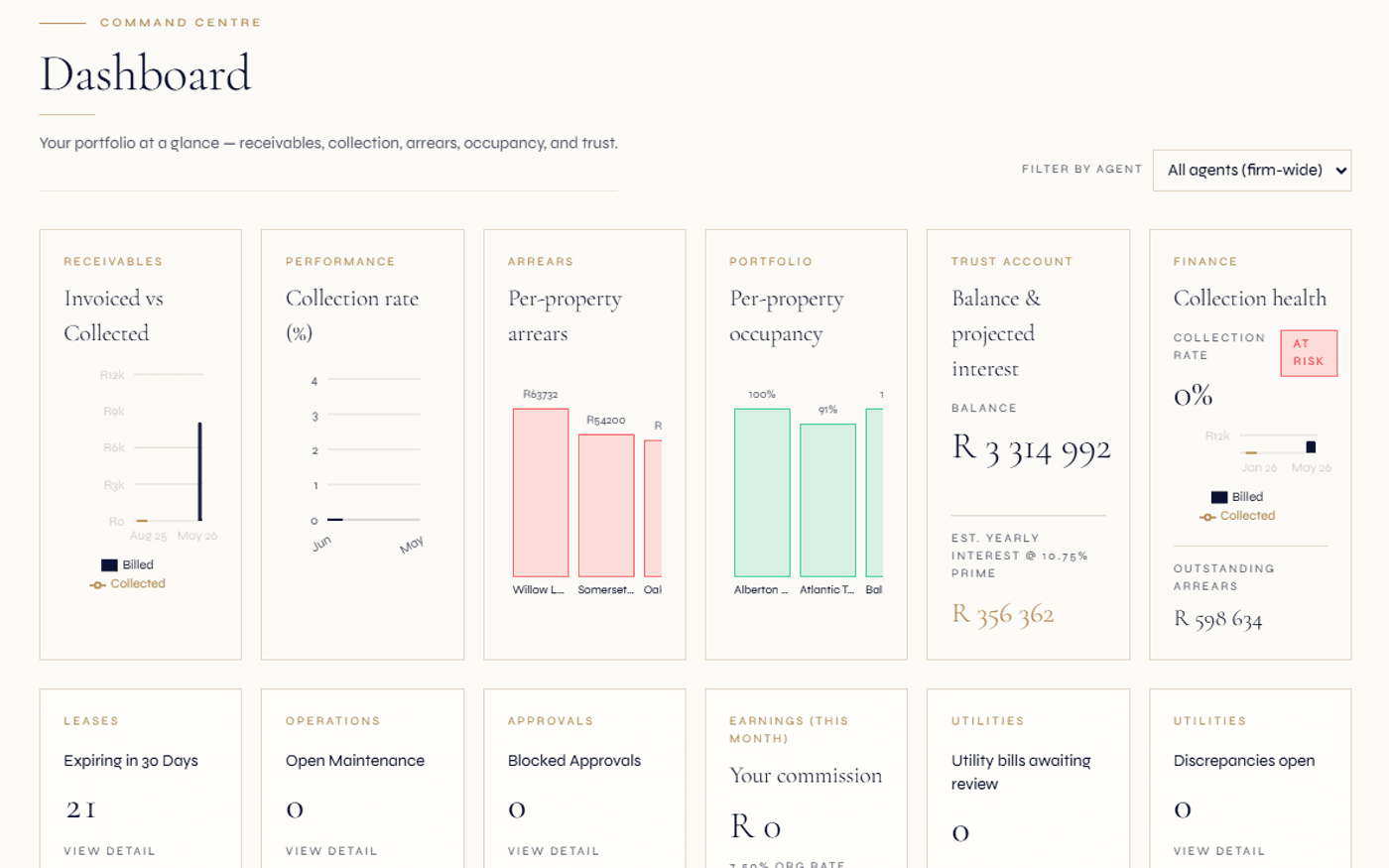
- Trustees see arrears tile on dashboard
Reminders fire on the configured cadence
Templated reminders go out over email and SMS on the schedule your firm defines, with one-tap WhatsApp send from the arrears workspace. Every send is logged with timestamp, channel and delivery receipt. Phone calls capture summary, outcome and follow-up date.
- One-tap WhatsApp send, logged per owner
- Phone-call log for verbal escalation
- Per-firm configurable reminder cadence
Bank reconciliation runs automatically
Incoming EFT payments are imported from bank payment notifications and CSV bank-statement imports and matched to the right owner and open invoice, with direct read-only bank feeds rolling out per bank. The platform records each receipt and updates the owner ledger when the bank confirms. Receipts auto-allocate.
- Bank-notification + CSV statement import
- Owner-code matching + operator override
- Receipts auto-allocated to right invoice
Escalate with full evidence
If reminders fail to recover the arrears, the workflow escalates. Collection status moves to final demand or attorney handover. The CSOS evidence pack exports with the full trail — statement, reminder log, payment history, conduct-rule offences, internal notes. Structured to support a CSOS dispute or attorney handover, generated from the same record.
- Statement + reminder log + payment history
- Internal note audit trail
- CSOS / attorney handover pack one-click
A complete levy-arrears toolkit for SA schemes.
Monthly levy run
Automatic monthly invoice generation per unit using participation quota or per-unit configured levy. Idempotent — re-running for the same period never double-bills.
Age analysis report
Per-owner outstanding balance bucketed by 0-30, 31-60, 61-90 and 90+ days. Filterable by property, suburb or managing agent. Drillable to per-owner detail.
Collection status engine
Per-firm configurable status workflow. Every transition captured with timestamp, reason and whether it was a manual or automated change.
Phone-call log
Capture every collection phone call with date, who called, summary, outcome and follow-up date. A structured audit trail for verbal escalation to support dispute preparation.
Internal owner notes
Running internal log on each owner — observations, agreements, payment plans. Visible to your team, hidden from the owner portal.
Owner EFT payments
Owners settle by EFT with proof-of-payment upload. Incoming payments reconcile to the right owner and invoice using owner-code references, from bank payment notifications and CSV bank-statement imports.
Multi-channel reminders
Email and SMS on a configurable cadence per firm, with one-tap WhatsApp send from the arrears workspace. Delivery log per reminder.
Auto-charge fines
When a conduct-rule offence escalates to a fine, the charge posts to the owner ledger automatically. No manual entry, no missed charges.
Levy clearance certificate
On transfer, the certificate generates only when outstanding amounts are settled — levies, special levies, fines, interest, pro-rata, all included.
Owner statements
Per-owner statements with full invoice + receipt detail, period filtering and PDF download. Available to the owner via portal or batch-emailable.
CSOS evidence export
One-click pack: statement, reminder log, payment history, call log, internal notes, offences. Structured to support a CSOS dispute and ready for attorney handover.
Bank-notification reconciliation
Incoming EFT notifications auto-match against the right owner using owner-code references plus a configurable tolerance band for partial payments.
Trustees dashboard
Trustees see real-time arrears on their portal — no waiting for AGM. Filterable, drillable, working off the same data your team uses every day.
Special levies
Raise special levies through the same engine with a one-off flag. Pro-rata if a transfer falls within the period. Trustee approval gated.
Email-bounce tracking
Every delivery captures status and bounces. Bounced reminders surface as exceptions so your team can switch to a different channel.
Reserve fund visibility
When arrears push the body corporate near its reserve fund threshold, the actual-vs-budget report flags it for trustee attention before AGM.
CSOS, the courts, and why levy evidence has to be audit-grade.
When a body corporate or HOA pursues an owner for levy arrears, the route is well-defined: internal reminders first, then a formal demand, then either a Community Schemes Ombud Service application or a civil claim through the magistrate's court (or for larger amounts, the high court). The Ombud is statutorily empowered under the CSOS Act to issue binding orders for the recovery of contributions. The court route is the conventional civil-claim path.
In either route, the evidence required is documentary: the levy schedule (showing the levies are properly raised), the owner statement (showing the balance), the demand correspondence (showing the owner was put on notice), the payment history (showing the gap between obligation and performance), and any negotiation record (showing the body corporate acted reasonably). Get any of these wrong and the matter slows down or fails on procedure.
Regalis is structured to capture every one of those by default. The monthly levy run produces the levy schedule. The owner statement is generated on demand. The reminder log, phone-call log and internal owner notes together form the demand and negotiation trail. The payment-allocation history shows what was paid against what. The export pack assembles all of this in a single PDF plus supporting-documents bundle — the same structured quality you would prepare for rent arrears at the Rental Housing Tribunal, applied to levies.
Continue exploring how Regalis handles the rest of the rental operation.
Bulk operations
Multi-scheme bulk levy run, supplier batches with bank-CSV / ACB EFT payment runs, portfolio bank recon across 5 SA banks.
Read moreCommunity schemes overview
The integrated community schemes mode covering HOA, body corporate, sectional title and share block.
Read moreSectional title & body corporate
STSMA-aligned management for body corporate schemes — reserve fund, participation quotas, trustees.
Read moreRental arrears collection
The rental-side equivalent — the same workflow discipline applied to overdue rent.
Read moreCommon questions
Common questions about levy collection.
How does Regalis automate levy collection?+
A monthly levy run mints invoices for every active unit using the participation quota (sectional title) or the configured per-unit levy (HOA). Owners get escalating reminders over email and SMS on the cadence you set, with one-tap WhatsApp send from the arrears workspace. Incoming EFT payments reconcile automatically against bank payment notifications and CSV bank-statement imports. The age analysis shows who is overdue, by how much and for how long.
How do owners pay levies?+
Owners settle by EFT. Receipts auto-match to the right owner and invoice using owner-code references, from bank payment notifications and CSV bank-statement imports (FNB, Standard Bank, Nedbank, ABSA, Capitec), with direct read-only bank feeds rolling out per bank; partial payments are handled with a configurable tolerance band. Regalis reconciles the money that lands rather than pulling it via a debit-order rail.
What is the collections status workflow?+
Each owner carries a collection status that drives the reminder cadence and escalation. Your firm configures the transitions: 30 days overdue triggers reminder 1, 60 days triggers reminder 2 and a phone call, 90 days triggers final demand, 120 days triggers attorney handover. Every status change, call and internal note is captured.
How does the age analysis work?+
A live report bucketing per-owner outstanding balance by 0-30, 31-60, 61-90 and 90+ days, sourced from invoice due dates and payment allocations. Surfaces on the trustee dashboard as a sanity check and on the principal's firm-wide view as a portfolio KPI.
What evidence does Regalis produce for a CSOS dispute?+
When an owner lodges a dispute at the Community Schemes Ombud — or when the body corporate refers an outstanding owner — the platform compiles the evidence pack from the same record the team has been operating on: statement of account, payment history, reminder log with delivery receipts, conduct-rule offences, internal notes. Structured to support a dispute or handover, exported with one click.
Can fines be auto-charged to the owner ledger?+
Yes. When a conduct-rule offence escalates to a fine, the platform automatically charges it to the owner's ledger. The fine appears on the next owner statement, accrues interest like any other arrears, and feeds into the age analysis.
Does the levy clearance certificate gate against arrears?+
Yes. When a transfer is opened, the certificate generates only when outstanding amounts — levies, special levies, fines, interest, pro-rata — are settled. The conveyancer cannot retrieve the certificate before the body corporate is paid. On completion, ownership transfers cleanly and the seller's ledger closes.
Can I run levies for hundreds of schemes at once?+
Yes. The multi-scheme bulk levy run dispatches the monthly run across every scheme in the portfolio in one click. Each scheme runs in its own transaction with its own participation quotas, its own budget and its own chart of accounts — but you fire it from one screen with one click and watch progress on a live dashboard. A 200-scheme portfolio that used to take half a day of clicking now takes the time to make a coffee. Per-scheme transaction isolation means one failure never blocks the other 199; failed schemes surface on the dashboard for individual rerun.
Is it safe to run levies for two schemes in the same month?+
Yes. Each scheme levy run is fully isolated from every other scheme, so running two schemes in the same period never lets one run overwrite or destroy invoices from another. This is a known failure mode in older levy systems, where overlapping runs can silently corrupt invoices and the problem only surfaces at year-end audit when balances do not tie out. Regalis is designed so each scheme run stands on its own, and that isolation is covered by automated checks on every release.
See everything built for you — explore the estates hub
Stop chasing levies.
Run the playbook.
Walk through the levy-collection engine, the configurable status workflow and the CSOS evidence export with someone from the team.