Sectional title management software South Africa
Body corporate, STSMA-aligned.
Manage body corporate schemes under the Sectional Titles Schemes Management Act. Participation-quota driven levies, reserve fund kept separate from the administrative fund, trustee multi-signature approvals, conduct-rule offences, transfers and the 10-year maintenance plan — integrated with your rental book.
- STSMA s.3(1)(b)
- Participation quotas
- Trustee multi-signature
- 10-year maintenance plan
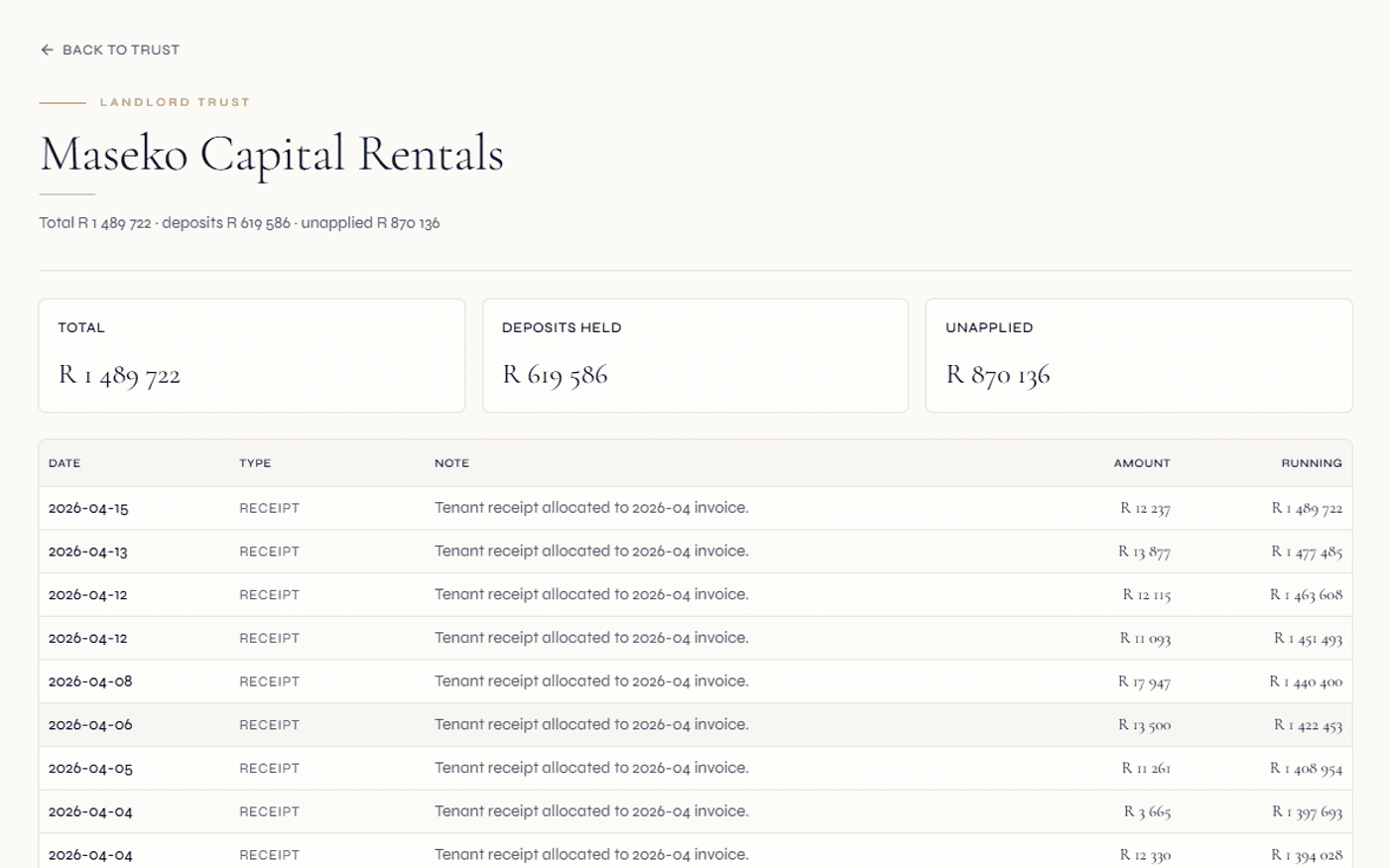
Reserve fund kept separate from the administrative fund in the chart of accounts, structured to align with STSMA s.3(1)(b).
Each unit's participation quota drives the levy calculation and the dual majority-by-number and majority-by-value check on STSMA special resolutions.
Round-robin resolutions under STSMA section 6(8) as a first-class meeting type — written assent between meetings.
STSMA, CSOS, the Sectional Titles Act — three regimes, one set of records.
Body corporate management in South Africa operates under a particularly dense regulatory stack. The Sectional Titles Schemes Management Act (STSMA, 2011) governs the financial and governance side: the requirement to maintain both an administrative fund and a reserve fund, the rules for trustee elections and meetings, the calculation of levies based on participation quotas, the maintenance-plan obligation. The Sectional Titles Act of 1986 governs the title-deed and survey side. The Community Schemes Ombud Service Act (CSOS, 2011) establishes the dispute-resolution and oversight body.
Managing agents who work in body corporates carry the practical weight of all three. They have to keep the reserve fund segregated correctly. They have to compute levies from quotas that match the registered scheme plans. They have to retain AGM minutes for the statutory period. They have to capture trustee approvals in a defensible way. They have to settle CSOS levies. They have to produce annual financial statements that an auditor and the trustees will sign off.
Regalis treats every one of those requirements as core, not optional. The reserve fund split is built in, not a setting you might forget to switch on. The levy roll comes from the participation quotas you maintain on each unit. Trustee approvals run through the same workflow as landlord-side approvals, with configurable N-of-M multi-signature thresholds. Year-end produces the trial balance, general ledger, actual-vs-budget, reserve fund report and per-owner statements, structured to align with STSMA expectations.
Read the full guide
How body corporates run on legacy software
- Reserve fund and administrative fund share a single bank account; the split is reconciled monthly in Excel and the auditor has to redo it at year-end.
- Participation quotas live in a separate spreadsheet from the levy roll; the two drift when a unit gets a subdivision or when a developer-held unit is finally sold.
- Trustee approvals happen at quarterly meetings — anything in between is informal, with no recorded multi-signature sign-off.
- 10-year maintenance plan is a Word document that nobody updates, with the reserve fund top-up calculated ad-hoc each AGM.
- CSOS levy obligations are tracked in a calendar reminder; the annual submission is occasionally missed.
- AGM annual financial statement takes 2-3 weeks of accountant time to assemble from PDFs, spreadsheets and bank statements.
How Regalis runs it
- Reserve fund kept separate from the administrative fund in the chart of accounts, with a dedicated reserve trust account.
- Participation quotas are held on each unit; the levy roll is computed live from the same figures registered for the scheme.
- Configurable multi-signature approvals per scheme (for example 2 of 3 trustees) for supplier payments and governance actions.
- 10-year maintenance plan stored as a structured document with a funding profile; the reserve fund top-up surfaces in the actual-vs-budget report.
- CSOS compliance items surface in the compliance planner with a reminder schedule, making the annual levy submission easy to stay on top of.
- Year-end runs the full report pack from the platform: trial balance, general ledger, actual-vs-budget, reserve fund report, owner statements, with AGM minutes attached.
From scheme registration to AGM sign-off.
Onboard the body corporate
Set the scheme type to body corporate. Capture the CSOS registration, financial-year start, constitution, conduct rules and management rules. Onboard owners, and add trustees with their role.
- Body corporate mode
- CSOS registration captured
- Trustees in the firm-wide team directory
Set up the chart of accounts and draft the budget
Set up the body-corporate chart of accounts covering administrative fund and reserve fund income and expenses, with reserve-fund accounts kept distinct. Draft the annual budget and submit it for trustee approval.
- Structured chart of accounts with a reserve-fund split
- Budget draft through to approved
- Trustee approval on the budget itself
Run levies, collect, approve, reconcile
The monthly levy run raises invoices using participation quotas. Owners pay by EFT, matched to the right unit by owner-code references. Supplier payments queue for trustee multi-signature approval, and once the threshold is met the EFT batch exports. Bank-notification and CSV bank-statement reconciliation matches receipts to invoices.
- Monthly levy run and special levies
- Trustee multi-signature supplier approvals
- FNB / Standard Bank CSV or ACB-format export
Year-end + AGM
Year-end runs the trial balance, general ledger, actual-vs-budget, reserve fund report and per-owner statements. AGM minutes attach as documents. The 10-year maintenance plan gets its annual review; reserve fund top-up calculated. CSOS submission filed via the compliance planner.
- Full year-end report pack
- AGM minutes retained per STSMA
- 10-year plan reviewed annually
- CSOS submission tracked
Everything STSMA expects, automated.
Body corporate mode
Selecting body corporate as the scheme type activates the statutory features. Capture the CSOS registration, financial-year start, and the constitution, conduct rules and management rules as linked documents.
Participation quotas
Each unit's participation quota is held on its record, and the levy calculation pulls directly from those values. Changes to a quota (rare, but they happen with subdivisions) are tracked in the audit trail.
Reserve fund segregation
Structured to align with STSMA s.3(1)(b): reserve-fund accounts are kept distinct, run through a dedicated reserve trust account, and auditor reports can be filtered to the reserve fund.
Levy roll
Regular administrative-fund levies, reserve-fund top-up levies and one-off special levies for projects — all driven by participation quota, with manual overrides where needed.
Trustee multi-signature
Configurable approval thresholds per scheme set how many trustees must sign off supplier payments and governance actions. Each trustee decides from the portal, with a full audit trail.
EFT batch export
Once the approval threshold is met, the supplier-payment batch exports in your bank's format (FNB, Standard Bank, Nedbank, ABSA Business) for import into business banking.
Conduct rule offences
Common offence categories (noise, parking, pets, alterations, common-area misuse, common-property damage). When a fine is issued it is charged automatically to the owner's ledger.
10-year maintenance plan
Structured plan with a funding profile. The annual review is tracked, and the implied reserve fund contribution is shown alongside actual reserve fund movements.
CSOS compliance planner
Per-scheme compliance items: AGM scheduling, annual financial statements, CSOS levy submission, reserve fund top-up and conduct-rule review, each with its own audit trail.
Transfers + clearance certificate
On a unit transfer, the platform computes the outstanding amounts and generates a levy clearance certificate once balances are settled. Ownership records update automatically on completion.
Recurring maintenance
Lift inspections, fire equipment, garden, pool and generator servicing — set a recurring schedule and Regalis raises the next work request automatically as each one falls due.
Owner + tenant coexistence
Each unit shows the owner alongside any active lease, so owner-occupied and owner-rented-out units are handled cleanly. Levy invoices and rent invoices sit on the same unit ledger.
Trial balance + general ledger
Once the chart of accounts is set up, both reports come automatically from the unified ledger, with a reserve-fund filter on the same reports.
Actual vs budget
Month-by-month, year-to-date, variance and totals. Filterable to the administrative fund or reserve fund, and surfaced on the trustees' dashboard as a check before payment approvals.
AGM-aligned year-end
Year-end financial statement formatted to align with STSMA and Companies Act expectations, ready for auditor handover, with a per-owner statement included.
POPIA + audit trail
Every owner action, payment, approval and offence is captured in the audit trail with the actor and the change made. The consent and retention controls are designed to support POPIA-aligned handling of owner data too.
The Deeds Office gate that breaks every transfer that is not properly tracked.
When a sectional title unit transfers, the Deeds Office requires a Levy Clearance Certificate from the body corporate confirming that all levies are paid up to the date of transfer. Get this wrong and the transfer is delayed; get it badly wrong and the body corporate ends up chasing the new owner for arrears the old owner left behind. The conveyancer is the one calling the managing agent at 4pm on a Friday asking for the certificate.
Regalis automates this. When a transfer is opened for a unit, the platform tracks the conveyancer, the seller, the buyer, the proposed transfer date and the agreed sale price. As the transfer date approaches, the platform computes the total owed: regular levies up to the transfer date, any pending special levies, conduct-rule fines, interest accrued and a pro-rata charge for the month of transfer. The certificate generates only once the outstanding amount is settled.
On completion of the transfer, the platform records the buyer as the new owner and closes the seller's ownership. The next levy run bills the new owner, and the old owner's statement is closed and archived. The conveyancer gets the certificate, the body corporate is paid in full, and the new owner starts clean.
Continue exploring how Regalis handles the rest of the rental operation.
AGM & meetings software
STSMA-aligned AGMs with participation-quota-weighted voting, owner self-RSVP, pre-filled proxy PDFs and round-robin resolutions under s.6(8).
Read moreScheme health scorecard
Composite 0-100 score per scheme across six weighted components — trustee-facing radar + 12-month trend.
Read moreCommunity schemes overview
The full integrated community schemes mode covering HOA, body corporate, sectional title and share block.
Read moreHOA management
Homeowners Association-specific workflows for gated estates and lifestyle developments.
Read moreLevy collection
Structured levy arrears recovery — multi-channel reminders, CSOS-grade evidence trail.
Read moreBulk operations
Multi-scheme bulk levy run, ACB EFT supplier batches, portfolio bank reconciliation across 5 SA banks.
Read moreCommon questions
Common questions about sectional title management.
Does Regalis support sectional title body corporates specifically?+
Yes. Setting a property to body-corporate mode activates the sectional title features. Participation quotas drive the levy calculation, the reserve fund is kept separate from the administrative fund in the chart of accounts, trustee multi-signature approvals are available from the start, and STSMA-aligned year-end reports come straight from the platform.
How does the reserve fund work under STSMA section 3(1)(b)?+
STSMA section 3(1)(b) requires every body corporate to maintain an administrative fund and a reserve fund. Regalis is structured to support this in the chart of accounts: reserve-fund accounts are kept distinct, their movements run through a dedicated reserve trust account, and the trial balance, general ledger and actual-vs-budget reports can be filtered to the reserve fund on demand. The 10-year maintenance plan informs the top-up calculation.
What is participation quota and how is it used?+
Participation quota is the fractional share each unit holds in the body corporate, set in the scheme plans and registered at the Deeds Office. The monthly levy multiplies each unit's quota by the budgeted monthly cost. Special levies use the same proportion unless explicitly overridden.
How do trustee meetings and approvals work?+
Trustees join the property with a role (chair, treasurer, secretary, member). Configurable multi-signature requirements per scheme define the threshold for supplier payments and governance actions (for example "2 of 3 trustees for payments above R20 000"). Decisions are captured in the portal with reasons, and AGM and trustee meeting minutes attach as documents with retention controls.
How does STSMA s.1 PQ-weighted voting work on AGM resolutions?+
STSMA distinguishes between ordinary, special and unanimous resolutions, with special resolutions requiring both a majority by number of members voting and a majority by value, where value is measured by participation quota. This participation-quota-weighted requirement on special resolutions is the part legacy platforms most often get wrong. Regalis is designed to apply both thresholds together — each percentage displays live as ballots are cast, and a resolution is only marked as carried when both thresholds are met. The vote record captures every ballot alongside the unit's participation quota to support statutory retention. Always confirm the exact thresholds against the current Act and your scheme rules.
What about Round-Robin Resolutions per STSMA s.6(8)?+
Round-robin resolutions under STSMA section 6(8) are a first-class meeting type in Regalis. Trustees draft the resolution, the platform circulates it through the same notifications that handle AGM notices, and owners (or trustees, depending on the resolution type) register their assent from the portal. The same threshold that the equivalent in-meeting resolution would carry applies, whether that is an ordinary, special or unanimous resolution. When the threshold is met, the resolution is recorded as carried with a full audit trail.
Does Regalis handle the 10-year maintenance plan?+
Yes. The 10-year maintenance plan is stored as a structured document on the property with a funding profile that informs the reserve fund top-up calculation. To help you keep the plan current under STSMA, the platform tracks the approval date, the next review date and the implied reserve fund contribution.
Are CSOS levies and dispute references tracked?+
Yes. Each scheme-mode property captures its CSOS registration. CSOS levy obligations surface in the compliance planner. When a dispute is lodged at the Community Schemes Ombud Service, the reference number, status and related documents attach to the property, and the annual CSOS levy submission is surfaced as a tracked reminder so it is easy to stay on top of.
Can a sectional title unit be rented out and managed in the same platform?+
Yes — this is the core of the integrated approach. A unit in a body corporate has an owner. If the owner rents it out, the lease sits alongside the ownership record on the same unit, with the owner shown above the active lease. Levy invoices and rent invoices coexist on the same unit ledger.
How is the body corporate financial year handled?+
STSMA allows the body corporate to choose its own financial year anchor. Regalis lets you set the anchor month per scheme. A body corporate running March-to-February runs cleanly alongside an HOA running July-to-June and a rental org running on the standard SA March-1 anchor — all in one platform.
See everything built for you — explore the estates hub
Body corporate management,
without the audit pain.
Walk through the sectional title features, the reserve fund split, the trustee multi-signature approvals and the year-end reports with someone from the team.