Rental application software
The front door to every tenancy, online.
Branded online application forms, structured document capture, a drag-and-drop applicant pipeline, and POPIA-aligned consent taken at the moment of capture. Turn every enquiry into a clean, reviewable application record — before a single credit check is run.
- Online apply link
- Document capture
- Applicant pipeline
- Consent at capture
A branded apply link a prospect can complete from a phone — questionnaire, documents and consent in one flow.
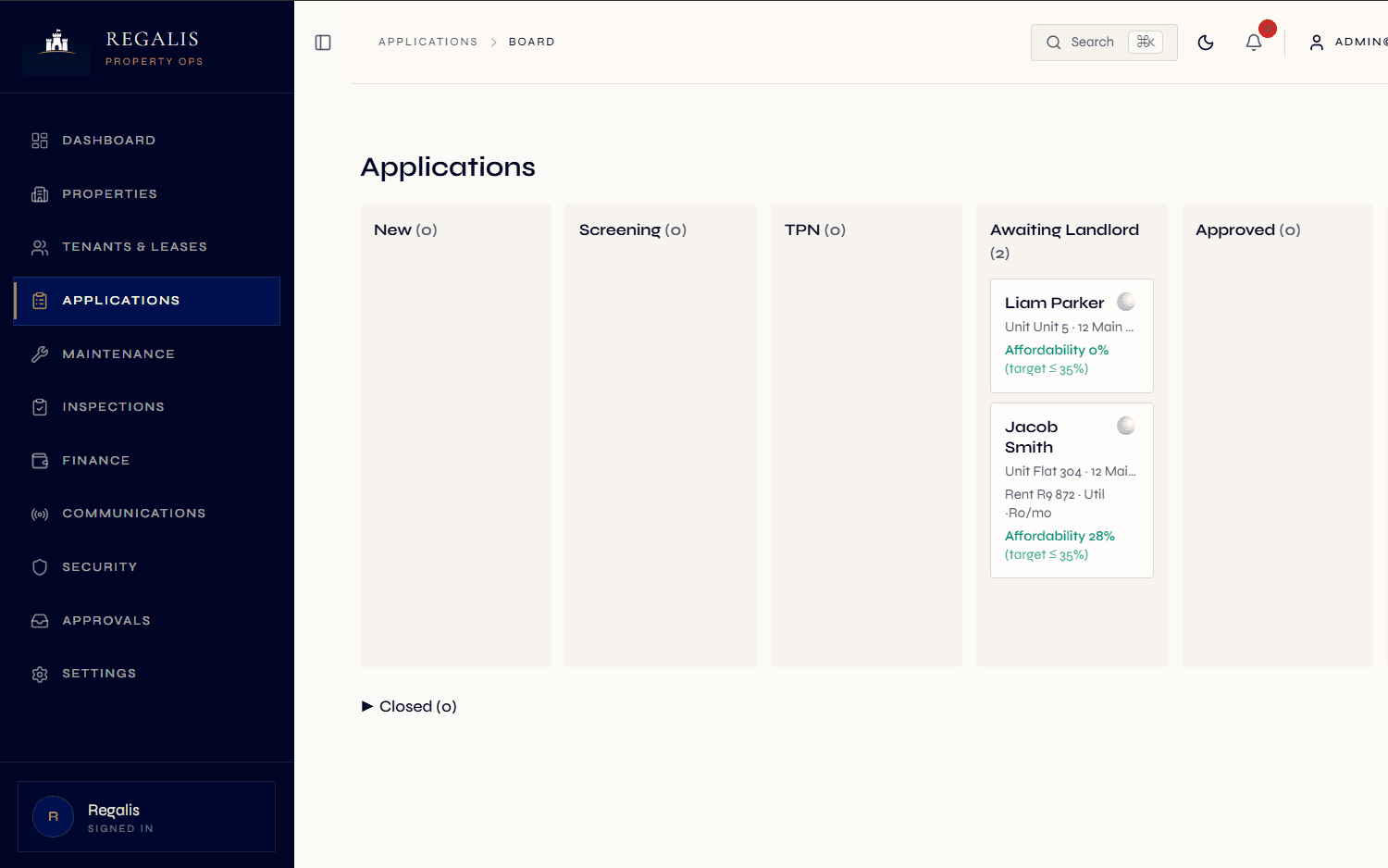
Submitted, under review, vetting, approved, ready for landlord, converted — plus declined and withdrawn lanes.
Consent recorded with timestamp and disclosure version the moment the applicant submits — designed to support POPIA.
Every problem tenancy started as an application nobody captured properly.
The application is the first time a prospect becomes data in your business — and on most letting desks it is the messiest step in the whole journey. The form is a Word document or a printed page. Supporting documents trickle in over several days as loose email attachments. Consent for what happens next is captured on paper, if at all. By the time someone sits down to review, the picture is scattered across a mailbox, a desk and somebody's memory.
Regalis turns that front door into a single, structured intake. The applicant opens one branded link, answers a guided questionnaire, uploads each supporting document into the right slot, and gives explicit consent before they submit. What lands on your side is not a pile of attachments — it is one application record on a pipeline, with everything in its place and a clean trail from the very first click.
This page is about that capture-and-review layer: the form, the documents, the board and the consent. The credit and affordability decision that runs against a captured application — the TPN report, the affordability ratio, the compatibility flags — lives in tenant screening, built on the very same record. Capture first, decide second, with no rekeying in between.
Read the full guide
What application intake looks like without a platform
- Applicants email PDFs of IDs, payslips and bank statements over several days, with no canonical order and no single file to open.
- The application form is a document that gets edited, renamed and re-sent — so two versions of the same applicant's details circulate at once.
- Consent for what happens next is on a paper form or never captured, leaving no defensible record if a prospect later disputes how their data was used.
- There is no shared view of where each applicant sits — submitted, being reviewed, waiting on documents — so the team opens every file just to check status.
- When an applicant goes quiet, nobody is sure whether they withdrew, were declined, or simply slipped through the cracks.
- Approved applicants are re-typed into a tenant record from scratch, introducing errors at the worst possible moment.
What it looks like in Regalis
- Applicants submit through one branded apply link — questionnaire, document upload and consent in a single guided flow.
- Every submission becomes one application record, so there is always a single canonical version of the applicant's details.
- Consent is recorded at the point of capture with a timestamp and the version of the disclosure shown — designed to support POPIA-aligned consent.
- A drag-and-drop pipeline shows exactly where each applicant sits, with outstanding documents and stage flagged on the card.
- Withdrawals are first-class: an applicant can withdraw themselves, or staff can withdraw on their behalf with a captured reason and actor.
- An approved application converts to a tenant record and a draft lease with one click — no rekeying, with a pointer back to the original application.
From apply link to approved applicant.
Share the apply link
Each organisation gets a branded online application link suitable for a Property24 or Private Property listing, a social post or a WhatsApp message. The applicant opens it in any browser — built to work on a phone — and the POPIA collection notice is shown before anything is entered.
- One public apply link per organisation
- Built to complete from a phone at a viewing
- Collection notice shown up front
Capture the application & consent
The applicant completes a structured questionnaire — employer, income, household composition, vehicles, pets, smoker status, reason for moving and current rent — uploads each supporting document by type, and ticks an explicit, versioned consent before submitting.
- Guided questionnaire, not a blank form
- Documents captured by type, each in its slot
- Versioned consent recorded at submission
Review on the pipeline
The submission lands as one application card in the submitted lane. A reviewer is assigned, and the team works it forward through under review and vetting — checking documents, capturing internal notes that stay private to staff, and chasing anything outstanding without losing the thread.
- Reviewer assigned per application
- Internal notes private to staff
- Outstanding documents flagged on the card
Approve & convert
Once the application is clean it moves to approved — and, if your firm runs landlord sign-off, to ready for landlord. On final approval the applicant converts to a tenant record and a draft lease in one click, with the application retained for traceability. The credit and affordability step runs alongside this in tenant screening.
- Optional landlord approval stage
- One-click convert to tenant + draft lease
- Hand-off to screening on the same record
A complete online application and intake toolkit.
Everything you need to turn an enquiry into a clean, consented, reviewable application — and nothing you have to rekey later. The credit and affordability layer lives in tenant screening, on the same record.
Branded apply link
A public online application link per organisation, suitable for sharing on listing portals, social media or WhatsApp. The POPIA collection notice is built into the flow.
Mobile-ready form
The application form is built to open and complete on a phone, so a prospect can apply from a viewing and photograph supporting documents on the spot.
Structured questionnaire
A guided application capturing employer, income, household composition, vehicles, pets, smoker status, current rent and reason for moving — not a blank document.
Typed document capture
ID document, proof of payment, bank statement, payslip and proof of address — each uploaded into its own slot and stored against the application with a retention policy.
Consent at capture
A versioned consent ticked before submission, recorded with timestamp and the disclosure text shown. Designed to support POPIA-aligned consent from the first step.
Applicant pipeline
A drag-and-drop board across submitted, under review, vetting, approved, ready for landlord and converted, plus declined and withdrawn lanes — every application at a glance.
Reviewer assignment
Assign an internal reviewer per application and drive it forward with stage controls. Internal notes are private to staff and never visible to the applicant.
Outstanding-document tracking
Each card surfaces what is still missing, so chasing a payslip or proof of address is a glance, not a hunt through a mailbox.
Beneficiary capture
When someone applies on behalf of another — a parent for a student, an employer for staff — the beneficiary and their relationship are captured on the same record.
Withdrawal handling
Applicants can withdraw themselves through the apply link; staff can withdraw on their behalf with a captured reason. The withdrawal actor is always recorded.
Internal notes & trail
Every review decision, note and stage change builds a defensible trail on the application record — useful long after the tenancy starts.
One-click convert to tenant
An approved application becomes a tenant record, a draft lease and a portal invite in one click, with a pointer kept back to the original application for traceability.
The application is where POPIA either starts clean — or starts broken.
The Protection of Personal Information Act (POPIA, 2013) turns the rental application into a moment of consequence. The instant a prospect hands over an ID number, a payslip and bank statement, you are processing special and financial personal information — and you need a lawful basis, a clear purpose, and a record that the applicant was told what would happen. Captured on paper, that record is fragile; captured at submission, it is part of the file forever.
Regalis is built so consent is taken at the point of capture, not bolted on afterwards. The collection notice is shown before the applicant enters anything, the consent is versioned against the exact disclosure text they saw, and it is stored with the application from the first click. This is designed to support your POPIA obligations — it does not replace your own legal advice, but it removes the most common gap, which is having no defensible record at all.
Because consent is captured here, the downstream steps inherit it cleanly. When a credit report is later requested in tenant screening, it runs against consent that was already given and recorded — so the screening trail and the consent trail stay clearly linked, rather than living in two different places that nobody can reconcile during a dispute.
Continue exploring how Regalis handles the rest of the rental operation.
Tenant screening
Once an application is captured, the credit and affordability decision takes over — native TPN reports, affordability scoring and compatibility flags on the same record.
Read moreLease management
An approved applicant converts to a draft lease — then the lease lifecycle handles signing, renewals and terminations end to end.
Read moreRental management
See how application intake fits the wider rental operation — properties, tenants, finance, maintenance and compliance on one platform.
Read moreCommon questions
Common questions about rental application software.
What does rental application software actually do?+
It replaces the paper or emailed application form. A prospective tenant opens a branded online application link, completes a structured questionnaire, uploads supporting documents and gives explicit consent — and the submission lands as a single application record on your applicant pipeline, ready for review. No more chasing PDFs across mailboxes or rekeying details into a spreadsheet.
How is this different to tenant screening?+
This is the application capture and review layer — the online form, the document intake, the applicant board and the consent taken at submission. Tenant screening is the next step: the TPN credit report, affordability scoring and compatibility flags that run against an already-captured application. The two are built on the same application record, so the handover is seamless — see the tenant screening solution for the credit and affordability side.
Can applicants apply from their phone?+
Yes. The application link opens in any browser and is built to work on a phone, so a prospect can apply from a viewing, a Property24 listing or a WhatsApp message. Documents can be captured by photographing an ID or a payslip on the spot, rather than waiting until they are back at a desk.
What documents can applicants upload?+
The form captures supporting documents by type — ID document, proof of payment, bank statement, payslip and proof of address — so each file lands in the right slot rather than as an unlabelled attachment. Every document is stored against the application with its own retention policy.
How is consent handled at the point of application?+
The application flow opens with a plain-language collection notice explaining what data is processed, on what basis and for how long. The applicant ticks consent before submitting, and the platform records the consent with a timestamp and the version of the disclosure text shown. This is designed to support your POPIA obligations, and it keeps the consent trail attached to the application from the very first step.
What is the applicant pipeline?+
A drag-and-drop board that walks every application from submitted, through under review and vetting, to approved and ready for landlord, then converted — with dedicated declined and withdrawn lanes. Each card shows screening stage, outstanding documents and key applicant details at a glance, so your team moves work forward instead of opening every application to check status.
Can someone apply on behalf of another person?+
Yes. When an application is submitted for someone else — a parent applying for a student, or an employer applying for staff — the beneficiary details and their relationship to the applicant are captured on the same record, so the file reflects who will actually occupy the unit.
What happens once an application is approved?+
An approved application converts into a tenant record and a draft lease with one click, and the application keeps a pointer to the resulting tenancy for traceability. From there the lease lifecycle — signing, renewals and terminations — takes over.
A messy application
becomes a messy tenancy.
Walk through the online application flow, the document capture and the applicant pipeline with someone from the team — 20 minutes is enough to see the whole front door.