Rental management software
for South Africa — end to end.
One platform for the whole rental lifecycle — applications, TPN screening, lease signing, rent collection, arrears recovery, trust accounting designed to support property-practitioner requirements, landlord and tenant portals, maintenance and inspections. Built for South African rental agencies, managing agents and landlords.
- TPN screening
- Bank-feed reconciliation
- EAAB trust accounting
- Landlord + tenant portals
Build your rental workspace — configured for how you operate.
Select your role and see the modules, price and workflow tailored to your rental operation.
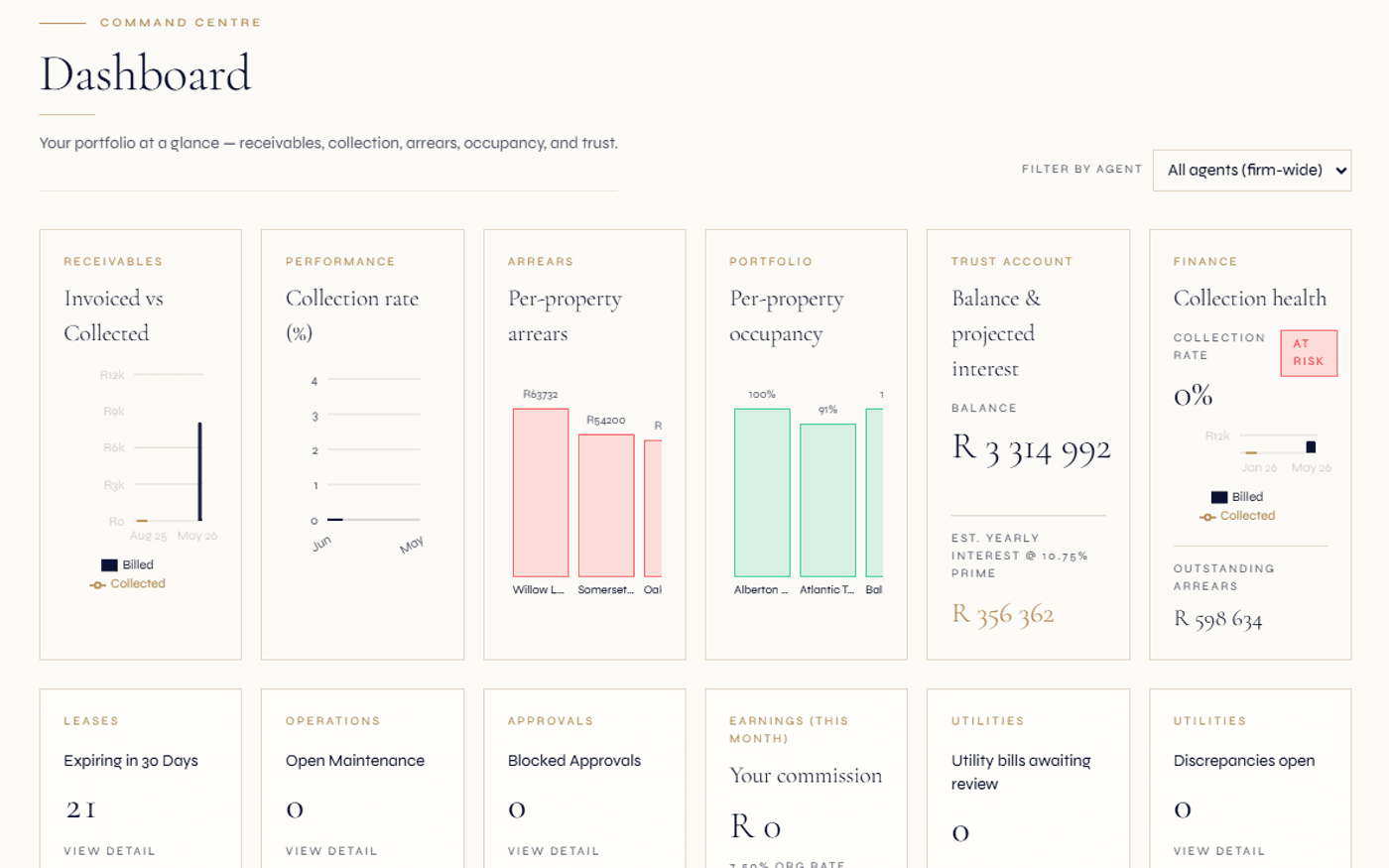
Every rental stage — screening, lease, rent, arrears, trust, portals, maintenance — on one operating record.
Native TPN, bank-notification and CSV bank-statement EFT reconciliation, email/SMS reminders with one-tap WhatsApp send, EAAB / PPA section 54 trust accounting.
Per-landlord trust ledgers roll into a single consolidated agency view for principals and managing agents.
The rental operation is a chain. Most software covers a link or two — Regalis runs the whole chain.
A let property does not live in one screen. It starts as an advert and an application, becomes a screened applicant, then a signed lease, then a monthly rent run, sometimes an arrears case, always a deposit held in trust, and eventually a move-out inspection and refund. Most rental tools cover one or two of those links well and leave the rest to spreadsheets, a second system, or your team's memory.
Regalis treats the whole rental lifecycle as one operating record. The applicant who passes screening becomes the tenant on the lease; the lease drives the rent run; the rent run feeds the arrears dashboard; the deposit posts to the per-landlord trust ledger; the landlord and tenant each see their slice through a portal; and maintenance and inspections hang off the same unit. Nothing is re-keyed between stages.
This page is the hub. It does not repeat the depth of each stage — that lives on the dedicated spoke pages linked throughout. Use it to see how the pieces connect, then drill into screening, leases, rent collection, arrears, trust, portals, maintenance or inspections for the detail.
What a fragmented rental stack costs you
- Applicants are screened in one tool, leases drafted in another, and rent collected in a third — the same person re-keyed at every handoff.
- Deposit trust money and rent flow live in the same bank account, so an EAAB audit means untangling them by hand.
- Arrears are tracked in a spreadsheet that is always a day behind, with no evidence trail when a case heads to the Rental Housing Tribunal.
- Landlords phone for statements because they have no portal; tenants email for invoices because they have no portal.
- Move-out disputes turn into arguments because the inspection photos are on someone's phone, not on the lease.
- A principal cannot answer "how is firm-wide arrears trending?" without stitching together several reports manually.
What one rental platform gives you
- A single record flows from application to converted tenant to lease to rent run — no re-keying between stages.
- Deposits sit in a per-landlord deposit trust ledger, kept separate from rent, so a trust-account audit can focus on the deposit ledger alone.
- Live arrears ranked by days late and balance, with a structured reminder and payment trail exportable as a PDF to support a Tribunal matter.
- Landlords self-serve portfolio statements; tenants self-serve invoices and maintenance requests — both from the same data.
- Move-out inspections carry timestamped photos against the lease, so deposit deductions are evidenced.
- Principals open one dashboard scoped to the whole firm and see combined arrears, trust and compliance in one place.
From first application to clean move-out.
Application & screening
Applicants complete a consent-first flow, designed to support POPIA-aligned consent capture, that gathers consent, income and lifestyle data. Native TPN reports, affordability ratios and unit compatibility flags compute on the record, and a 6-column applicant board moves each application from submitted to converted.
- Native TPN credit checks
- Affordability + compatibility flags
- 6-column applicant board
Lease signing & onboarding
The approved applicant becomes the tenant on a lease with documents, signatures and the first invoices. Each lease shows a clear live status, and the platform flags leases that are expiring or already expired well ahead of time, so renewals never sneak up on the team.
- Lease documents + signatures
- Expiring and expired flags
- First invoices raised on signing
Rent collection
Rent comes in by EFT. Incoming bank payments are matched to the right lease automatically from bank payment notifications and CSV bank-statement imports and recorded against it. Rent defaults to direct-to-landlord settlement, so it never touches the regulated deposit trust.
- EFT reconciled against the bank record
- Bank-notification auto-match
- Direct-to-landlord settlement
Arrears, trust, portals & maintenance
Late invoices put a lease into arrears with escalating email and SMS reminders, one-tap WhatsApp send and a Tribunal-grade trail. Deposits post to a per-landlord trust ledger with interest accrual. Landlords and tenants self-serve through portals, and maintenance and inspections hang off the same unit.
- Arrears escalation + evidence
- Per-landlord trust ledger
- Landlord + tenant portals
Every stage of the rental lifecycle, on one record.
Each tile is a stage in the rental operation that lives on its own dedicated solution page. The hub shows how they connect; the spoke pages carry the full depth.
Tenant screening
POPIA consent capture, native TPN credit checks, automatic affordability scoring, lifestyle compatibility flags and a 6-column applicant Kanban — all on the application record.
Lease management
Lease documents, signatures and invoices, with a clear live status on every lease that automatically flags those expiring or already expired based on the lease dates.
Rent collection
EFT rent received with incoming bank payments matched to the right lease automatically from bank payment notifications and CSV bank-statement imports.
Rental arrears recovery
Structured escalation over email and SMS with one-tap WhatsApp send, and an arrears dashboard ranked by days late and outstanding balance.
Trust accounting
Per-landlord deposit trust ledgers, structured to align with South African property-practitioner trust-account requirements, with monthly deposit-interest accrual and a year-end you can lock once audit is complete.
Landlord portal
Landlords self-serve their own portfolio — properties, occupancy, statements and arrears that reconcile to the trust ledger — without phoning the office.
Tenant portal
Tenants see invoices, payment history and lease documents, and log maintenance requests, all drawn from the same operating record your team works in.
Maintenance coordination
Tickets tracked from logged to resolved with supplier assignment, plus recurring schedules that automatically raise the next work request when routine servicing falls due.
Inspection templates
Structured move-in, move-out and routine inspections with photo capture, so deposit deductions at move-out are evidenced against the lease.
Receipts & general ledger
Every receipt and invoice flows through to the general ledger, so financial reports reflect real money movements rather than an empty book.
Multi-channel notices
Targeted reminders and notices over email and SMS from one place, with audience selectors so each message reaches the right recipients (WhatsApp channel coming soon).
Renewals & expiry
Automatic expiring and expired flags keep renewals visible on the property view, alongside units, occupancy and upcoming lease ends.
On the regulatory shape — EAAB, PPA, Rental Housing Act and POPIA
EAAB, the PPA, the Rental Housing Act and POPIA — the rental rails Regalis lines up to.
South African rental management sits inside a layered regulatory stack. The Property Practitioners Act (PPA, 2019) and the Estate Agency Affairs Board lineage govern the managing-agent trust-account regime, including the deposit-only regulated trust posture reflected in PPA section 54 after the 2022 amendments. The Rental Housing Act requires deposits to be held in an interest-bearing account, with interest paid to the tenant — its section 5 deposit-interest rule is what the platform's monthly accrual satisfies. POPIA governs how applicant and tenant personal data is collected, with consent captured against a clear collection notice.
Regalis is built to support each of those. Deposits flow to a per-landlord deposit trust ledger kept separate from rent; deposit interest accrues monthly; the reminder, retry and payment trail is exportable as a structured record to help you prepare for a Rental Housing Tribunal matter; and TPN screening only proceeds once POPIA consent is recorded with timestamp, IP and disclosure version. The aim is to keep your records structured and audit-ready so you can prepare with confidence for a trust-account audit, a Tribunal hearing or a POPIA enquiry.
Informational only — not legal advice. Statutory references are stated in plain text to point you at the right Act and section; confirm your own obligations with your principal property practitioner, auditor or attorney before relying on them.
Continue exploring how Regalis handles the rest of the rental operation.
Tenant screening
POPIA consent capture, native TPN credit checks, affordability scoring, compatibility flags and a 6-column applicant Kanban.
Read moreLease management
Lease documents, signatures and invoices, with a clear live status and automatic expiring / expired flags.
Read moreRent collection
EFT rent received, with bank payment notifications and CSV bank-statement imports auto-matched to the lease.
Read moreRental arrears collection
Structured escalation over email and SMS with one-tap WhatsApp send, and a Tribunal-grade evidence trail.
Read moreTrust accounting
Per-landlord deposit trust ledgers, structured to align with property-practitioner trust-account requirements, with deposit-interest accrual.
Read moreLandlord portal
Landlords self-serve portfolio, occupancy, statements and arrears that reconcile to the trust ledger.
Read moreTenant portal
Tenants self-serve invoices, payment history and lease documents, and log maintenance requests.
Read moreMaintenance coordination
Tickets from logged to resolved with supplier assignment, plus recurring schedules that raise the next work request automatically.
Read moreInspection templates
Structured move-in, move-out and routine inspections with photo capture, evidencing deposit deductions.
Read moreCommon questions about rental property management.
What is rental property management software, and what does Regalis cover?+
Rental property management software runs the full lifecycle of a let property — from advertising and applications, through tenant screening and lease signing, to rent collection, arrears recovery, deposit trust accounting, maintenance and inspections. Regalis covers the entire chain on one platform built for South African agencies, managing agents and landlords, with each stage documented on its own dedicated solution page.
Is Regalis built for South African rental operations specifically?+
Yes. The platform is built around SA rails: native TPN credit checks (TPN distribution-partner onboarding in progress), bank-notification and CSV bank-statement EFT reconciliation, email and SMS reminders with one-tap WhatsApp send, EAAB / PPA section 54 trust accounting, the Rental Housing Act deposit-interest rules, the Rental Housing Tribunal evidence trail, and POPIA consent capture. Currency is in rand and the provinces, banks and forms reflect the SA market.
How does tenant screening work?+
Applicants complete a consent-first flow, designed to support POPIA-aligned consent capture, that gathers consent, income and lifestyle data. Your team can request a native TPN report with one click (TPN distribution-partner onboarding in progress); the recommendation, payload and PDF store against the application. Affordability ratios and unit compatibility flags compute automatically, and a 6-column applicant board moves work from submitted to converted. Full depth lives on the tenant screening page.
How is rent collected and arrears recovered?+
Rent is received by EFT, with bank payment notifications and CSV bank-statement imports auto-matched to the lease. When an invoice runs late the lease enters arrears state and escalating reminders fire over email and SMS, with one-tap WhatsApp send from the arrears workspace. The arrears dashboard ranks every overdue invoice by days late and balance. See the rent collection and arrears pages for detail.
How does the trust accounting support property-practitioner requirements?+
Each trust account is either a deposit-only trust account or a landlord interest-bearing account, with workflows designed to support South African property-practitioner trust-account requirements (PPA section 54). Rent defaults to direct-to-landlord settlement so it never enters the trust ledger; the trust ledger only sees deposit movements. Deposit interest accrues monthly per lease, structured to align with section 5 of the Rental Housing Act, and a financial year can be locked once audit is complete. Informational only — not legal advice.
Do landlords and tenants get their own self-service portals?+
Yes. Landlords see their own portfolio — properties, occupancy, statements and arrears that line up to the trust ledger. Tenants see invoices, payment history, lease documents and a maintenance request channel. Both portals draw from the same operating record your team works in, so there is no second copy of the truth to reconcile.
Does it handle maintenance and inspections too?+
Yes. Maintenance coordination tracks tickets from logged to resolved with supplier assignment, and recurring schedules automatically raise the next work request when servicing falls due. Inspection templates drive structured move-in, move-out and routine inspections with photo capture, so deposit deductions at move-out are evidenced. Both connect back to the unit, lease and tenant record.
Can one firm run many landlords and properties on a single instance?+
Yes. A managing agent firm with one principal, several property managers and dozens of landlord books runs everything on one Regalis. The principal drills into any manager profile and sees that person's combined book — leases, arrears, trust balances, maintenance and compliance — without switching products. The same instance also runs community schemes alongside the rental book.
Stop stitching tools together.
One rental lifecycle, one record.
Walk through the rental lifecycle — screening, leases, rent, arrears, trust and portals — with someone from the team, and see how each stage connects without re-keying.