Body corporate accounting software
Built for South African schemes, audit-ready.
The finance layer for sectional title and HOA schemes: a scheme chart of accounts, ring-fenced reserve fund under STSMA s3(1)(b), a live levy roll, owner statements, arrears interest, and trial balance, general ledger and actual-vs-budget reports that hand straight to your auditor — all on one ledger.
- STSMA s3(1)(b) fund split
- Live levy roll
- Owner statements
- Auditor-ready
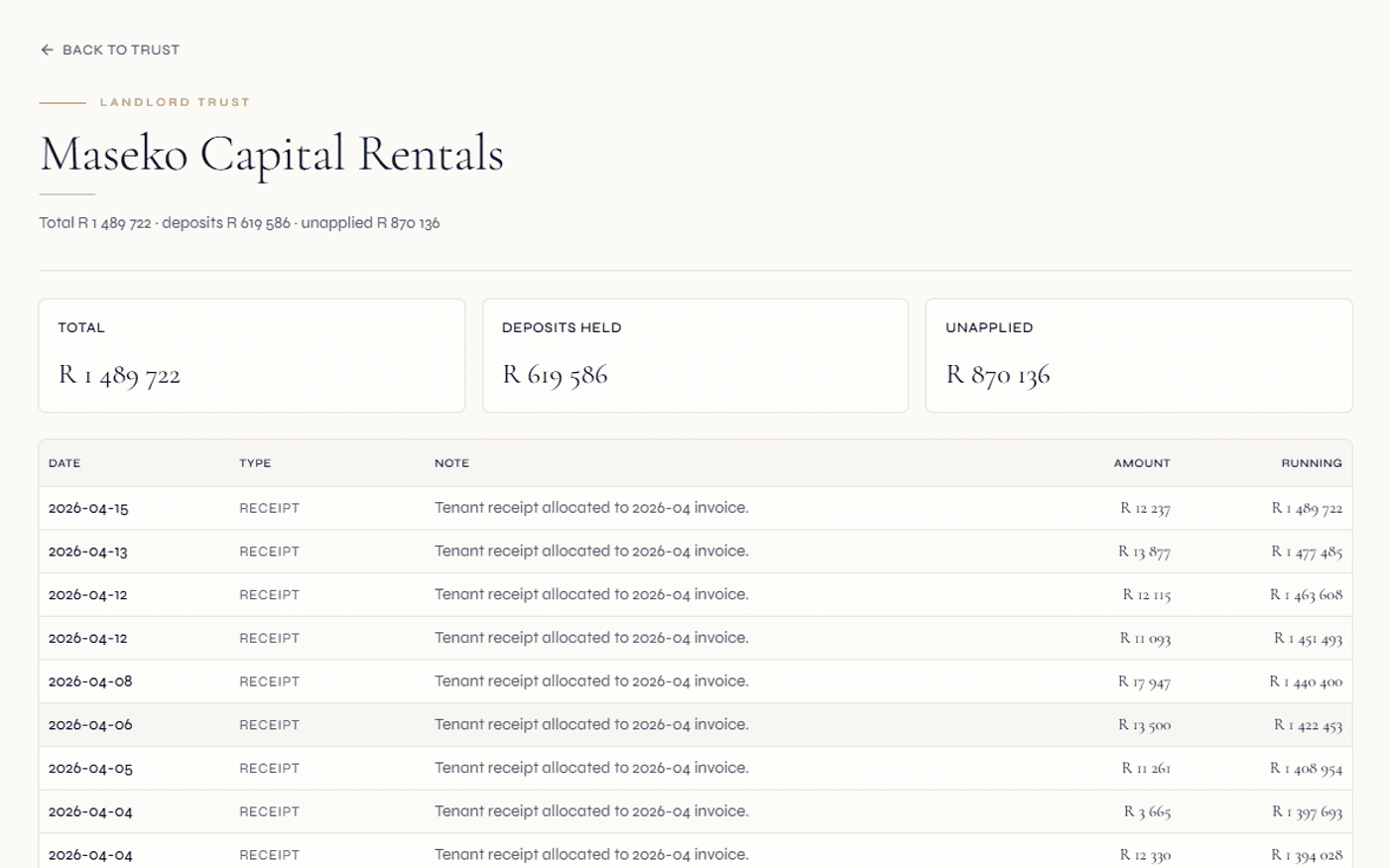
STSMA s3(1)(b) administrative and reserve funds ring-fenced at the chart-of-accounts level.
The levy roll computes from each unit’s participation quota and the active budget — no spreadsheet.
Trial balance, general ledger and actual-vs-budget come straight off the same posted ledger.
A scheme’s books are not the same animal as deposit trust money.
A body corporate is a legal person with its own finances. It raises levies, holds two statutory funds, pays suppliers, accrues arrears, and produces annual financial statements that an independent auditor reviews before the AGM. That is general-purpose accounting under a specific statutory shape — distinct from the regulated deposit money a managing agent holds in trust for rental landlords.
Regalis keeps these separate on purpose. Rental deposit trust accounting lives on its own ledger under the Property Practitioners Act; a scheme’s books — chart of accounts, administrative and reserve funds, levy roll, owner statements, cashbook — are the subject of this page. Both run on the same posting engine, so every receipt, allocation and journal lands on a general ledger line, but they answer different questions and feed different reports.
For a managing agent, the practical effect is a clean handover. When the auditor asks for the trial balance, the reserve-fund movement, or the actual-vs-budget for a scheme, those reports run from inside the platform — no rebuilding ledger history from bank statements and accountant emails.
Read the full guide
How scheme accounting usually goes wrong
- The administrative fund and the reserve fund share one balance, and nobody can say at any moment how much of the cash is genuinely reserve money set aside under STSMA s3(1)(b).
- The levy roll lives in a spreadsheet that drifts from the actual ledger every time a unit transfers or a budget changes.
- Owner statements are pieced together by hand each month, so a query about a single owner’s arrears means a manual reconstruction.
- Arrears interest is either never charged or charged inconsistently, because the right figure is too fiddly to work out per owner.
- Year-end means rebuilding the trial balance from bank statements, then waiting on the auditor to find the gaps.
- When a unit is also rented out, its levy flow and its rent flow sit in two unrelated systems and reconciliation becomes spreadsheet work.
How Regalis does it
- Reserve-fund accounts are flagged at the chart-of-accounts level; movements write to a dedicated reserve trust account so the two funds never co-mingle.
- The levy roll computes live from participation quota and the active budget, with pro-rata handled automatically on a mid-period transfer.
- Every owner has a standing statement — levies, payments, allocations, arrears, interest and fines — drawn from the same ledger the auditor reads.
- Arrears interest posts to the owner ledger and shows on the statement and the arrears report.
- Trial balance, general ledger and actual-vs-budget come off the posted ledger automatically; the financial year locks once audit signs off.
- A rented-out unit shows both the owner panel and the active lease, so the levy and rent flows reconcile cleanly.
From chart of accounts to clean audit handover.
Install the scheme chart of accounts
Set up a hierarchical chart of accounts — income, expense, asset, liability, equity — from a reusable template, with per-scheme overrides. Reserve-fund accounts are flagged so the administrative and reserve funds stay separated from the first journal.
- Hierarchical chart of accounts with templates
- Reserve-fund flag at account level
- Per-scheme overrides
Set the budget and raise the levy roll
Draft the annual budget — monthly amounts per line — and submit for trustee approval. The levy roll then mints an invoice per unit each month from the participation quota and the active budget. Special levies and reserve-fund top-ups layer in on demand.
- Budget draft → approved
- Levy roll by participation quota
- Special levies + reserve top-ups
Collect, allocate and statement owners
Owner payments arrive by EFT and allocate against the right levy invoice via owner-code matching, with manual proof-of-payment capture as the fallback. Arrears interest and conduct fines post to the owner ledger. Each owner’s statement updates from the same posted entries.
- Owner-code allocation rules
- Arrears interest + fines posted
- Live owner statements
Report, close and hand to audit
Run the trial balance, general ledger, actual-vs-budget and the segregated reserve-fund report off the unified ledger. At year-end the close runs per scheme, and the financial year locks once the auditor signs off — immutable thereafter.
- TB · GL · actual-vs-budget
- Reserve-fund report on demand
- Lockable financial year
The finance toolkit a body corporate and its auditor actually need.
The accounting surface for a scheme — the chart of accounts, the two statutory funds, the levy roll, owner statements and the statutory reports. The arrears recovery journey, the levy run mechanics and the deposit trust ledger each have their own dedicated page; this page is the books.
Scheme chart of accounts
Hierarchical chart of accounts with reusable templates and per-scheme overrides. Every money-touching record links to the right general-ledger account for clean reporting.
Administrative + reserve funds
Structured to align with STSMA s3(1)(b) fund segregation. Reserve-fund accounts are flagged at the chart-of-accounts level and movements write to a dedicated reserve trust account, keeping the two funds segregated.
Live levy roll
Per-unit levy calculation from participation quota and the active budget. Base levies, special levies and reserve-fund top-ups all flow through the same monthly run.
Owner statements
A standing statement per owner — levies raised, payments received, allocations, arrears, interest and fines — drawn from the same ledger the trustees and auditor read.
Arrears interest
Interest on overdue levy balances posts to the owner ledger and surfaces on the statement and the arrears report. The recovery workflow lives on the levy collection page.
Budget + actual-vs-budget
Annual budget per scheme with monthly amounts per line. Actual-vs-budget reporting shows month-by-month, YTD, variance and percentage drift.
Trial balance + general ledger
Once the chart of accounts is installed, the trial balance and general ledger come automatically from the unified ledger. One source, two reports, both ready for audit preparation.
Cashbook + bank recon
Per-bank-account cashbook with a hide-allocated toggle and allocation rules per scheme. CSV bank-feed import today, with direct bank API on the roadmap.
Conduct fine postings
Warning → penalty → fine escalation auto-charges the owner ledger when a fine is issued, so the books reflect governance actions without a separate entry.
Supplier-payment batches
Approved supplier payments batch into your bank’s EFT import format and post against the right expense lines, keeping the cashbook and the GL in step.
Year-end lock
A financial year can be locked once the audit is signed off. After locking, every receipt, allocation and ledger entry inside it becomes immutable.
Immutable journals
Every posting writes an immutable ledger entry linked to its source record and timestamped — structured records and audit trails designed to help you prepare for an auditor or a Community Schemes Ombud query.
STSMA, CSOS and the audit — the books line up to all of them.
A sectional title scheme is governed by the Sectional Titles Schemes Management Act (STSMA, 2011). Section 3(1)(b) requires a body corporate to establish and maintain both an administrative fund — for ordinary running costs — and a reserve fund for future maintenance and repairs. Keeping those two funds genuinely separate in the books, not just on paper, is the heart of scheme accounting. The Community Schemes Ombud Service Act (CSOS, 2011) establishes the oversight and dispute-resolution body that the annual returns and evidence ultimately answer to.
Regalis builds the segregation in rather than bolting it on. Reserve-fund accounts are flagged at the chart-of-accounts level and their movements write to a dedicated reserve trust account, so a reserve-fund report runs on demand without rebuilding it from the general ledger. Levies raise from participation quota and the active budget, owner statements draw from the posted entries, and the trial balance, general ledger and actual-vs-budget reports come off the same unified ledger the auditor reviews ahead of the AGM.
This is informational only and not legal advice — your scheme’s auditor and the trustees remain responsible for the statutory treatment. What Regalis provides is books that are structured the way the Act and the audit expect, so the year-end handover is a report run rather than a reconstruction.
Continue exploring how Regalis handles the rest of the rental operation.
Body corporate management
The full scheme operation — trustees, conduct rules, transfers, AGMs and compliance — with the accounting on this page underneath it.
Read moreLevy roll
How the per-unit levy roll is computed from participation quota and the active budget, including special levies and pro-rata on transfer.
Read moreLevy collection
Structured levy arrears recovery — multi-channel reminders and a CSOS-grade evidence trail — sitting on top of these books.
Read moreTrust accounting
Regulated deposit trust ledgers under the Property Practitioners Act — a separate ledger from a scheme’s own books.
Read moreCommunity scheme management
The platform-wide view of how Regalis runs HOA, sectional title and body corporate schemes alongside rentals.
Read moreCommon questions
Common questions about body corporate accounting.
What is body corporate accounting software?+
It is the finance layer that keeps a sectional title or HOA scheme’s books — a scheme chart of accounts, the administrative and reserve funds, the live levy roll, owner statements, the cashbook, and the trial balance and general ledger your auditor needs. Regalis runs all of that on one unified ledger rather than a separate accounting package bolted on the side.
How does Regalis handle the administrative fund versus the reserve fund?+
STSMA section 3(1)(b) requires a body corporate to establish and maintain both an administrative fund and a reserve fund. Regalis ring-fences the reserve fund at the chart-of-accounts level — reserve-fund accounts carry a dedicated flag and movements write to a separate scheme-reserve trust account, so the two funds never co-mingle in the books. This is informational, not legal advice.
Does it produce owner statements and a levy roll?+
Yes. The levy roll is computed live from each unit’s participation quota and the active budget. Every owner has a statement showing levies raised, payments received, allocations, arrears and any interest or fines — the same statement the trustees and the auditor see, drawn from one source.
Can it charge interest on levy arrears?+
Yes. Arrears interest can be raised on overdue levy balances and posted to the owner’s ledger, with the charge visible on the owner statement and the arrears report. The recovery workflow itself — reminders, age analysis, evidence trail — lives on the levy collection page.
Is the output auditor-ready?+
Once the scheme chart of accounts is installed, the trial balance, general ledger, actual-vs-budget and the segregated reserve-fund report come straight off the unified ledger. Every money-touching record links to a general-ledger account, entries are immutable, and a financial year can be locked once the audit is signed off.
How is this different to your trust accounting page?+
Trust accounting covers regulated deposit money under the Property Practitioners Act — per-landlord deposit ledgers and audit workflows designed to support South African property-practitioner requirements. This page is about a scheme’s own books: its chart of accounts, fund segregation, levy roll, owner statements and statutory reports. The two share the same ledger engine but answer different questions.
Does the accounting connect to the bank?+
Each scheme has a per-bank-account cashbook with a hide-allocated toggle and allocation rules that match payments by owner code. Bank-feed import is via CSV today, with direct bank API on the roadmap. Approved supplier payments batch into your bank’s EFT import format.
Can a managing agent firm keep many schemes’ books on one platform?+
Yes. Each scheme keeps its own chart of accounts, budget and funds, while the firm sees a consolidated roll-up. Per-scheme year-end close, trial balance and reserve-fund reports run without separating one scheme’s books from another by hand.
Stop rebuilding the trial balance every year-end.
One ledger, audit-ready.
Walk through the scheme chart of accounts, the reserve-fund segregation, the live levy roll and the auditor reports with someone from the team.