Property maintenance software
for rentals and schemes — maintenance and inspections, together.
One maintenance and inspections system for your whole book. Reactive work orders dispatched to eligible vendors over WhatsApp, schedule-based preventative maintenance plans that create their own work automatically, and field-ready inspection templates that keep working when the signal drops — for rental properties and community schemes alike.
- Work orders + vendors
- Preventative cadences
- Offline inspections
- Rentals + schemes
Build your maintenance workspace — reactive, preventative and inspections, together.
Select your operation type and see a workspace configured for your rental or scheme portfolio.
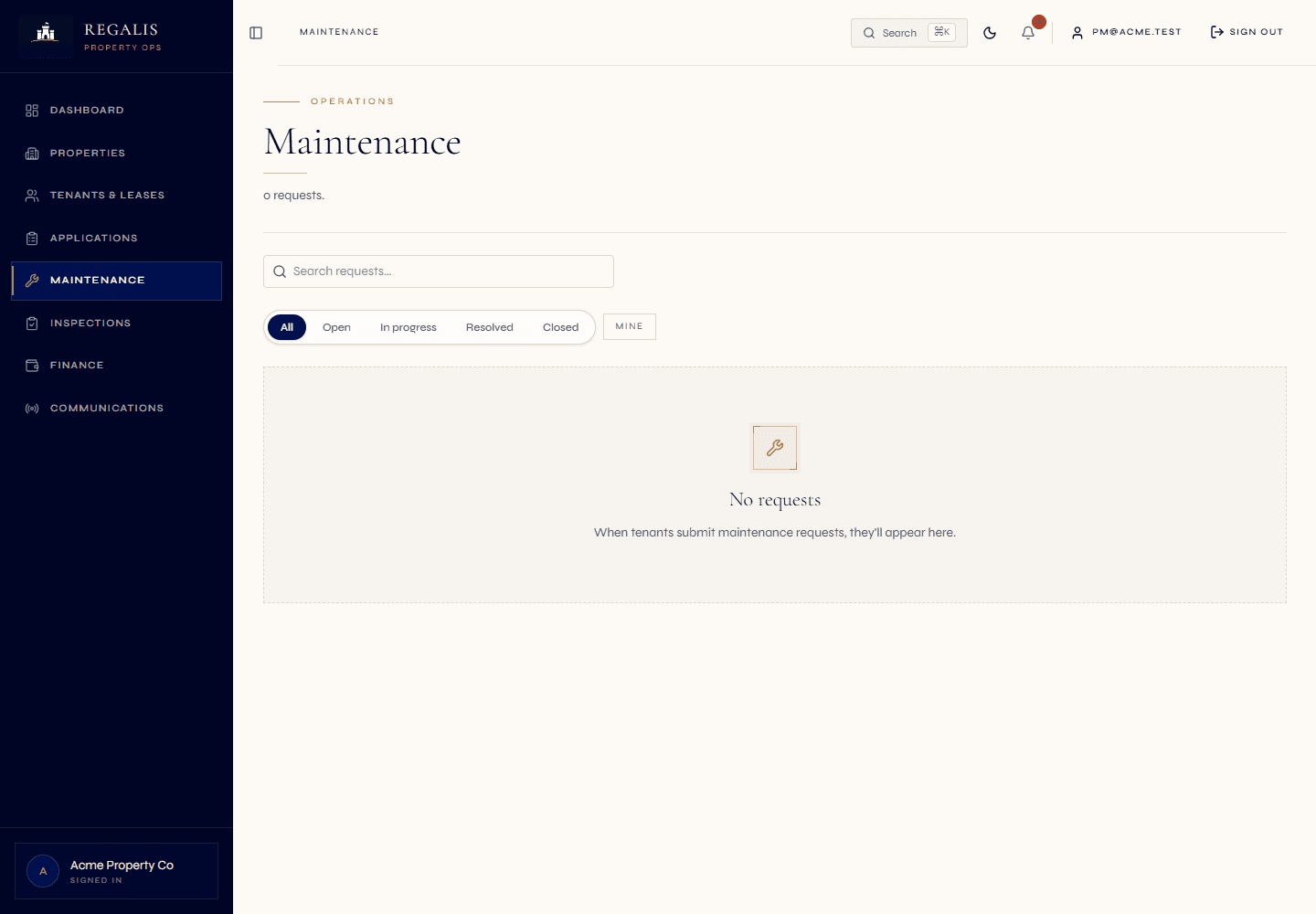
Reactive work orders, preventative maintenance plans and inspections — connected on the same property record.
A rental home and a body corporate run the same dispatch, the same cadences and the same inspection templates.
Eligible vendors bid over WhatsApp; the earliest credible ETA wins, with ties broken on the vendor health score.
Reactive, preventative and inspections are the same job seen at three moments in time.
Most property teams in South Africa run maintenance as a scatter of disconnected tools — a WhatsApp group for repairs, a spreadsheet for the annual fire-equipment service, a clipboard or a generic forms app for move-in and move-out inspections. The work order, the preventative schedule and the inspection never share a record, so the team rebuilds context every time and the auditor never gets a clean trail.
Regalis treats maintenance as one pillar with three surfaces. A reactive work order answers a complaint as it lands. A preventative maintenance plan does the work before the complaint — and the automatically created task runs through the very same vendor dispatch the reactive request did. An inspection captures the condition of the property at a point in time, and a failed inspection item is the natural trigger for the next work order. Same property, same vendors, same photos, same ledger.
Because the pillar sits on the same platform as your rentals and your community schemes, there is no second system to reconcile. The cost of a repair settles into the same finance hub. A trustee approving a scheme supplier payment and a landlord approving a rental repair use the same approvals queue. The maintenance work and the money it costs are one record, not two.
What scattered maintenance tooling costs you
- Repairs live in a WhatsApp group with no status, no photos on the record and no audit trail when a deposit dispute lands.
- Preventative work — fire-equipment service, gutter cleans, pool chemistry — sits in a spreadsheet that nobody opens until something fails.
- Inspections are done on a generic forms app or paper, so the move-out inspection and the repair it should trigger never connect.
- Vendors are managed in a contacts list with no history, no health score and no way to compare who actually shows up.
- A body corporate and a rental landlord need entirely different tools, so a managing agent runs two maintenance stacks side by side.
- When the auditor or the CSOS adjudicator asks for the maintenance record, the team rebuilds it from messages, invoices and memory.
What one maintenance pillar gives you
- Every work order carries status, photos, work-log entries, the assigned vendor and the invoice — one tap from the property.
- Preventative plans create their own work on schedule and dispatch through the same engine, so scheduled work never slips.
- A failed inspection item and the work order that follows sit on one property timeline, ready for a deposit reconciliation.
- Vendors are first-class records with categories, history and a health score that breaks auction ties and guides manual dispatch.
- Rentals and schemes run on one maintenance engine — the same dispatch, cadences and templates serve both modes.
- The maintenance trail is one click away for an auditor, an insurer or a Community Schemes Ombud Service evidence pack.
From inspection finding to closed work order — on one record.
Inspect with field-ready templates
Run a move-in, move-out or common-area inspection on the installable mobile app. Items pre-populate from a template; the inspector marks each item as Pass, Fail or Damaged with notes and photos. Offline-safe — photos are held on the device and upload when signal returns.
- Organisation-wide or single-property templates
- 3 SA defaults ready out of the box
- Works offline, syncs when back online
Log the reactive work order
A tenant or trustee logs a categorised repair, or an inspection finding triggers one. The platform identifies eligible vendors at that property and dispatches over WhatsApp. Vendors bid with their earliest credible ETA; the auction awards the best fit.
- Categorised by trade
- Eligible-vendor matching
- WhatsApp bid-auction dispatch
Schedule the preventative plans
Set recurring plans for the work that prevents complaints — gutter cleans, fire-equipment service, pool chemistry, lift inspections. Regalis works out the next due date and automatically creates the work order into the same dispatch flow. Pause, resume or archive without losing history.
- Six schedule options
- Auto-creates work when due
- Pause / resume / archive
Track, photograph, settle and audit
Work-log entries, photos and the closure note stay on the request. The vendor invoice settles into the finance hub against the right ledger line. Tenants and trustees see status on their portal; the full trail is ready for a deposit dispute, an insurer or a CSOS evidence pack.
- Photo + work-log trail
- Invoice into the ledger
- Portal status + audit trail
A complete maintenance toolkit, integrated with the rest of the platform.
Reactive work orders, preventative cadences and field inspections — each with a dedicated solution page. The pillar below aggregates them; follow the related links for the full surface of any one.
Work orders
Categorised maintenance requests with status, priority and ageing. Logged by tenants, trustees or staff, or triggered from an inspection finding. Every request carries its full history on the property record.
Vendor dispatch over WhatsApp
Eligible vendors at the property receive a one-tap claim link over WhatsApp and bid with their earliest credible ETA. The earliest credible bid wins automatically; ties are broken on the vendor health score.
Vendor records + health score
Vendors are first-class records with their categories, contact details and an optional linked account. A health score reflects bid response, ETA accuracy and completion — it breaks auction ties and guides manual dispatch.
Preventative maintenance plans
Recurring plans on any property — rental or scheme. Six schedule options (weekly, monthly, quarterly, semi-annual, annual or a custom number of days), each with its own start date. Regalis creates the work automatically when the next date arrives.
Automatic dispatch
Each scheduled task is clearly marked as preventative and linked back to its plan, then flows into the same WhatsApp vendor-bidding flow as reactive work. The team can filter preventative, reactive or all on one dashboard.
Plan lifecycle controls
Pause a plan to suspend it without losing history, resume to pick the schedule back up, or archive to close it while preserving the history. Both pause and archive are reversible.
Inspection templates
Build inspection templates with drag-to-reorder areas and items, saved for every property in your organisation or for just one scheme or home. Three SA defaults ship ready to use: residential move-in, move-out and common-area.
Installable mobile inspection app
An app that installs straight from a link — no App Store, no Play Store. Large, easy-to-tap controls and a full-screen layout built for phones in the field. Inspectors mark items as Pass, Fail or Damaged with notes and photos.
Offline-first field capture
The app keeps working without a connection. Inspection items are filled in on the device and photos are held safely on the phone, then upload automatically when signal returns. A mid-inspection signal drop is a non-event for the inspector.
Move-in / move-out + deposits
Standard residential move-in and move-out templates support the inspection side of the Rental Housing Act tenancy lifecycle, with the move-out condition record feeding the deposit reconciliation on exit.
Scheme common-area inspections
The body corporate common-area template supports scheme-wide periodic inspections of shared areas, with PROPERTY-scope templates for the bits unique to one scheme. Findings flow straight into scheme work orders.
Emergency + after-hours routing
For after-hours repairs the auction window shortens by priority. For health-and-safety emergencies the emergency-alert workflow takes over instead, routing to your security partner or the in-house dispatcher rather than the repair auction.
On the regulatory and operational shape — compliance, deposits and reserve funds
Maintenance is where compliance, deposits and reserve funds meet the real world.
Maintenance is not a back-office afterthought in South African property — it is where several obligations land at once. On the rental side, a documented move-in and move-out inspection is central to a fair deposit reconciliation; a clean condition record protects landlord and tenant alike when a deposit dispute is escalated. The platform keeps the inspection, the photos and any resulting repair on one property timeline so the reconciliation is evidence-led, not memory-led.
On the community-scheme side, preventative maintenance is closely tied to the reserve fund and the maintenance planning a body corporate is generally expected to keep current under the Sectional Titles Schemes Management Act framework. Scheduled service of common property — fire equipment, lifts, gates, pools — produces a structured schedule record and cost trail designed to support the kind of evidence auditors and the Community Schemes Ombud Service look for. Photos and work logs help you build a defensible maintenance record.
Throughout, vendor photos and inspection images are stored securely with retention controls designed to support POPIA-aligned data handling, and the maintenance cost settles into the same finance hub as the rest of the operation. Informational only — not legal advice; confirm your scheme's specific statutory obligations with a registered professional.
Continue exploring how Regalis handles the rest of the rental operation.
Maintenance coordination
Tenants and trustees log categorised repairs; eligible vendors bid over WhatsApp and the earliest credible ETA wins. Photos, work logs, invoices and vendor health scores on every request.
Read morePreventative maintenance
Schedule-based plans for rentals and schemes. Regalis automatically creates preventative work orders into the same dispatch flow when they are due. Pause, resume or archive without losing the history.
Read moreInspection templates + mobile app
Organisation-wide and single-property inspection templates with an installable, offline-capable mobile app. Three SA defaults ready to use, large easy-to-tap controls, and photos that sync automatically when signal returns.
Read moreRental management
The full rental operation — leases, applications, rent collection, arrears and trust accounting — that maintenance work orders and move-out inspections feed straight into.
Read moreCommunity scheme management
HOA, body corporate, sectional title and share block management — levy roll, trustee approvals and reserve fund — where scheme maintenance and common-area inspections live.
Read moreAll solutions
Browse the full surface of the platform — finance, compliance, communications, portals and every solution across rentals and community schemes.
Read moreCommon questions about property maintenance and inspections.
What does the maintenance and inspections pillar cover?+
Three connected pieces: reactive work orders (a repair is logged, vendors bid over WhatsApp, the work is tracked to completion), preventative maintenance plans (recurring tasks that create the next work order automatically on a set schedule), and inspections (templated, field-ready inspections you run on a phone in or out of signal). All three run on the same platform that handles your rentals and your community schemes.
Does it work for both rentals and community schemes?+
Yes — that is the point of a pillar. A rental landlord runs reactive repairs and annual fire-extinguisher service through the same engine a body corporate runs its common-area maintenance and quarterly inspections through. Work orders, vendors, preventative plans and inspection templates all attach to a property regardless of whether that property is in rental mode or scheme mode.
How does the maintenance work order workflow function?+
A tenant or trustee logs a categorised request (electrical, plumbing, appliance, security, structural). The platform identifies eligible vendors linked to that property and active for that category, and messages them. Vendors bid with their earliest credible ETA; the auction awards the best fit. Photos, work-log entries, invoices and a vendor health score all stay on the request. The maintenance-coordination page covers the full dispatch flow.
What is preventative maintenance and how is it scheduled?+
Preventative maintenance is scheduled-in-advance work — a quarterly gutter clean, an annual fire-extinguisher service, a weekly pool chemistry test — done on a schedule rather than in response to a complaint. Regalis checks every active plan daily, works out the next due date and automatically creates the next work order — clearly marked as preventative — into the same vendor dispatch flow. Six schedule options are supported (weekly, monthly, quarterly, semi-annual, annual, or a custom number of days), and plans can be paused, resumed or archived without losing the history.
Can inspectors work offline in the field?+
Yes. The inspection mobile app installs straight from a link and keeps working without a connection. Inspection items are filled in on the device; photos are held safely on the phone and upload automatically when signal returns. Inspectors keep moving instead of staring at a spinner. Three South African defaults ship ready to use — standard residential move-in, standard residential move-out, and body corporate common-area.
How do inspections connect to the rest of the maintenance pillar?+
An inspection that flags a fault is a natural trigger for a work order. The same property record holds the inspection history, the maintenance requests and the preventative plans, so a failed move-out inspection item and the repair that follows it sit on one timeline. Inspection templates can be reused across every property in your organisation, or built for just one scheme or one home.
Does the team need WhatsApp to dispatch vendors?+
The vendors do — dispatch runs on WhatsApp by design, using the official WhatsApp business messaging channel, because vendor coverage in South Africa is strongest there. There is no SMS or email dispatch path; in-house maintenance staff receive the same WhatsApp claim links via their linked user's phone, and a vendor with no WhatsApp number on file is simply skipped in the round. For schemes with established vendor relationships, the bidding step can be skipped in favour of dispatching the job directly to a named vendor.
Is this a separate maintenance product bolted on?+
No. Maintenance and inspections are native surfaces on the same Regalis instance that runs your properties, leases, levy roll, finance hub and trust ledger. There is no second login, no separate vendor database and no separate inspection app to reconcile — the maintenance work and the money it costs settle into the same ledger.
Stop running maintenance in three disconnected tools.
Work orders, preventative, inspections — together.
Walk through reactive vendor dispatch, the preventative cadence engine and the offline inspection app — for your rentals and your community schemes — with someone from the team.