Rent collection software for South Africa
The rail that invoices, collects, allocates and posts.
Recurring rent invoicing, EFT reconciled against bank payment notifications and CSV bank-statement imports, automatic allocation of every payment to the right invoice, receipts and proof-of-payment, and clean posting to your accounts. The engine that brings rent in — not the chase that starts once it is late.
- Bank-statement reconciliation
- Auto allocation
- Tenant receipts + PoP
- Clean accounting
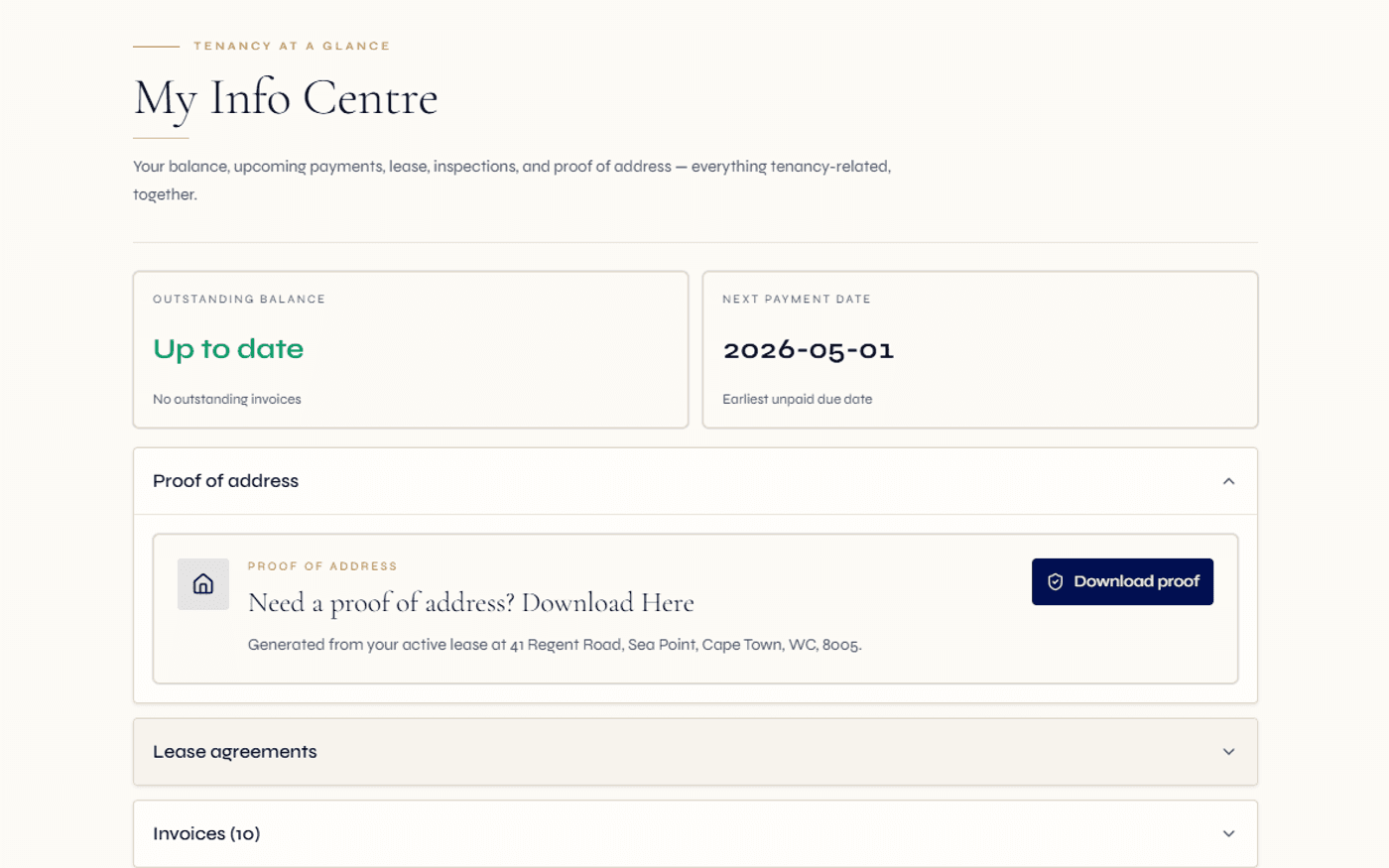
Incoming EFT payments imported from bank payment notifications and CSV bank-statement imports and matched to the lease automatically.
Incoming EFT payments match to the open invoice and record a receipt against the lease.
Rent settles direct-to-landlord; the regulated deposit trust account stays focused on deposit money.
Collection is the rail that should be working long before anyone is late.
In South African residential lettings, "rent collection" gets used to mean two different things, and conflating them is where teams lose money. There is the collection rail — the recurring invoice, the incoming EFT, the matching of money to invoice, the receipt, the posting to the ledger. And there is arrears recovery — the chasing, reminders, Letters of Demand and tribunal evidence that only matter once a payment has failed. This page is about the first one.
When the collection rail is solid, far fewer files ever reach the recovery stage. A predictable monthly invoice and automatic bank-record matching mean a payment that lands is matched to the right invoice immediately instead of sitting unreconciled. A receipt is issued the moment money is allocated, so the tenant and the landlord see the same balance.
Regalis runs collection consistently on every active lease. The recurring invoice, the EFT reconciliation, the allocation, the receipt and the posting to your accounts are one connected record — not a chain of disconnected exports between a bank portal, a spreadsheet and an accounting package. When something does slip past due, it hands off cleanly to the arrears recovery workflow rather than starting cold.
Read the full guide
How rent gets collected without a real rail
- Rent depends on tenants pushing an EFT each month, with nothing tying the payment back to its invoice automatically.
- Payments land in a bank account and then sit unallocated — nobody is sure which receipt matches which invoice until month-end reconciliation.
- A tenant who paid swears they did; without an issued receipt and proof of payment on file, the dispute is a he-said-she-said over a bank statement.
- Rent and deposit money mingle in one account, so the trust records have to be untangled by hand before any audit.
- A partial payment is recorded as either paid or unpaid, never as the partial it actually was, so the outstanding balance is wrong on the next cycle.
- Late fees are calculated manually and bolted on after the fact, so the next invoice shows the wrong amount.
How the rail collects rent
- Recurring invoices raise on the billing cycle and bank payment notifications and CSV bank-statement imports match each incoming EFT to its invoice automatically.
- Every incoming payment auto-matches to its invoice and posts a receipt against the lease — no unallocated limbo.
- Each allocated payment issues a receipt the tenant sees in their portal; manual EFTs accept an uploaded proof of payment.
- Rent settles direct-to-landlord and stays out of the regulated deposit trust account — a clean separation that helps you prepare for audit.
- Partial payments are captured as partials; the remaining balance stays visible and rolls into the next cycle correctly.
- A configured late-fee policy lands the charge on the next invoice automatically, so the next invoice reflects the corrected balance.
From lease to receipted, posted rent.
Raise the recurring invoice
On each active lease the rent invoice is raised on its billing cycle — base rent plus any recurring charges and recoveries. The invoice carries its due date and links to the lease, the tenant and the landlord, so every later step ties back to one record.
- Recurring per-lease billing cycle
- Base rent + recurring charges
- Due date drives everything downstream
Receive rent by EFT
Tenants settle by EFT against the invoice. Incoming bank payment notifications are recorded as receipts as money arrives, with CSV bank-statement import alongside and direct read-only bank feeds rolling out per bank.
- EFT reconciled against the bank record
- CSV bank-statement import (5 major banks)
- Bank notifications recorded as receipts
Allocate the payment + issue the receipt
Each incoming payment auto-matches to the open invoice on the lease. Full payments clear the invoice; partials are captured as partials with the balance kept visible. The allocation issues a receipt that the tenant sees in the portal, alongside any proof of payment they uploaded for a manual EFT.
- Auto-match to the open invoice
- Partial allocations captured
- Receipt + proof of payment on file
Post to the ledger — rent vs trust kept apart
The movement posts to the right place: rent settles direct-to-landlord, while the regulated deposit trust account stays focused on deposit money. The result is a continuous, traceable record from invoice to receipt to posting — and a hand-off to the arrears workflow on anything still unpaid past due.
- Direct-to-landlord rent settlement
- Trust account reserved for deposits
- Clean hand-off to arrears recovery
The complete inbound money flow, on one record.
Recurring rent invoicing
Per-lease recurring invoices raised on the billing cycle — base rent plus recurring charges and recoveries — each carrying a due date and linked to the lease, tenant and landlord.
Bank-statement reconciliation
Incoming EFT rent is captured from bank payment notifications and CSV bank-statement imports and matched to the lease and open invoice automatically, with direct read-only bank feeds rolling out per bank.
EFT payments
Tenants settle by EFT against the invoice. Incoming bank payment notifications are recorded as receipts as money lands.
Automatic allocation
Each incoming payment auto-matches to the open invoice on the lease. Full payments clear it; partials are recorded as partials with the balance kept visible.
Receipts
Every allocated payment issues a receipt the tenant sees in the portal next to their invoices and running balance — landlord and tenant work from the same number.
Proof of payment
For a manual EFT, the tenant uploads a proof of payment against the invoice for your team to confirm, so a deposit does not get lost between a bank statement and a spreadsheet.
Posting to your accounts
Collected rent posts to the right place. Rent settles direct-to-landlord; the regulated deposit trust account stays reserved for deposit money, a separation designed to support the Property Practitioners Act trust-account requirements.
Automatic late fees
A per-lease late-fee policy — fixed amount or percentage of the overdue balance, after a grace period — lands on the next invoice automatically, so the next invoice reflects the corrected balance.
Tenant portal payments
Tenants view invoices, receipts and balances in the tenant portal and settle from there — reducing the manual EFTs your team has to chase and confirm.
Bank notification matching
Incoming bank payment notifications are recorded as receipts and auto-matched to the lease, so a paid invoice is reconciled without re-keying a bank statement.
Per-landlord, per-property view
Managing agents see one consolidated collection view across landlords; each landlord on the landlord portal sees only their own units, receipts and balances.
Billing-cycle scheduling
Invoicing and bank reconciliation run on the lease billing cycle so the inbound flow is predictable month after month rather than an ad-hoc end-of-month scramble.
Bank-statement reconciliation, the Property Practitioners Act and where collected rent should sit.
Reconciliation against the bank record is the standard behind clean rent collection: incoming EFT payments are captured from bank payment notifications and CSV bank-statement imports, matched to the right lease and invoice, and receipted — with direct read-only bank feeds rolling out per bank. Regalis reconciles the money that lands rather than pulling it, so there is no debit-order mandate to dispute and the record stays a faithful reflection of the bank.
Where the collected rent sits is the other half of the picture. The Property Practitioners Act and its trust-account requirements govern money a practitioner holds in trust — principally tenant deposits. A common, defensible approach is to keep rent out of the regulated trust account entirely and settle it direct-to-landlord, leaving the trust records to do one job: hold deposit money. Regalis is designed to support that approach, so the trust records stay focused on deposits rather than rent flows.
Informational only — not legal advice. The deposit side, interest accrual under the Rental Housing Act and the full deposit trust records live on the trust accounting page; this page is the collection rail that feeds rent to the landlord and deposits to trust without mixing the two.
Continue exploring how Regalis handles the rest of the rental operation.
Rental arrears collection
Once an invoice is past due: escalating reminders, Letters of Demand and tribunal-grade evidence. The recovery side of the same money flow.
Read moreTrust accounting
Per-landlord deposit trust accounting designed to support Property Practitioners Act requirements, with deposit-interest accrual and a year-end-lockable record trail.
Read moreTenant portal
Where tenants view invoices, receipts and balances, pay rent and upload proof of payment against the invoice.
Read moreLandlord portal
Each landlord sees their own units, receipts and balances, with statements that line up to the ledger.
Read moreRental management
The full residential lettings operation — leases, invoicing, collection, arrears, trust and reporting — on one record.
Read moreEvery solution
Browse the full surface — community schemes, compliance, money flow and the rest of the Regalis platform.
Read moreCommon questions
Common questions about rent collection.
What does the rent collection rail actually do?+
It runs the full inbound money flow on every active lease: it raises the recurring rent invoice, receives payment by EFT reconciled against bank payment notifications and CSV bank-statement imports, allocates each incoming payment against the correct invoice, issues a receipt, and posts the movement to the right ledger. The arrears chase is a separate, downstream workflow — this is the engine that brings the money in cleanly in the first place.
How is rent received and reconciled?+
Rent is received by EFT. Incoming bank payment notifications and CSV bank-statement imports (FNB, Standard Bank, Nedbank, ABSA, Capitec) are recorded as receipts and matched to the lease and open invoice automatically, with direct read-only bank feeds rolling out per bank. Regalis does not operate a debit-order collection rail; it reconciles the money that lands rather than pulling it.
How does payment allocation work?+
When an EFT payment lands, Regalis matches it to the open invoice on that lease and records the receipt. Where a tenant pays part of an amount, the partial allocation is captured and the remaining balance stays visible. The allocation links the receipt, the invoice and the ledger entry so the audit trail is one continuous record.
Where does collected rent go — does it touch the trust account?+
Rent defaults to direct-to-landlord settlement, so it does not sit in the regulated deposit trust account. Deposits are the trust money; rent flows are recorded against the landlord. This separation is designed to support the trust-account requirements in the Property Practitioners Act, and it helps keep the regulated trust records focused on deposit money for audit preparation. See the trust accounting page for the deposit side.
Do tenants get a receipt and can they upload proof of payment?+
Yes. Every allocated payment produces a receipt the tenant can see in the tenant portal alongside their invoices and running balance. Where a tenant pays manually by EFT, they can upload a proof of payment against the invoice for your team to confirm, so a manual deposit does not get lost between a bank statement and a spreadsheet.
Can I charge a late fee automatically when collection fails?+
Yes. Configure a late-fee policy per lease — a fixed amount or a percentage of the overdue balance, after a configurable grace period — and the charge lands on the next invoice automatically. The collection rail and the late-fee logic share one record, so the next invoice reflects the corrected balance.
How is this different from rental arrears collection?+
Rent collection is the inbound rail that should be working before anyone is late: invoice, EFT reconciliation, allocation, receipt, posting. Rental arrears collection is the recovery workflow that kicks in once an invoice is past due — escalating reminders, Letters of Demand and tribunal-grade evidence. Same platform, two stages of the same money flow.
Does it work across multiple landlords and properties?+
Yes. A managing agent collecting rent across many landlords sees one consolidated collection view, while each landlord on the landlord portal sees only their own units, receipts and balances. The same invoicing and allocation engine serves a single landlord with two units and a firm with hundreds.
Collect rent on a real rail.
Invoice, collect, allocate, post.
Walk through the recurring invoice, the EFT reconciliation, the allocation-and-receipt step and the clean ledger posting with someone from the team — and see where the arrears workflow takes over.