Levy roll software
South Africa.
A live levy roll from quota and budget. The roll is computed live from each unit participation quota and the active budget — not retyped into a spreadsheet every year. Per-unit base levies, arrears bands and special levies all flow through one engine, with a one-off flag for the specials. Built for South African body corporates, sectional title schemes and HOAs.
- Participation-quota driven
- Budget-derived
- Special levies, one engine
- STSMA-aligned
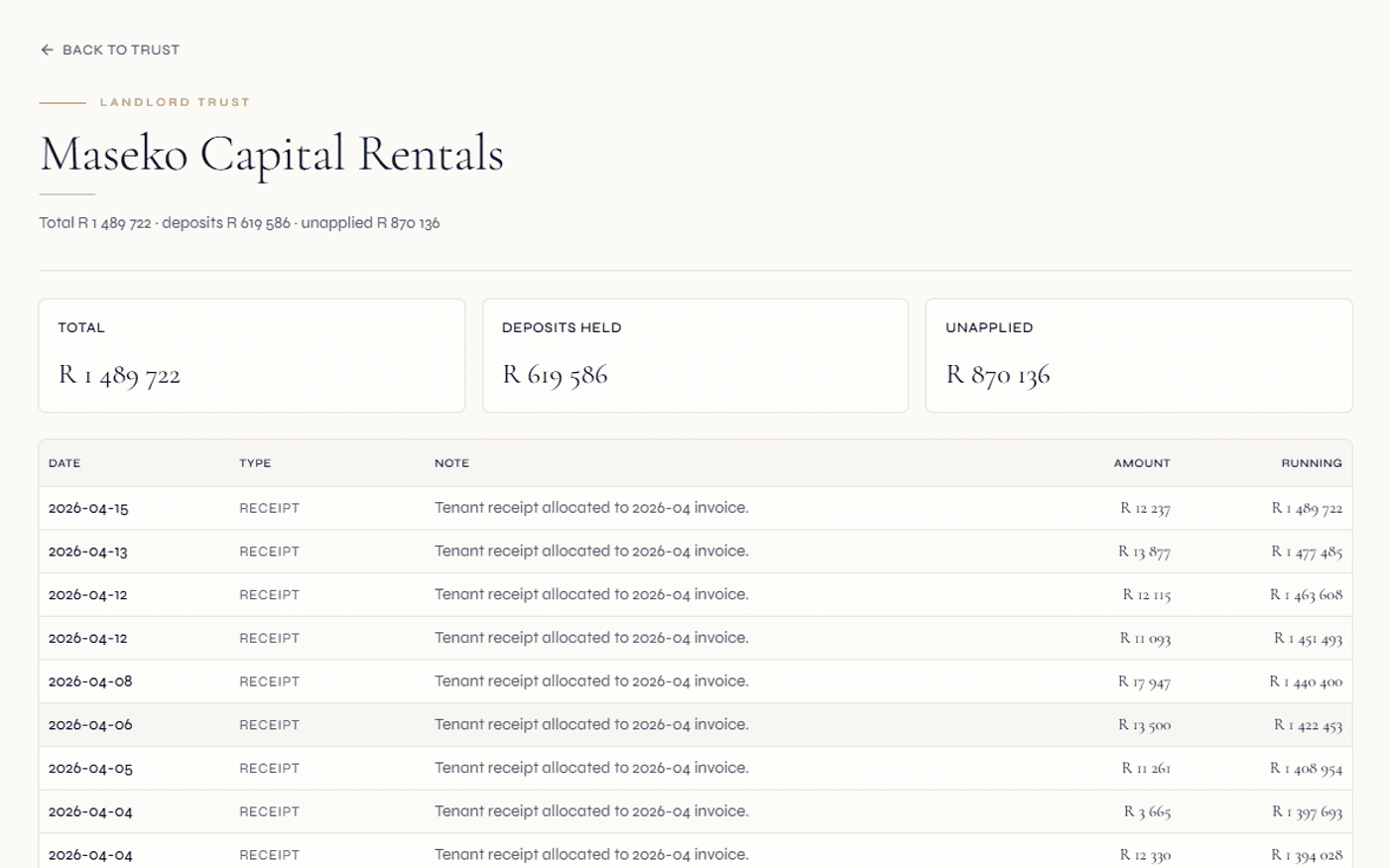
The roll recomputes from each unit participation quota and the active budget — no annual spreadsheet rebuild.
Base levies and special levies run through the same engine; specials carry a one-off flag and a target unit list.
Every unit on the roll carries a live balance and an ageing band from invoice due dates and allocations.
The levy roll is a calculation, not a document. So we calculate it — every time the inputs change.
In most managing-agent offices the levy roll lives in a spreadsheet that gets rebuilt at the start of every financial year: take last year's sheet, paste in the new budget, re-divide by the quotas, hope nobody fat-fingers a row. The moment a quota is corrected, a unit subdivides, or the budget is re-approved mid-year, the sheet is out of date and the invoices it produced no longer reconcile to anything.
Regalis treats the roll as a live derivation. Two inputs feed it: each unit participation quota — for a sectional title scheme, the schedule of quotas registered against the scheme — and the active, trustee-approved budget. The engine distributes the budgeted income across units by quota, splits into monthly amounts, and the monthly levy run mints an invoice per unit from that. Change either input and the roll moves with it.
Because the roll and the collection side share one ledger, the per-unit balance on the roll is always the true balance. There is no reconciliation between "the roll" and "what was actually invoiced" — they are the same number. That is the difference between a roll you trust at audit and one you rebuild at audit.
Read the full guide
What a spreadsheet levy roll costs you
- The roll is rebuilt by hand every financial year — and every rebuild is a chance to mis-key a quota or a budget line.
- A mid-year budget re-approval or quota correction does not flow through: invoices keep going out on stale figures.
- Special levies live in a second spreadsheet with their own apportionment logic, never reconciled against the base roll.
- Per-unit balances drift from the ledger, so the roll and the trial balance disagree at year-end.
- Arrears ageing is a manual VLOOKUP exercise rather than a live view, so escalation lags the actual overdue position.
- Pro-rata on a mid-period transfer is computed by hand, and the split between seller and buyer is a frequent source of disputes.
What a live roll gives you
- The roll recomputes from quota and budget automatically — correct an input once and every downstream invoice follows.
- A re-approved budget reprices the roll for the next run; no parallel spreadsheet to keep in step.
- Special levies run through the same engine with a one-off flag and a target unit list — apportioned on the same basis.
- Per-unit balances are the ledger balances — the roll and the trial balance are the same record.
- Arrears bands (0-30 / 31-60 / 61-90 / 90+) are live on the roll, so escalation tracks the real overdue position.
- Pro-rata on transfer is computed automatically; the participation quota travels with the unit, seller and buyer split cleanly.
From quota schedule to a monthly invoice per unit.
Capture quotas and the budget
Load each unit participation quota — the registered schedule for a sectional title scheme, or the configured per-unit levy for an HOA — and draft the annual budget, monthly amounts per line, submitted for trustee approval. These two inputs are everything the roll needs.
- Participation quota per unit
- Approved annual budget, monthly per line
- HOA per-unit levy supported alongside PQ
The engine derives the roll
The engine distributes budgeted income across units by participation quota and splits into monthly amounts. The result is the levy roll: a live schedule of what every unit owes this year, recomputed whenever a quota or the budget changes.
- Quota-weighted distribution
- Monthly breakdown per unit
- Recomputes on any input change
Run the roll monthly
On the 1st of each month the levy run mints an invoice per unit from the roll. Special levies and reserve-fund top-ups layer in on demand through the same engine with a one-off flag. Pro-rata is computed automatically when a transfer falls within the period.
- Automated monthly levy run
- Special levies via one-off flag
- Pro-rata on mid-month transfers
Read balances and arrears bands
Every unit on the roll carries a live balance and an ageing band. Trustees see the full roll with arrears bands; owners see their own per-unit balance. Overdue units feed straight into the collection workflow — same ledger, no re-keying.
- Per-unit live balance
- 0-30 / 31-60 / 61-90 / 90+ ageing
- Hands off to levy collection
The roll, the inputs that drive it, and the balances it produces.
The levy roll is one layer of the scheme money flow. It computes the charge; the collection side recovers it; the accounting side reports it. This page is the computation layer.
Live levy roll
A per-unit schedule computed from participation quota and the active budget, recomputed whenever an input changes. The roll drives the monthly levy run, not the other way around.
Participation quota
Each unit carries its registered participation quota for sectional title schemes. The quota drives base-levy apportionment and travels with the unit through a transfer.
Budget-derived
The approved annual budget — monthly amounts per line — is the income side the roll distributes by quota. Re-approve the budget and the roll reprices the next run.
Special levies, one engine
One-off levies for repairs or reserve-fund top-ups run through the same engine with a one-off flag and a target unit list — apportioned on the same basis as the base levy.
Per-unit balances
Every unit on the roll shows its live outstanding balance, sourced from the unified ledger. The roll balance and the ledger balance are the same number.
Arrears bands
Live 0-30, 31-60, 61-90 and 90+ day ageing per unit from invoice due dates and allocations. Trustees see the full roll; the overdue position feeds escalation.
Pro-rata on transfer
When a transfer falls within a period, the roll splits the levy pro-rata between seller and buyer from the transfer date — no manual apportionment.
Actual-vs-budget
Because the roll derives from the budget, levy income raised reconciles against budgeted income month-by-month and YTD, with variance and percentage drift visible before the AGM.
Owner statements
Each owner sees a statement built from their own slice of the roll — base levy, special levies, interest and balance — without seeing any other unit.
Reserve-fund segregation
STSMA s.3(1)(b) reserve-fund top-ups raised through the roll post to a flagged reserve account, keeping the administrative and reserve funds separate at the COA level.
Unified general ledger
The roll, the levy runs and every per-unit balance sit on one ledger. The trial balance and GL come from the same record at year-end — structured records and audit trails to support audit preparation, with no rebuild.
Owners and units
Units, owners and quotas are first-class records. An owner who also rents elsewhere on the platform is the same person across both contexts — one profile, two roles.
Participation quota, the budget and the reserve fund — where the roll meets STSMA and CSOS.
For sectional title schemes the levy roll is not an arbitrary apportionment. The Sectional Titles Schemes Management Act (STSMA, 2011) ties an owner's base liability to the section participation quota under section 3(1)(c), and requires under section 3(1)(b) that the body corporate maintain both an administrative fund and a separately held reserve fund. The Community Schemes Ombud Service Act (CSOS, 2011) establishes the oversight and dispute-resolution body that may, in a dispute, ask to see exactly how a levy was raised.
Regalis lines the roll up to that shape. The participation quota drives base-levy apportionment by default. Reserve-fund top-ups raised through the roll post to a flagged reserve account so the two funds stay segregated at the chart-of-accounts level. Special levies carry their resolution context, and the per-unit balance is the same figure the ledger reports — so a CSOS query about a specific owner's levy can be answered from one record rather than reconstructed.
Informational only — not legal advice. Statutory references are given in plain terms to help you map the product to the framework; confirm the treatment of a specific scheme with your auditor, your attorney or CSOS. For the recovery side of arrears that the roll surfaces, see levy collection; for the full books behind the roll, see body corporate accounting.
Base-levy apportionment follows the registered section participation quota by default.
Reserve-fund top-ups raised through the roll post to a segregated, flagged account.
The per-unit roll figure and the general-ledger balance are the same number, every time.
Continue exploring how Regalis handles the rest of the rental operation.
Levy collection
The recovery side of the roll — multi-channel reminders, collection statuses, age analysis and a CSOS-grade evidence trail.
Read moreBody corporate accounting
The full books behind the roll — chart of accounts, budgets, trial balance, general ledger and reserve-fund reporting on one unified ledger.
Read moreCommunity schemes
The integrated scheme platform — HOA, body corporate, sectional title and share block — running alongside your rental book on one Regalis.
Read moreCommunity scheme management
How Regalis runs community schemes end-to-end: levies, trustees, compliance, transfers and meetings under STSMA and CSOS.
Read moreSectional title & body corporate
STSMA-aligned reserve fund segregation, trustee multi-sig, participation quotas and body corporate levies.
Read moreCSOS compliance
Per-scheme compliance items, CSOS levy obligations, dispute references and the documents an ombud asks for.
Read moreCommon questions
Common questions about the levy roll.
What is a levy roll, and how does Regalis compute it?+
A levy roll is the master schedule of what every unit in a scheme owes in levies for the financial year. On Regalis it is not a static spreadsheet — it is computed live from two inputs: each unit participation quota and the active approved budget. Change the budget or correct a quota and the roll recalculates. The roll then drives the monthly levy run that mints an invoice per unit.
How is the roll derived from participation quota and the budget?+
For a sectional title scheme, STSMA section 3(1)(c) ties each owner's base levy liability to that section's participation quota — broadly the floor area of the section as a proportion of the total. Regalis takes the approved annual budget total, distributes it across units by their participation quota, and divides into monthly amounts. For an HOA, where there is no statutory PQ, the roll uses the configured per-unit levy. The same roll holds both bases.
How does the roll handle special levies?+
A special levy — a one-off raised for a specific purpose, such as a roof repair or a reserve-fund top-up — flows through the same engine with a one-off flag and a target unit list. It is computed on the same participation-quota basis as the base levy (or apportioned as the trustees resolve), appears on the affected owners' statements, and ages into the arrears bands like any other levy. You do not run a separate system for special levies.
What are the arrears bands on the roll?+
Every unit on the roll carries a live balance and an ageing band — 0-30, 31-60, 61-90 and 90+ days — sourced from invoice due dates and payment allocations. Trustees see the full roll with arrears bands; owners see only their own per-unit balance. The bands are the bridge between the roll and the collection side: they tell you which owners to escalate.
How is the levy roll different to levy collection on Regalis?+
The roll is the computation layer — what each unit owes, derived from quota and budget, including special levies and per-unit balances. Levy collection is the recovery layer — reminder cadences, collection statuses and the CSOS evidence pack. The same ledger underpins both: the roll determines the charge, collection chases the shortfall. See the levy collection page for the recovery side.
Does the roll handle pro-rata when a unit transfers mid-period?+
Yes. When a transfer falls within a billing period, the roll computes the pro-rata split automatically so the seller carries their portion and the buyer carries theirs from the transfer date. The participation quota travels with the unit, not the owner, so the new owner inherits the unit's share of the roll cleanly.
Can trustees see actual-vs-budget against the roll?+
Yes. Because the roll is derived from the approved budget, the platform reconciles levy income raised against budgeted income, and budgeted expenditure against actuals, month-by-month and year-to-date. That keeps the roll honest: if the budget drifts, trustees see it before the AGM rather than at year-end audit.
Does the levy roll support audit preparation?+
The roll, the budget it derives from, the per-unit balances and every levy run sit on the unified general ledger. Reserve-fund movements are segregated at the chart-of-accounts level, structured to align with STSMA section 3(1)(b). At year-end the trial balance, GL and actual-vs-budget reports come from the same record the trustees operate on, maintaining structured records and audit trails to support audit preparation. Informational only — not legal advice; confirm statutory treatment with your auditor or CSOS.
A levy roll you trust at audit,
not one you rebuild at audit.
Walk through the roll, the participation-quota apportionment, a special-levy run and the arrears bands with someone from the team — then see how it hands off to collection and the books.