Body corporate management software
for South Africa, STSMA-aligned.
Run sectional title body corporates under the Sectional Titles Schemes Management Act: participation-quota levies, statutory administrative and reserve fund segregation, multi-trustee approvals, conduct-rule offences, AGM resolutions and transfers — on the same platform that runs your rental book.
- STSMA s.3(1)(b)
- Participation-quota levies
- Multi-trustee approvals
- Conduct-rule offences
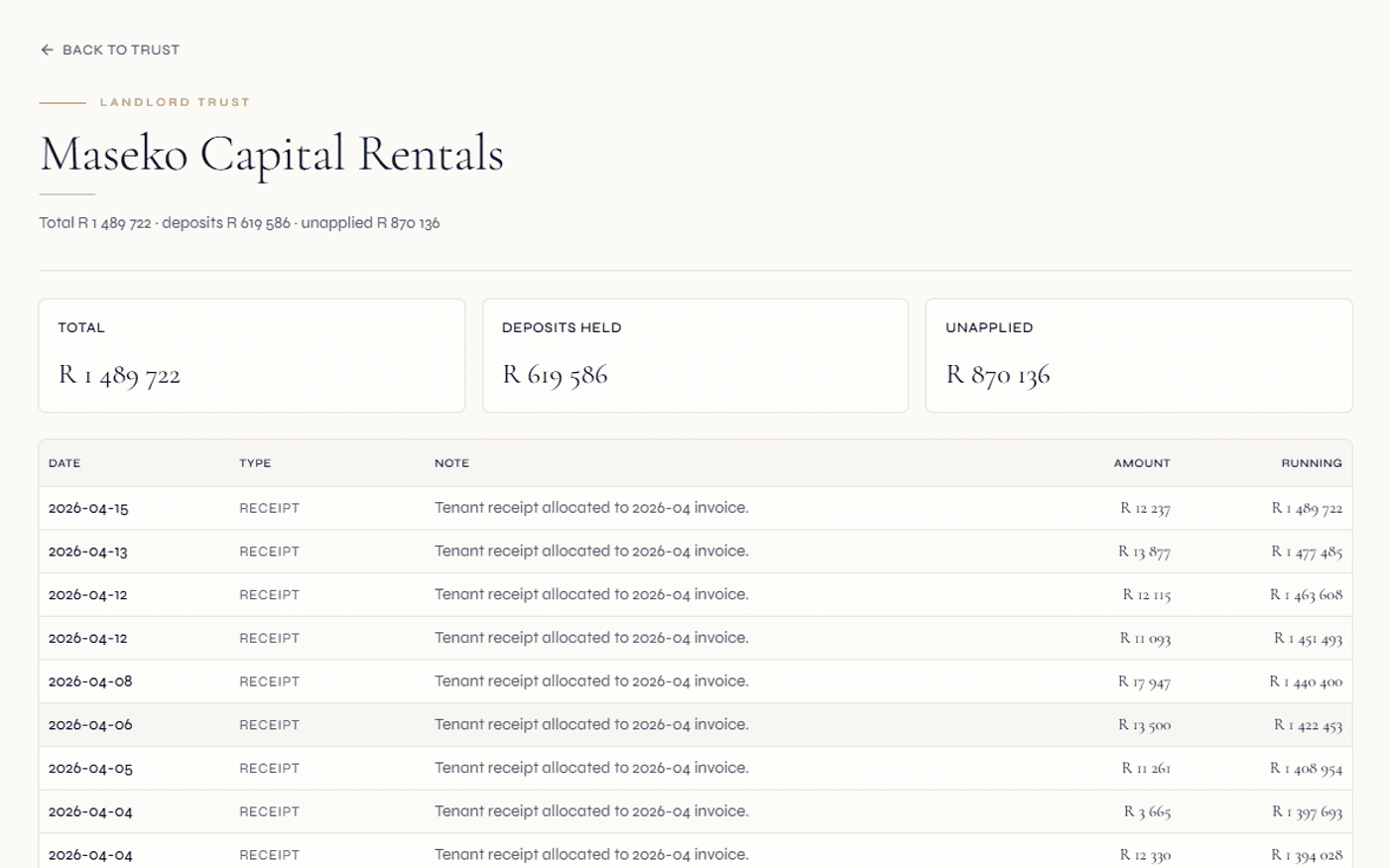
The administrative fund and reserve fund stay separated in your accounts, with a dedicated reserve trust account — structured to align with STSMA section 3(1)(b).
Each unit's participation quota drives its monthly levy — the same figures held on the registered scheme plans.
Set how many trustees must approve (for example, 2 of 3) before supplier payments and governance actions go ahead.
A body corporate is the most regulated scheme type — and the levy, the funds and the trustees all behave differently.
A body corporate is the legal entity that comes into existence the moment a sectional title scheme is registered. Under the Sectional Titles Schemes Management Act (STSMA, 2011) it carries obligations that no rental landlord and no Homeowners Association share in quite the same form: it must maintain two distinct funds, it must raise levies from registered participation quotas, it must hold an AGM, it must keep conduct and management rules, and it answers to the Community Schemes Ombud Service.
Trustees, not a landlord, hold the governing authority. They are elected, they carry fiduciary duties, and they sign off on spending. That changes the software shape: a body corporate needs recorded, multi-signatory approvals rather than a single owner clicking pay. It needs a levy roll computed from quotas, not a rent schedule. It needs a reserve fund that an auditor can see is genuinely ring-fenced. Regalis treats each of those as core, not as a configuration option a manager might forget to switch on.
This page is deliberately narrower than our broader scheme pages. If you manage Homeowners Associations, sectional title and share blocks across a mixed book, start with community schemes. If you want the full sectional-title regime, see sectional title management. This page is the body corporate specifically — the STSMA funds, the levy roll, the trustee governance and the conduct-rule machinery.
Read the full guide
How body corporates run on legacy tools
- Administrative and reserve funds share one bank account; the split is rebuilt in Excel each month and the auditor redoes it at year-end.
- Participation quotas live in a spreadsheet separate from the levy roll; the two drift when a unit is subdivided or a developer-held unit is finally sold.
- Trustee approvals happen only at quarterly meetings — anything in between is informal, with no recorded sign-off from the required trustees.
- Conduct-rule offences are tracked in email threads, so the warning-to-fine escalation and the charge to the owner's account are inconsistent.
- AGM Special resolutions are tallied by a show of hands, with no record of the participation-quota value gate STSMA requires.
- A levy clearance certificate is typed up manually, and outstanding amounts are checked against a statement that may already be stale.
How Regalis runs it
- The administrative and reserve funds stay separated in your accounts, with a dedicated scheme-reserve trust account.
- Participation quotas live on the unit records, and the levy roll is calculated from the same figures held on the registered scheme plans.
- You set how many trustees must approve supplier payments and governance actions before they go ahead.
- Conduct-rule offences escalate from warning to penalty to fine, with the fine charged to the owner's ledger automatically.
- AGM resolutions tally votes by both number and value, designed to support the thresholds that apply to Special resolutions.
- The transfers workflow holds completion until outstanding amounts are settled, then produces the levy clearance certificate.
From scheme registration to clean audit.
Set the body corporate up
Set the property up as a body corporate, capture its CSOS registration and financial-year start, and attach the constitution, conduct rules and management rules. Add the trustees with their roles. The body corporate workspace then opens up its compliance, offences, transfers and trustee areas automatically.
- Body-corporate type + CSOS registration
- Per-scheme financial-year start
- Trustees added with chair / treasurer / secretary roles
Build the two funds and the budget
Set up the chart of accounts with reserve-fund accounts marked to keep the STSMA section 3(1)(b) split. Draft the annual budget — monthly amounts per line for both the administrative and reserve funds — and send it for trustee approval. Actual-vs-budget reporting starts immediately.
- Reserve-fund accounts marked in the chart of accounts
- Administrative + reserve budget per line
- Budget draft sent for trustee approval
Run the levy roll monthly
Each month the levy run produces an invoice per unit using participation quota and the active budget. Special levies and reserve-fund top-ups layer in on demand, and the amount is automatically pro-rated when a transfer falls within the period.
- Participation-quota driven
- Special levies on demand
- Pro-rata on mid-month transfers
Approve, act, transfer, close
Supplier payments wait for the required number of trustee approvals before the payment batch is exported to your bank. Conduct-rule offences escalate to fines on the owner ledger. Transfers hold until outstanding amounts are settled, then issue the levy clearance certificate. Year-end runs the full close including the reserve-fund report.
- Multi-trustee approvals
- Conduct-rule fines to ledger
- Levy clearance + reserve-fund report
The STSMA toolkit, integrated with rentals.
Every feature below is a real part of the platform — the same finance hub, trust ledger and approvals queue that run the rental book also run the body corporate.
Body-corporate property setup
Set any property up as a body corporate and capture CSOS registration and the scheme financial-year start. The sectional-title features then become available on that property.
Trustees register
Trustees join with a role (chair, treasurer, secretary, member) and appear in the firm-wide team directory with a Trustee badge.
Participation-quota levy roll
Live per-unit levy calculation from each unit's participation quota and the active budget. Base levies, special levies and reserve-fund top-ups flow through the same monthly run.
Reserve fund segregation
Designed to support STSMA section 3(1)(b). Reserve-fund accounts are marked in the chart of accounts, and their movements flow into a dedicated reserve trust account, separate from the administrative fund.
Chart of accounts + budget
Hierarchical chart of accounts with reusable templates and per-property overrides. Annual budget per line, with month-by-month actual-vs-budget and variance reporting.
Trial balance + general ledger
Once the chart of accounts is in place, the trial balance and general ledger come straight from one shared ledger — a single source, reports ready for audit preparation, both funds reflected correctly.
Conduct rule offences
Warning, penalty and fine escalation, offence categories set up per body corporate, and the fine charged to the owner's ledger automatically when it is issued.
AGM resolutions
Ordinary, Special and Unanimous resolution types, tallying both number and value for Special resolutions, plus round-robin resolutions between meetings as their own meeting type.
Transfers + levy clearance
Transfer workflow from opened to complete, with conveyancer assignment, a hold on completion until outstanding amounts are settled, and a levy clearance certificate produced when the balance is cleared.
Multi-trustee approvals
Set how many trustees must approve per body corporate (for example, 2 of 3 trustees for payments above a threshold). Each trustee's decision is captured with reasons and supporting documents.
CSOS compliance planner
Per-scheme compliance items created at each financial-year rollover — AGM scheduling, CSOS levy submission, annual financial statements, reserve fund top-up — each with documents and an audit trail.
Cashbook + EFT batch export
Per-bank-account cashbook with allocation rules, and approved supplier payments batched into your bank's import format (FNB, Standard Bank, Nedbank, ABSA Business).
Owner statements
Per-owner ledger with levies, special levies, conduct-rule fines and payments on one running statement, available to the owner through the portal.
Year-end close
Per-scheme year-end produces the trial balance, general ledger, actual-vs-budget and the reserve-fund report — aligned to STSMA reporting expectations.
STSMA, the Sectional Titles Act and CSOS — what the body corporate actually answers to.
A body corporate sits at the intersection of three South African regimes. The Sectional Titles Schemes Management Act (STSMA, 2011) governs the financial and governance side: section 3(1)(b) requires both an administrative fund and a reserve fund; section 1 defines the Ordinary, Special and Unanimous resolution thresholds; section 6(8) provides for Round-Robin Resolutions between meetings. The Sectional Titles Act of 1986 governs the title-deed and survey side, including the participation quotas registered against each unit. The Community Schemes Ombud Service Act (CSOS, 2011) establishes the ombud that bodies corporate report to and that resolves disputes.
Regalis is built to line up with each. The reserve fund split is kept in the chart of accounts rather than left to a manager's discipline. Participation quotas live on the unit records and drive the levy roll directly. AGM resolutions tally votes by both number and value, designed to support the thresholds that apply to Special resolutions. CSOS registration is captured as a dedicated field, and CSOS levy obligations and dispute references appear in the compliance planner. Trust accounts follow the same disciplined approach deposits do on the rental side — clean separation, a tamper-evident record and a ledger structured for audit preparation.
Informational only — not legal advice. Statutory references are provided in plain text to explain the public requirements; confirm your scheme's specific obligations with your auditor, attorney or the Community Schemes Ombud Service before relying on them.
Continue exploring how Regalis handles the rest of the rental operation.
Community schemes
Every scheme type on one platform — HOA, body corporate, sectional title, share block — alongside your rental book.
Read moreSectional title management
The broader STSMA sectional-title regime: participation quotas, reserve fund, 10-year maintenance plan, PQ-weighted voting.
Read moreLevy collection
Structured levy arrears recovery — multi-channel reminders and a CSOS-grade evidence trail.
Read moreTrustee portal
Where trustees approve payments, review the levy roll, track offences and follow scheme health from their own login.
Read moreCSOS compliance
CSOS registration, levy submission, dispute references and the annual compliance planner per scheme.
Read moreCommunity scheme management
The full picture of how Regalis runs schemes and rentals together on one operating record.
Read moreCommon questions
Common questions about body corporate management.
What is body corporate management software?+
It is software that runs the financial and governance work a body corporate carries under the Sectional Titles Schemes Management Act (STSMA, 2011): raising monthly levies per unit, keeping the administrative and reserve funds separate, recording trustee approvals, handling conduct-rule offences, running AGMs and managing ownership transfers. Regalis does all of this as a mode of the same platform that runs rentals.
How does the administrative fund and reserve fund split work?+
STSMA section 3(1)(b) requires a body corporate to establish and maintain an administrative fund AND a reserve fund. Regalis keeps the split in your accounts — reserve-fund accounts are marked as such and their movements flow into a separate scheme-reserve trust account. The trial balance, general ledger and actual-vs-budget reports can be filtered to the reserve fund when you prepare for auditor handover.
How is the levy roll calculated?+
Each unit holds a participation quota, set in the registered scheme plans. The monthly levy run multiplies each unit's quota by the budgeted monthly cost to produce one invoice per unit. Special levies use the same proportion unless you override them, and the amount is automatically pro-rated when a transfer falls mid-period.
How do trustee approvals work?+
Trustees join the body corporate with a role — chair, treasurer, secretary or member. For each body corporate you set how many trustees must approve supplier payments and governance actions, for example "2 of 3 trustees must approve payments above R20 000". Each trustee decides from their own login, and the record keeps who approved, who declined and the supporting documents.
Does it handle conduct rule offences?+
Yes. Conduct-rule and management-rule offences move through a warning, then penalty, then fine escalation, with offence categories set up per scheme. When a fine is issued it is charged to the owner's ledger automatically, so the penalty appears on the next levy statement.
Are AGM resolutions handled under STSMA voting rules?+
STSMA distinguishes Ordinary, Special and Unanimous resolutions, and Special resolutions are commonly understood to need both a majority by number of members voting and a majority by value (participation quota). Regalis is structured to support this by tallying both percentages as votes come in and flagging a resolution as passed only when both measures are met. Round-robin resolutions between meetings are supported as their own meeting type. Confirm the exact thresholds that apply to your scheme with your auditor or attorney.
Can it issue a levy clearance certificate on transfer?+
Yes. The transfers workflow runs from opened to complete with conveyancer assignment and an outstanding-amount gate. Once the balance is settled, the levy clearance certificate PDF is generated and ownership updates on the unit record.
Is this different to your community schemes and sectional title pages?+
This page focuses specifically on body corporates under the STSMA. Community schemes covers every scheme type (HOA, sectional title, share block) on one platform, and sectional title management covers the broader sectional-title regime. A body corporate is one scheme type within that family — narrower, and the subject of this page.
One operating record for
your whole book.
Walk through the participation-quota levy roll, the STSMA reserve fund split, the trustee approvals workflow and the conduct-rule offences with someone from the team.