Rental deposit management
for money you hold in trust.
A deposit is not your money — it is the tenant's, held on their behalf until the lease ends. Regalis manages the whole lifecycle as trust money: capture at signing, monthly interest accrual under the Rental Housing Act, deductions and refunds at move-out, and reconciliation to the trust ledger. Distinct from your rent flows and your wider trust audit — the deposit has its own clean, defensible record.
- Held as trust money
- RHA interest accrual
- Move-out deductions & refunds
- Reconciled to the trust ledger
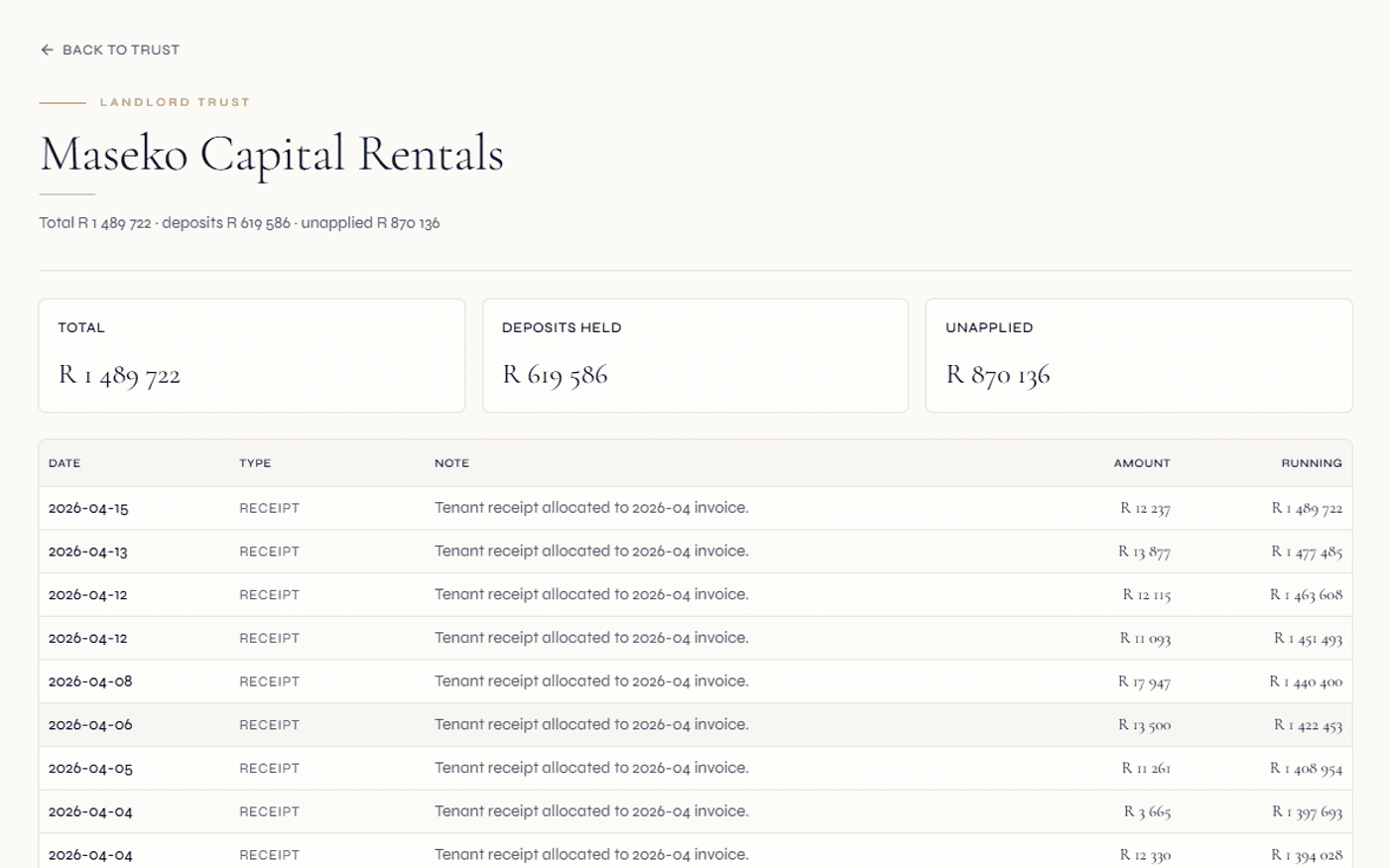
Deposit interest accrues monthly per lease, designed to support the Rental Housing Act deposit-interest obligation.
Deposits are captured against the lease and held in the regulated trust account — never mixed with rent or operating funds.
Every deposit receipt, accrual, deduction and refund is an immutable ledger entry that ties back to the trust balance.
A deposit changes the legal character of the cash. Treat it like rent and you create risk.
The moment a tenant pays a deposit at lease signing, you are holding someone else's money. It is not revenue, it is not the landlord's to spend, and it is not yours. It has to be ring-fenced, it has to accrue interest for the tenant, and at the end of the lease it has to be returned — less any legitimate, documented deductions. Most rental software treats this as a line in a rent statement or a balance in a spreadsheet, and that is exactly where deposits go wrong.
Regalis gives the deposit its own lifecycle. The receipt is captured against the lease and written straight to the regulated trust account for that landlord. Interest accrues monthly, non-destructively, on the rate held on the trust account. When the lease ends, the move-out inspection feeds the deductions, the interest is added, and the net refund is recorded out. At every step the deposit is a structured, immutable record — not a number someone has to reconstruct later.
This is deliberately distinct from your wider trust-accounting discipline and from your rent and arrears flows. Trust accounting is the audit-grade ledger and per-landlord separation; rent and arrears are operating money on its way to the landlord. The deposit sits in its own lane: held money, with its own interest clock and its own end-of-lease settlement.
Read the full guide
Where deposit handling breaks down
- The deposit is held in the same account as rent, so nobody can say at any given moment how much of the balance is deposit money versus operating money.
- A spreadsheet tracks deposits separately from the actual bank balance, and the two drift apart over the years of a tenancy.
- Nobody accrues interest because nobody knows what the right number is — and the tenant is legally owed it.
- Move-out refunds happen ad-hoc; deductions are argued over because there is no documented condition record to point to.
- When a deposit dispute lands, the team is emailing each other "what did we actually hold, and what did we take out?" instead of opening one record.
What deposit management gives you
- Deposits live in the regulated trust account, ring-fenced from rent and operating funds, with a per-landlord balance visible at any time.
- The deposit ledger reconciles to the trust balance to the cent — no spreadsheet that drifts.
- Interest accrues automatically each month per lease on the rate held on the trust account, and is netted into the refund at move-out.
- Deductions are anchored to the move-out inspection — condition, photos and sign-off — so a refund is defensible, not a negotiation.
- When a dispute arises, one record shows what was held, what accrued, what was deducted and why, and what was returned.
From the deposit receipt to a clean refund.
Capture the deposit at signing
When the lease is signed, the deposit receipt is captured against that lease and written to the regulated trust account for the landlord. From the first cent, the deposit is a structured record tied to the tenant, the lease and the landlord — not a note in a rent statement.
- Receipt captured against the lease
- Written to the regulated trust account
- Per-landlord deposit balance from day one
Accrue interest monthly
Interest accrues every month per lease using the rate stored on the trust account. The accrual is non-destructive — the deposit principal is never touched. The accumulated interest is visible per lease and per period, designed to support the Rental Housing Act deposit-interest obligation.
- Monthly accrual per lease
- Rate held on the trust account
- Principal untouched, interest visible
Settle deductions at lease end
When the lease moves to its end, the move-out inspection captures the condition of the unit with ratings, photos and sign-off. Legitimate deductions are recorded against the deposit, anchored to that inspection so each one is documented rather than disputed after the fact.
- Move-out inspection feeds deductions
- Each deduction documented with evidence
- Interest added to the held balance
Refund and reconcile
The net refund — deposit plus accrued interest, less documented deductions — is calculated and recorded out of the trust account. The ledger now reads cleanly: held, accrued, deducted, returned. The per-landlord trust balance always matches what you are holding.
- Net refund calculated automatically
- Refund recorded out of the trust account
- Reconciled to the trust ledger
The full deposit lifecycle, held as trust money.
Deposit capture
The deposit receipt is captured against the lease at signing and written to the regulated trust account for that landlord. A structured audit trail from the first cent.
Held in trust
Deposits sit in the regulated, deposit-only trust account — ring-fenced from rent and operating funds. The deposit is held money, never agency revenue.
Interest accrual
Interest accrues monthly per lease on the rate stored on the trust account. Non-destructive — the principal is untouched and the accrued amount is visible per lease and period.
Rental Housing Act alignment
The monthly accrual is designed to support the deposit-interest obligation in section 5 of the Rental Housing Act, so the tenant is owed the right number at move-out.
Move-out deductions
Deductions at lease end are anchored to the move-out inspection — condition ratings, photos and sign-off — so each one is documented and defensible rather than argued.
Refund calculation
The net refund — deposit plus accrued interest, less documented deductions — is worked out automatically and recorded out of the trust account.
Per-landlord balances
Each landlord's deposit balance is visible at any time. A managing agent running multiple books can answer "what deposits am I holding for this landlord?" instantly.
Rent / deposit separation
Rent defaults to direct-to-landlord settlement and never enters the trust ledger. The regulated ledger only ever sees deposit movements — a clean split for inspection.
Trust-ledger reconciliation
Every receipt, accrual, deduction, fee and refund is an immutable ledger entry. The deposit you hold on paper always matches the trust balance — to the cent.
Lease-linked history
The deposit travels with the lease record. Renew the lease and the deposit history carries forward; raise a dispute and the full held-to-refunded trail is right there.
Move-out timing
Ending leases surface inside a configurable window so deposit settlement is scheduled, not scrambled. The move-out date drives the inspection and the refund.
Defensible audit trail
When a deposit is questioned, one record shows what was held, what accrued, what was deducted and why, and what was returned — timestamped and immutable.
The Rental Housing Act and the PPA both shape how a deposit must be handled.
Two pieces of South African law sit behind every rental deposit. The Rental Housing Act (1999) sets out, in section 5, that a deposit must be invested in an interest-bearing account and that the accrued interest belongs to the tenant — payable, with the balance of the deposit, at the end of the lease once any legitimate deductions are accounted for. The Property Practitioners Act (2019), in section 54, governs the trust-account regime within which a property practitioner holds money on someone else's behalf — deposits being textbook trust money.
Regalis is built to support both. The deposit is held in the regulated trust account from the moment it is received. Interest accrues monthly per lease, non-destructively, on the rate held on that account — designed to support the section 5 obligation rather than leaving the agency to compute it by hand at move-out. And because rent defaults to direct-to-landlord settlement, the regulated ledger only ever carries deposit movements, which keeps the section-54 separation clean and inspectable.
For an agency that has been holding deposits in a shared account and tracking them on a spreadsheet, the practical effect is real. The interest owed to each tenant is computed as you go. The refund at move-out is a calculation, not an argument. And when a deposit dispute or an inspection arrives, the evidence — receipt, accrual, deductions, refund — is gathered in one defensible record.
Continue exploring how Regalis handles the rest of the rental operation.
Trust accounting
The wider audit-grade ledger — per-landlord trust accounts, the deposit-only regulated ledger and rent / trust separation under PPA section 54.
Read moreLease management
The living lease record that the deposit attaches to — signing, renewals that preserve history, and the move-out workflow that drives settlement.
Read moreTenant portal
Where tenants see their lease, invoices, payment status and the deposit on their record — under your agency brand.
Read moreCommon questions
Common questions about rental deposit management.
What does rental deposit management mean on Regalis?+
A deposit is someone else's money that you hold on their behalf until the lease ends. Regalis treats it that way from the first cent: the deposit is captured against the lease, written to the regulated trust account for that landlord, accrues interest monthly, and is settled — deductions and refund — at move-out. Every movement is an immutable, timestamped ledger entry tied to the lease and the tenant.
How is deposit management different to trust accounting?+
Trust accounting is the wider ledger and audit discipline — per-landlord accounts, the deposit-only regulated ledger, and rent / trust separation. Deposit management is the day-to-day lifecycle of a single tenant's deposit inside that discipline: take it in at signing, accrue its interest, work out deductions at lease end, refund the balance, and reconcile. The deposit lifecycle posts into the trust ledger, but the workflow you live in is the deposit one.
How does deposit interest accrual work?+
Interest accrues monthly per lease using the rate stored on the trust account itself. The accrual is non-destructive — the deposit principal is never touched. At move-out, the accumulated interest is netted into the refund automatically, which is designed to help you meet the deposit-interest obligation in section 5 of the Rental Housing Act.
How are deductions and refunds handled at lease end?+
When a lease moves to its end, the move-out inspection captures the condition of the unit. Legitimate deductions are recorded against the deposit, the accrued interest is added, and the net refund is calculated. The refund records out of the trust account, leaving a clean trail of what was held, what was deducted and why, and what was returned.
Does the deposit reconcile to the trust ledger?+
Yes. Every deposit receipt, interest accrual, deduction, fee and refund is a ledger entry in the regulated trust account. Balances per landlord are visible at any time, so the deposit you are holding on paper always matches the trust ledger — no spreadsheet that drifts from the bank balance.
Is the deposit ledger kept separate from rent?+
It is. Rent defaults to direct-to-landlord settlement, so it never enters the trust ledger. The regulated trust ledger only ever sees deposit movements — a split structured to align with how property practitioners are inspected under section 54 of the Property Practitioners Act. Deposit arrears and rent arrears stay distinct.
Is it POPIA-aligned?+
Yes — it is designed to support your POPIA obligations. Tenant and lease data behind a deposit lives in the same consent ledger, retention sweep and data-subject-request surface as the rest of the platform, so a deposit record is never a privacy island.
Stop tracking deposits on a spreadsheet.
Hold them as trust money.
Walk through the deposit lifecycle — capture at signing, monthly interest accrual, move-out deductions and refund, and the reconciliation to the trust ledger — with someone from the team.