Maintenance dispatch software
that runs itself.
Tenants log categorised repairs. Eligible vendors at the property bid over WhatsApp. The earliest credible ETA auto-wins. Photos, work logs, invoices and vendor health scores all stay on the request — no more office switchboard.
- WhatsApp Cloud API
- Auction-style dispatch
- Vendor health scoring
- Emergency fallback
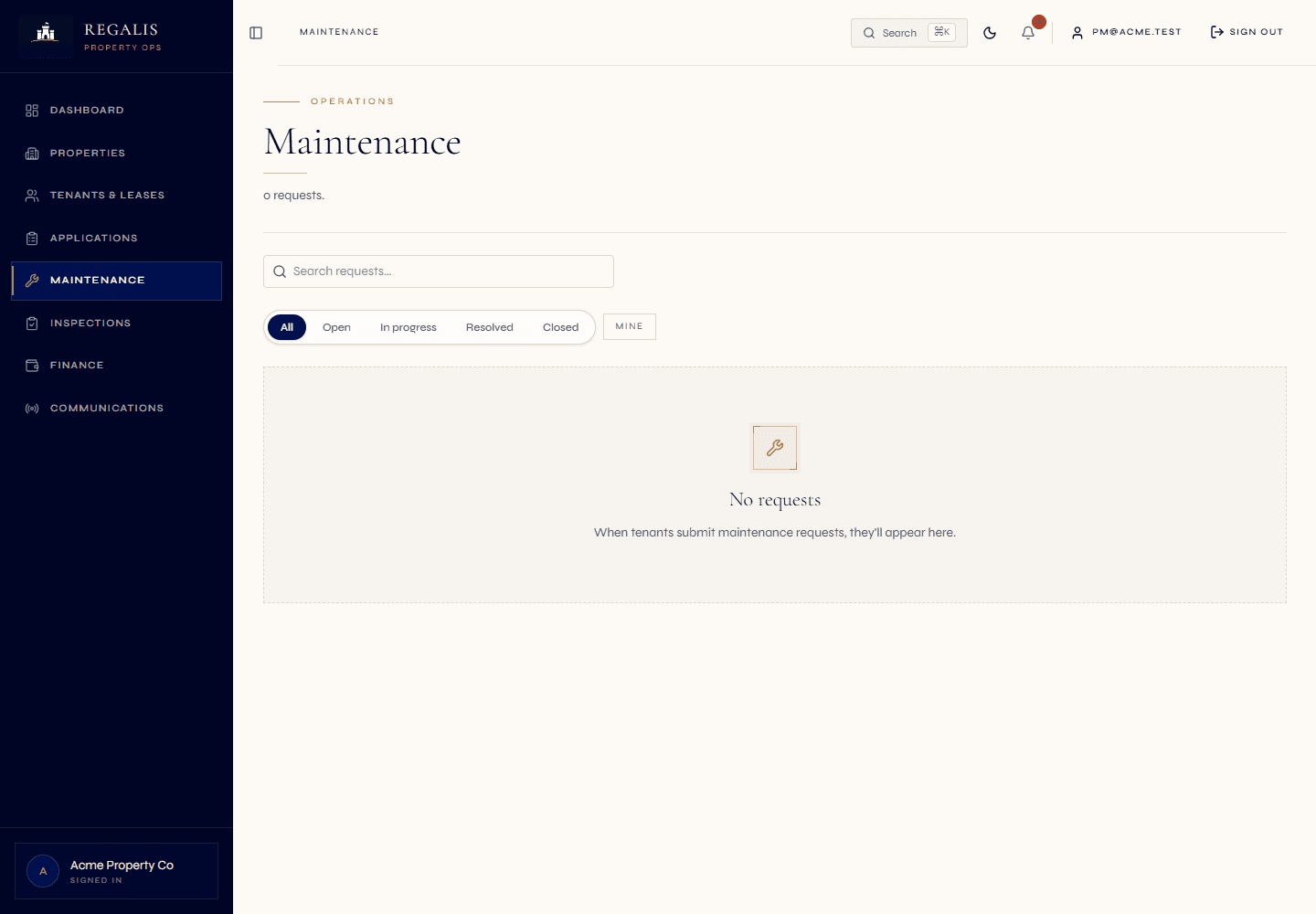
Approved Meta templates open the 24h conversation window for follow-ups.
No phone calls, no negotiation. Tie-break on vendor health score, then which bid arrived first.
Regalis reviews open dispatches every few minutes so an empty round is escalated, never left sitting.
Vendor coordination is the most invisible drain on a rental team.
Most rental teams underestimate what dispatch actually costs. A geyser bursts, the tenant calls the office, the office WhatsApps three plumbers, two reply within an hour and one replies three days later, the tenant escalates because nobody told them what was happening, and the property manager spends 90 minutes shepherding a single repair that should have taken 90 seconds of attention.
The fundamental problem is that dispatch is a many-to-many matching problem (tenants vs vendors), with real-time pressure (the tenant wants action now), under information asymmetry (you do not know who is free), under price tension (the cheapest vendor is not necessarily the right one), under accountability gaps (you cannot prove the SLA was missed).
Regalis solves it with an explicit auction. It identifies the eligible vendors automatically, sends each a secure one-tap WhatsApp claim link, runs a short bid window, and picks the earliest credible ETA. The full bid trail stays on the request, so when a tenant follows up two months later you can show what happened and when.
Read the full guide
How dispatch usually fails
- A tenant phones the office to report a leak; nobody is available; the call goes to voicemail; the leak doubles before the team learns of it.
- The property manager messages "the usual plumbers" on WhatsApp from a personal phone; two reply, neither commits to an ETA, the third is unreachable.
- A vendor commits verbally and then no-shows; nobody recorded the commitment so there is no consequence.
- Repair photos live in scattered WhatsApp chats and personal phones; when the landlord asks for evidence, the team has to rebuild it.
- Invoices arrive over email weeks after the repair; matching them back to a specific incident is half-detective-work.
- There is no view of which vendors are reliable across the portfolio — every property manager has their own list.
How Regalis runs it
- Tenant logs the repair categorised through the portal — category, description, photos, urgency.
- Eligible vendors are worked out automatically from each vendor’s service categories and the properties they are assigned to.
- Approved WhatsApp templates send a secure one-tap claim link to every eligible vendor. Vendors bid an ETA with one tap.
- The auction resolves: the earliest credible ETA wins automatically (or the earliest ETA when the window closes). Ties break on vendor health score.
- Vendor uploads photos through the claim page; work log entries record progress; invoice attaches at completion.
- Vendor health score updates from completion, accuracy and feedback — feeding back into future ties.
Tenant logs → vendor wins → repair completes.
Tenant logs a categorised repair
The tenant submits through the portal with the maintenance category (electrical, plumbing, appliance, security, structural), description, photos and urgency. The request opens with priority and category captured.
- Categorised request intake
- Priority (low, medium, high, urgent)
- Photo upload from tenant phone
Eligible vendors are worked out
Regalis works out the eligible vendors — those linked to the property and active for the request category. The first bidding round launches automatically.
- Vendors scoped to each property
- Property triage holds respected
- Portfolio-wide fallbacks for uncovered categories
WhatsApp auction
Each eligible vendor gets a secure one-tap WhatsApp claim link. They open it, see the job details, and bid an ETA. The auction resolves either early (any bid whose ETA falls before the window closes wins automatically) or when the window closes (the earliest ETA wins, ties on vendor health score).
- Approved WhatsApp templates
- Secure one-tap claim page, no login
- Health-score tie-break
Work, photos, invoice, close
Winning vendor accepts, marks in progress, uploads photos, logs work entries and attaches the invoice. On completion the request resolves with a closure note visible to the tenant. Auto-close at 48 hours. Health score updates.
- Work log with timestamps
- Photos held under retention controls
- Auto-close 48h after resolution
A complete dispatch + vendor management toolkit.
Categorised request intake
Tenant logs the repair through the portal with category, description, photos and urgency. Routing is deterministic from the category alone.
Vendor eligibility engine
Property-level vendor assignments, service categories, triage holds and portfolio defaults work out the eligible vendor set automatically — no manual lookup.
WhatsApp dispatch
Approved WhatsApp templates for offer, empty round, and escalation open the 24-hour conversation window for vendor follow-ups.
Auction resolution
Earliest credible ETA wins by early-stop, or earliest absolute ETA wins at window-close. Ties break on vendor health score, then bid arrival time. All deterministic.
Vendor health score
Computed per vendor from response rate, ETA accuracy, completion rate and tenant feedback. Surfaces as a sortable column and breaks auction ties.
Empty-round escalation
If round 1 has no winner, ops gets a WhatsApp ping. Round 2 expands eligibility or triggers manual dispatch.
Photo trail
Tenant photos at intake, vendor photos at completion. Stored securely, linked to the request, held under retention and legal-hold controls.
Work log
Vendors and staff log work entries on the request with notes, author and timestamp. Tenants see a curated subset; the full trail stays internal.
Quote → invoice flow
Estimate → quote → final invoice on the request, with the vendor invoice attached. Cost tracking surfaces in landlord and agency dashboards.
Property-vendor map
Scope which vendors serve which properties. Useful for estates with preferred service providers or geographic clustering.
In-house staff dispatch
Internal-staff vendors receive the same WhatsApp dispatch — claim links are sent to their linked user's phone.
Auto-close + reopen
Auto-close 48 hours after resolution keeps the queue clean. Tenants can reopen with a note if the repair was not actually completed; the cycle restarts cleanly.
Predictable dispatch you can actually explain.
Dispatch is not a black box. Every few minutes Regalis reviews each open job and asks the same questions: has the bidding window closed, has a bid already won outright, and does the request need escalating?
Because the rules are explicit, the timing is predictable, every step is easy to trace, and the system scales cleanly as your portfolio grows.
For very high-volume estates the review can run more frequently. For in-house teams the auction can be skipped entirely. The result is a process your team trusts because they can understand exactly how a job moves from logged to assigned.
Continue exploring how Regalis handles the rest of the rental operation.
Tenant portal
The tenant-side experience: log a repair, watch status, see who is assigned, view photos and closure note.
Read moreLoad shedding alerts
When the issue is power, the load-shedding workflow takes over instead of vendor dispatch.
Read moreManaging agent software
Multi-property dispatch oversight, vendor coverage gaps, health-score visibility across the agency.
Read moreCommon questions
Common questions about maintenance dispatch.
How does the maintenance auction actually work?+
A tenant logs a categorised repair (electrical, plumbing, appliance, security, structural). Regalis identifies the eligible vendors at that property — those linked to the property and active for that category. Each receives a secure WhatsApp message with a one-tap claim link. Vendors place ETA bids; the earliest credible bid wins automatically if it falls before the bidding window closes, otherwise the earliest ETA wins when the window closes. Ties break on vendor health score, then on which bid arrived first.
What if no vendor responds?+
Round 1 finishes with no winner. Ops gets pinged on WhatsApp. The property manager can manually dispatch, expand the eligibility pool, or trigger round-2 escalation. Empty-round dispatches are logged so the team can see vendor coverage gaps over time.
How are vendors onboarded?+
Vendors are records in the platform with their categories, contact details and an optional linked user account. Connect a vendor to a property to make them eligible there. Vendors can also be internal staff for in-house maintenance teams — they receive the same WhatsApp dispatch offers and claim links, sent to their linked user's phone.
What is the vendor health score?+
A score per vendor reflecting historical performance — bid response rate, ETA accuracy, completion rate, average cost vs estimate, tenant feedback. It breaks ties in the auction and surfaces as a sortable column when staff are deciding manual dispatch.
Does it work without WhatsApp?+
No — dispatch is WhatsApp-first by design, because vendor coverage in South Africa is best on WhatsApp and vendors reliably read it. There is no SMS or email dispatch path. If a vendor has no WhatsApp number on file, the offer simply skips them; and if a round closes with no bids, ops gets a WhatsApp ping and can dispatch manually or widen the vendor pool.
Can the tenant see status?+
Yes. The tenant portal shows the request status (open, in progress, resolved, closed), the assigned vendor, photos, work log entries and any tenant-visible notes. When the request closes, the tenant sees the closure note.
How are photos handled?+
Vendors upload photos through the claim page (no login needed — secure one-tap access). Tenants upload through their portal. Photos are stored securely, linked to the repair request, and held under retention controls.
What about emergency or after-hours dispatch?+
For after-hours repairs the auction window can be shortened automatically based on priority. For health and safety emergencies (fire, medical, security) the emergency-alert workflow takes over instead — routing to your security partner (Beagle Watch, Fidelity ADT, Chubb, Aura, Namola) or the in-house dispatcher.
See everything built for you — explore the property managers hub
Dispatch should not be
a full-time job.
Walk through the dispatch engine, the vendor workflow, and the tenant experience with someone from the team.