Levy clearance certificate software
for clean unit transfers.
Manage scheme unit transfers from opened to registered on one record. Capture the transfer detail — erf, date, sale price, conveyancer and parties — gate the clearance certificate on a true settled balance, and update ownership without a spreadsheet in sight. The conveyancing-side counterpart to the levy roll, built for South African community schemes.
- Clearance gate on arrears
- Conveyancer assignment
- Pro-rata aware
- STSMA / CSOS aligned
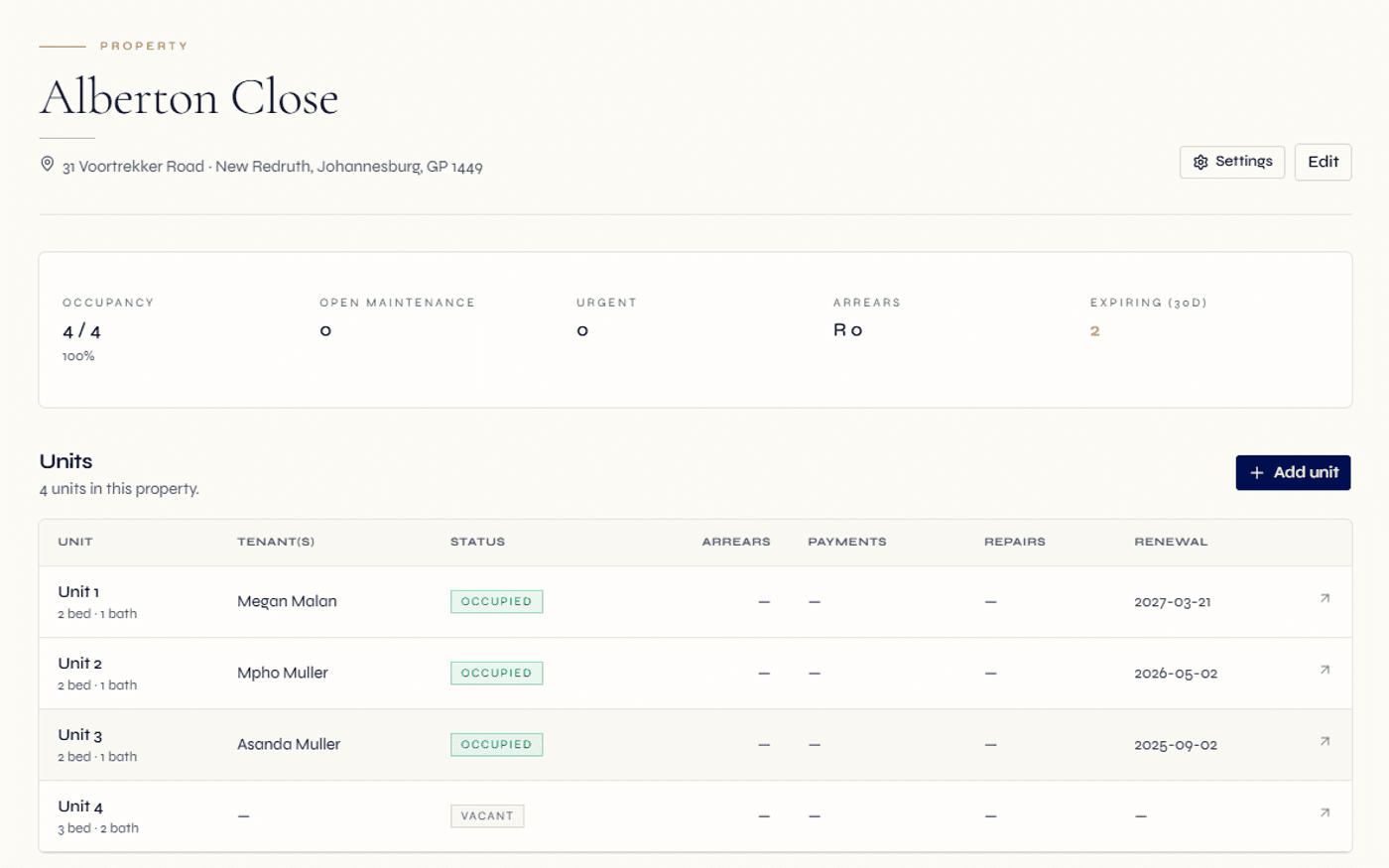
The clearance certificate is calculated from the live unit balance — not a figure rebuilt by hand in a spreadsheet at the last minute.
The certificate generates only once levies, special levies, fines, interest and pro-rata are settled — protecting the body corporate.
Every in-flight transfer carries a clear status so the managing agent and trustees always know where a unit sits.
The transfer is the one moment where a scheme can quietly transfer out a liability. Regalis closes that gap.
Most of a scheme's financial life is recurring — the levy roll goes out, owners pay, arrears get chased. The transfer is the exception: a one-off, high-stakes event where a unit leaves one owner and arrives with another. Get the figure wrong, release the certificate too early, or miss a fine that was sitting on the ledger, and the body corporate has just handed a clean title to a unit that still owes money. That money is now very hard to recover.
Regalis treats the transfer as a first-class workflow on the unit, not an afterthought. You open a transfer, capture the conveyancing detail, and the platform draws the clearance figure straight from the live ledger the levy roll and collections workflow have been keeping current all year. The clearance certificate is gated: it will not generate until that figure reaches zero. The conveyancer cannot retrieve a clean certificate before the scheme is paid.
This is deliberately a different surface to levy collection. Collection keeps owners current month to month; transfers govern the moment of handover. They share one ledger, so the clearance figure is never a separate set of numbers to reconcile — it is the same balance, frozen at the right point and released only when it is right to release it.
Read the full guide
What a manual transfer process costs the scheme.
- Clearance figures rebuilt by hand in a spreadsheet at the last minute, with no link to the live ledger — and no way to be sure a fine or interest line was not missed.
- A certificate released before the unit is fully paid up, leaving the body corporate to chase a former owner who has already left the scheme.
- Pro-rata for a mid-month transfer worked out manually, so the seller is over- or under-charged and the buyer inherits the wrong opening balance.
- Ownership updated in one place but not another — statements still going to the seller, notices still naming the wrong party.
- No single view of in-flight transfers, so trustees cannot answer "which units are mid-transfer and which are waiting on clearance?".
- The conveyancer chases the managing agent by email for figures the agent then assembles by hand under time pressure.
What a gated, ledger-linked transfer gives you.
- The clearance figure is the live unit balance — levies, special levies, fines, interest and pro-rata, all in one number, all traceable.
- The certificate will not generate until that figure is settled. Early release is structurally impossible.
- Pro-rata on a mid-period transfer is apportioned automatically and flows into the clearance calculation.
- On completion, ownership updates once and everything downstream — statements, notices, the levy roll — follows the new owner.
- A single transfer view shows every unit in flight, its conveyancer, its status and whether it is cleared.
- The conveyancer gets a clean certificate the moment the balance is settled, with no last-minute scramble.
From the moment a unit is sold to a clean ownership update.
Open the transfer on the unit
Start a transfer against the unit being sold and capture the conveyancing detail — reference number, erf, transfer date, sale price, the assigned conveyancer, and the seller and buyer details. The transfer opens in an in-flight status that everyone can see.
- Reference, erf, transfer date and sale price
- Conveyancer assigned to the transfer
- Seller and buyer details captured
Settle the unit and let the gate hold
The platform shows the unit's outstanding position drawn from the live ledger — levies, special levies, fines, interest and any pro-rata for the period. Until those amounts are settled, the clearance gate holds and no clean certificate can be produced.
- Live outstanding figure, not a rebuilt one
- Pro-rata apportioned automatically
- Gate holds until the balance is zero
Generate the levy clearance certificate
Once the balance is settled, the levy clearance certificate is produced on demand as a PDF. Because it is generated from the live record, the figure on the certificate matches the ledger to the cent — ready for the conveyancer and the Deeds Office side of the transfer.
- Certificate gated on a settled balance
- Figure ties to the ledger to the cent
- Produced on demand for the conveyancer
Complete and update ownership
On completion the transfer closes, the unit's ownership updates to the buyer, and the seller's ledger closes off cleanly. From that point the new owner is the party the scheme bills, communicates with and reports on — across statements, notices and the levy roll.
- Ownership updates on completion
- Seller ledger closes cleanly
- New owner flows through statements and notices
Everything the handover of a scheme unit needs, on one record.
Transfer record
Open a transfer against any unit and capture the reference number, erf, transfer date, sale price, conveyancer and the seller and buyer details — all on the unit it belongs to.
Conveyancer assignment
Assign the conveyancing firm handling the transfer so the managing agent, trustees and the firm itself are all looking at the same record.
Clearance arrears gate
The levy clearance certificate generates only once outstanding amounts are settled — levies, special levies, fines, interest and pro-rata. Early release is structurally prevented.
Levy clearance certificate
A certificate PDF produced on demand from the live ledger, so the figure ties to the cent. No spreadsheet rebuild and no hand-typed amount.
Pro-rata apportionment
When a transfer falls mid-period, the levy run apportions the pro-rata between seller and buyer automatically, and that figure feeds the clearance calculation.
Ownership update
On completion the unit's ownership moves to the buyer and the seller's ledger closes. The new owner becomes the party the scheme bills and communicates with.
In-flight transfer view
Every transfer carries a status from opened to complete, so trustees and the managing agent can see which units are mid-transfer and which are waiting on clearance.
Unified owner records
Incoming and outgoing owners are the same unified records used across the platform. An owner who also rents or sits on a trustee committee stays one person, not two profiles.
Settled-balance evidence
The settled position behind a certificate is drawn from the same statement, payment history and offence ledger the team has operated on all year — structured to support a clean handover.
Trust-account aligned
Transfer-related movements follow the same trust-accounting posture as the rest of the scheme — clean separation and a clear audit trail through to year-end.
Scheme-scoped notices
Targeted notices reach the right party at the right time — the outgoing owner up to the transfer date, the incoming owner from completion — through the same notification engine.
Governance trail
Who opened the transfer, who it was assigned to, when the certificate was generated and when ownership updated — captured as an audit trail to support CSOS and auditor review.
The Sectional Titles Act, STSMA and CSOS all touch a transfer. Regalis is built to support each of them.
A community-scheme transfer sits at the intersection of two bodies of law. The Sectional Titles Act of 1986 governs the title-deed side — the registration of the unit in the new owner's name at the Deeds Office, handled by the conveyancer. The Sectional Titles Schemes Management Act (STSMA, 2011) and the Community Schemes Ombud Service Act (CSOS, 2011) shape the body corporate's own obligations — the levies that must be settled, the financial records that must tie out, and the oversight CSOS exercises over schemes.
Regalis is designed to support the body corporate side of that picture. The clearance gate is built so a certificate reflects a genuinely settled balance rather than an optimistic estimate. The transfer record keeps the conveyancing detail in one place. The settled position is drawn from the same ledger that feeds the trial balance and the reserve-fund reporting, so a transfer never quietly knocks the year-end numbers out of true.
The platform does not replace your conveyancer or the Deeds Office, and it does not issue the legal title — that remains the conveyancing firm's work. What it does is give the managing agent a defensible, audit-ready clearance process: the right figure, gated at the right moment, with a trail of who did what and when, ready for CSOS or an auditor if either ever asks.
Continue exploring how Regalis handles the rest of the rental operation.
Community schemes management
The full HOA, sectional title, body corporate and share block platform — levy roll, trustee multi-sig, reserve fund, compliance and transfers in one place.
Read moreLevy collection
Keep owners current month to month — automated levy runs, age analysis and a CSOS-grade evidence trail. The balance a clearance certificate clears against.
Read moreCommunity scheme management
How Regalis runs body corporates, HOAs and sectional title schemes alongside rentals on one operating record for South African managing agents.
Read moreCommon questions
Common questions about unit transfers and levy clearance certificates.
What is a levy clearance certificate and how does the software generate it?+
A levy clearance certificate confirms a unit's scheme charges are settled so the transfer can be registered. In Regalis the certificate is generated from the same record you already operate — the unit's outstanding levies, special levies, fines, interest and any pro-rata amount. When the arrears gate shows everything settled, the certificate PDF is produced on demand. There is no separate spreadsheet to rebuild and no figure typed in by hand.
How is this different to levy collection?+
Levy collection is the ongoing recovery of arrears month after month — reminders, age analysis, escalation. Property transfers is the end-of-ownership event: capturing the transfer record, gating the clearance certificate on the final settled balance, and updating ownership. They share the same ledger, so the clearance figure is always the live balance the collection workflow has been managing. Use levy collection to keep owners current; use this for the moment a unit changes hands.
What does the transfer record capture?+
Each transfer opens against a unit and records the reference number, the erf, the transfer date, the sale price, the assigned conveyancer, and the seller and buyer details. It carries a status from opened through to complete, so the managing agent and the trustees can see exactly where every in-flight transfer sits.
Can the certificate be released before the unit is paid up?+
No — that is the point of the arrears gate. The clearance certificate generates only once outstanding amounts on the unit are settled: levies, special levies, fines, interest and any pro-rata for the period. The conveyancer cannot retrieve a clean certificate before the scheme is paid, which protects the body corporate from transferring out a liability.
What happens to ownership when the transfer completes?+
On completion the ownership on the unit updates to the new owner and the seller's ledger closes off cleanly. Because owner records are unified across the platform, the incoming owner becomes the same person the scheme communicates with, bills and reports on from that point — statements, notices and the levy roll all follow the new owner automatically.
How are pro-rata levies handled when a transfer falls mid-month?+
When a transfer date lands inside a billing period, the levy run works the pro-rata apportionment automatically so the seller carries their share up to the transfer date and the buyer picks up the remainder. That apportioned figure feeds into the clearance calculation, so the certificate reflects the true settled position rather than a rounded full month.
Is this aligned with the relevant South African legislation?+
It is designed to support the way community-scheme transfers work under the regulatory stack. The Sectional Titles Act of 1986 governs the title-deed side of a transfer, while the Sectional Titles Schemes Management Act (STSMA, 2011) and the Community Schemes Ombud Service Act (CSOS, 2011) shape the body corporate's financial and governance obligations. Regalis structures the clearance gate and the audit trail to help managing agents meet those obligations; it does not replace your conveyancer or the Deeds Office.
Does this work for HOAs as well as sectional title schemes?+
Yes. The transfer workflow runs on any scheme-mode property — Homeowners Association, body corporate, sectional title or share block. The clearance gate draws on whichever levy basis that scheme uses, so an estate running flat HOA levies and a sectional title scheme running participation-quota levies both produce a certificate against a true settled balance.
Never release a clearance certificate
against an unsettled unit again.
Walk through the transfer record, the arrears gate and the on-demand levy clearance certificate with someone from the team — and see how it ties back to the levy roll you already run.