Special levy software
for the one-off project.
Raise a one-off levy for a project, apportion it across units by participation quota, bill it to every owner and track it to paid — all on the same record as the standing levy roll. Special levy software for South African body corporates, sectional title schemes and HOAs: define the purpose, set the split, watch the project balance reduce, hand over a clean audit trail.
- Quota-apportioned
- One engine with the roll
- Project-tracked to paid
- STSMA-aligned
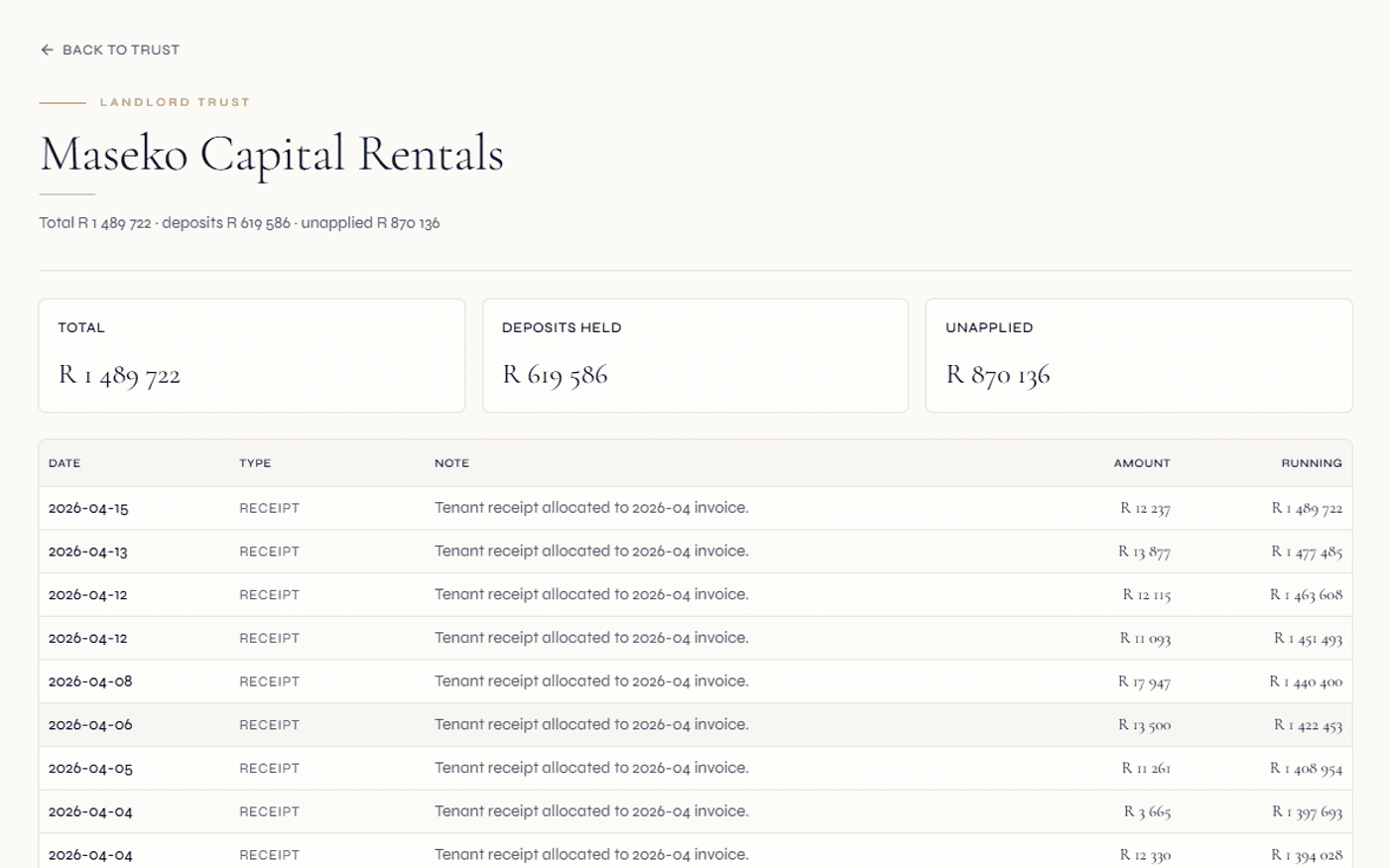
A special levy carries a stated purpose and a target unit list — billed once for a defined project, not month after month.
Apportioned across units on the same participation-quota basis as the ordinary levy, or as the trustees resolve.
A special levy runs through the same levy engine as the standing roll, reading on the same statements and the same ledger.
The one-off project is where scheme accounting most often comes apart.
Ordinary levies are easy to keep honest because they recur — the same quota, the same budget, the same run, month after month. A special levy is different. It is raised once, for a specific project, against a specific set of units, often for a large amount payable over several months. That is exactly the kind of charge that ends up tracked in a side spreadsheet — and side spreadsheets are where reconciliations quietly fail.
On Regalis a special levy is not a side spreadsheet. It is raised through the same engine that produces the standing levy roll, with a one-off flag, a stated purpose and a target list of units. The amount is apportioned by participation quota (or as the trustees resolve), written to each affected owner statement, and tracked on the same unified ledger as every other charge. The project balance reduces as owners pay, and you can see at any moment what has been raised, what has been collected and what is still outstanding on the project.
Because it lives on the standing record rather than beside it, the special levy reconciles cleanly at year-end. The trial balance, the general ledger and the actual-vs-budget report all account for it without a rebuild, and when CSOS or an auditor asks about the project, the evidence is already gathered in one place.
Read the full guide
How a special levy usually goes wrong
- The project is tracked in a separate spreadsheet that never quite ties back to the ledger, so the books and the project balance drift apart.
- Apportionment is worked out by hand, unit by unit, and a quota error is only spotted when an owner queries their share.
- Part-payments against a multi-month special levy get allocated inconsistently, so nobody can say cleanly what each owner still owes on the project.
- A special-levy balance is missed at transfer because it lived outside the main ledger, and the project debt passes to a new owner unreconciled.
- A reserve-fund top-up raised as a special levy is not kept distinct from the administrative fund, blurring the segregation the auditor expects.
- At year-end, the project has to be rebuilt from emails and bank statements before the financials will balance.
What raising it on Regalis gives you
- The special levy sits on the unified ledger — the project balance and the books are the same number, always.
- Apportionment is computed from each unit participation quota automatically; correct a quota and the split recalculates.
- Part-payments allocate against the project charge on each owner statement, so every owner balance is clear at a glance.
- An outstanding special levy is captured at transfer and gates the levy clearance certificate — it cannot pass on unreconciled.
- A reserve-fund top-up routes to the marked reserve accounts and the dedicated reserve trust account, kept distinct from the administrative fund.
- At year-end the project is already in the trial balance, the general ledger and the actual-vs-budget report — no rebuild.
From trustee resolution to a settled project.
Resolve and define the special levy
Once the trustees (or the AGM) have resolved to raise the levy, capture it: the purpose of the project, the total amount to be raised, the period it covers and whether it follows the ordinary participation-quota basis or a different split. The special levy is flagged as one-off so it never recurs.
- Stated project purpose and total
- One-off flag — never recurs
- Quota basis or a resolved split
Target the units and apportion
Choose the units the levy applies to — typically every unit in the scheme, but a defined list where the project benefits only a phase or a section. The platform apportions the total across those units by participation quota (or as resolved), so each owner share is computed for you rather than worked out by hand.
- Target every unit or a defined list
- Apportioned by participation quota
- Per-unit share computed automatically
Bill it to owner statements
The special levy posts to each affected owner statement alongside the ordinary levy, on the same unified ledger. Owners see the project charge on their account, and where it is payable over several months they see the balance to settle. Notices targeted to the affected owners go out through the same notification engine.
- Posted to each owner statement
- Reads on the same ledger as ordinary levies
- Targeted notices to affected owners
Track to paid and reconcile
Owner payments arrive by EFT and allocate against the project charge, and the project balance reduces as they come in. Any amount that falls overdue feeds the arrears bands for collection. At year-end the special levy is already in the trial balance, the general ledger and the actual-vs-budget report.
- Payments allocate against the project
- Overdue amounts feed the arrears bands
- Reconciled into the year-end close
Everything a one-off levy needs, on the standing record.
A special levy is raised, apportioned, billed and tracked through the same surfaces that run the ordinary roll — so it reconciles cleanly instead of living in a side spreadsheet.
One-off raise
Raise a special levy through the same engine as the standing roll, with a one-off flag, a stated purpose and a defined period. It never recurs and never gets confused with the ordinary monthly run.
Quota apportionment
The total is apportioned across the targeted units by each unit participation quota — the same basis as the ordinary levy — or by a split the trustees resolve. Correct a quota and the apportionment recalculates.
Target unit list
Apply the levy to every unit in the scheme, or to a defined list where the project benefits only a phase or a section. The target list travels with the special levy on the record.
Owner statements
The project charge posts to each affected owner statement alongside ordinary levies, so owners see exactly what they owe on the project and watch the balance reduce as they pay.
Instalment-friendly
A large special levy is often payable over several months. Owner payments allocate against the project charge as they arrive, with part-payments handled the same way as on the ordinary roll.
Reserve-fund top-up
Raise a reserve-fund top-up as a special levy routed to the marked reserve accounts and the dedicated reserve trust account, structured to support the STSMA section 3(1)(b) fund segregation.
Arrears bands
Any special-levy amount that falls overdue ages into the same 0-30, 31-60, 61-90 and 90+ day bands as ordinary levies, so the collection side can see and escalate it.
Transfer gate
An outstanding special levy is captured at transfer and gates the levy clearance certificate, which generates only once the project balance and all other amounts are settled.
Trustee approval trail
The resolution to raise, the apportionment and any related supplier payments for the project sit alongside the trustee approval workflow, keeping a clear decision trail for the scheme.
General ledger
The special levy and every payment allocated to it sit on the unified general ledger, so the project appears in the trial balance and the GL without a separate rebuild.
Actual-vs-budget
Where a special levy funds a budgeted project, levy income raised reconciles against the project spend month-by-month and year-to-date, so trustees see drift before the AGM.
Audit-ready evidence
The purpose, the apportionment, the statements and the payments are gathered on one record, structured to support audit preparation and any CSOS query about the project.
STSMA, CSOS and the participation-quota basis — Regalis is built to support a special levy properly.
A special levy in a sectional title scheme is raised under the Sectional Titles Schemes Management Act (STSMA, 2011). Section 3(1)(c) ties an owner ordinary contribution to that section participation quota, and a special levy is ordinarily apportioned on the same basis unless the rules or a resolution provide otherwise. Where the levy tops up the reserve fund, section 3(1)(b) requires that the administrative and reserve funds be kept distinct. The Community Schemes Ombud Service Act (CSOS, 2011) overlays the dispute-resolution and oversight regime an owner can invoke if they contest the levy.
Regalis is built around that shape. The default apportionment follows participation quota, with the option to target a defined unit list or apply a resolved split. A reserve-fund top-up routes to the marked reserve accounts and a dedicated reserve trust account, designed to keep the funds distinct. The whole project — purpose, apportionment, statements, payments — sits on the unified ledger that produces the trial balance and the general ledger, structured to support audit preparation.
For a managing agent, the practical effect is that the one-off project stops being the exception that breaks the books. It reconciles on the same record as the ordinary roll, the evidence is gathered for any CSOS query, and the segregation an auditor expects is built in rather than reconstructed at year-end. Informational only — not legal advice; confirm statutory treatment with your auditor or CSOS.
Continue exploring how Regalis handles the rest of the rental operation.
Levy roll software
The recurring schedule — per-unit base levies computed live from participation quota and the approved budget, month after month.
Read moreLevy collection software
Chase any overdue levy — ordinary or special — with reminder cadences, collection statuses and a CSOS-grade evidence pack.
Read moreBody corporate accounting
Chart of accounts, budget, trust ledger, trial balance and reserve-fund segregation — the books a special levy reconciles into.
Read moreCommon questions
Common questions about raising a special levy.
What is a special levy and how does Regalis raise one?+
A special levy is a one-off charge a scheme raises for a specific purpose — a roof replacement, a façade repaint, a security upgrade, a reserve-fund top-up — over and above the ordinary monthly levy. On Regalis you raise it through the same levy engine that produces the standing roll, but with a one-off flag, a stated purpose and a target list of units. It is apportioned across those units, billed to each owner statement, and tracked through to settlement. You do not run a separate spreadsheet for the project.
How is a special levy apportioned across units?+
By default a special levy follows the same participation-quota basis as the ordinary levy, so each unit carries a share proportional to its quota — the basis STSMA section 3(1)(c) ties to ordinary contributions. Where the trustees resolve a different split, you can target a chosen list of units or apportion as resolved. The amount per unit is computed for you, written to each affected owner statement, and ages into the same arrears bands as any other charge.
How is the special levy different to the standing levy roll?+
The levy roll is the standing, recurring schedule — what every unit owes month after month, derived from quota and the approved annual budget. A special levy is a one-off raised against a project, layered on top of the roll for a defined purpose and period. Both flow through one engine, so a special levy reads on the same statements and the same ledger as the ordinary levy. See the levy roll page for the recurring side.
How is it different to levy collection?+
Special levy is about raising and billing the one-off charge — defining the project, apportioning it by quota, and posting it to owner statements. Levy collection is the recovery layer that chases any of those amounts once they fall overdue: reminder cadences, collection statuses and a CSOS-grade evidence trail. The special levy creates the charge; collection pursues the shortfall on the same ledger. See the levy collection page for the arrears side.
Can a special levy be paid off in instalments?+
A large special levy is often payable over several months rather than in one hit. Because the charge sits on the same owner ledger as ordinary levies, owner payments are allocated against it as they come in — by EFT, matched by owner code — and each owner statement shows the project balance reducing over time. Part-payments are handled the same way as on the ordinary roll.
What happens to a special levy balance when a unit transfers?+
An outstanding special levy is an amount owing on the unit, so it is captured at transfer like any other arrears. The levy clearance certificate generates only once outstanding amounts — ordinary levies, special levies, fines, interest and pro-rata — are settled, which means a project balance cannot quietly pass to a new owner unreconciled. The conveyancer cannot retrieve the certificate before the scheme is paid.
How does a special levy relate to the reserve fund?+
A reserve-fund top-up can be raised as a special levy and routed to the reserve side. Reserve-fund accounts are marked separately in the chart of accounts and movements post to a dedicated reserve trust account, structured to support the STSMA section 3(1)(b) requirement to keep the administrative and reserve funds distinct. The reserve-fund report then filters those movements on demand for audit preparation. Informational only — not legal advice; confirm statutory treatment with your auditor or CSOS.
Does the platform keep an audit trail for a special levy?+
Yes. The special levy, the units it was raised against, the apportionment, every owner statement it touched and every payment allocated to it sit on the same unified general ledger as the rest of the scheme. At year-end the trial balance, general ledger and actual-vs-budget reports come from that one record, maintaining structured records and an audit trail to support audit preparation and any CSOS query about the project.
Raise it once. Apportion it fairly.
Track it to paid.
Walk through raising a special levy, apportioning it by participation quota, billing it to owner statements and reconciling it into the year-end close with someone from the team.