
Vacancy management software
that closes the gap between tenants.
Track every vacant unit, measure time-to-let, and run the turnover pipeline from notice through make-ready to re-let — on the same record as your occupied units. An empty unit is lost rent every day; Regalis makes the gap visible and hands it straight to applications so it closes faster.
- Vacant unit tracking
- Time-to-let
- Turnover pipeline
- Notice to re-let
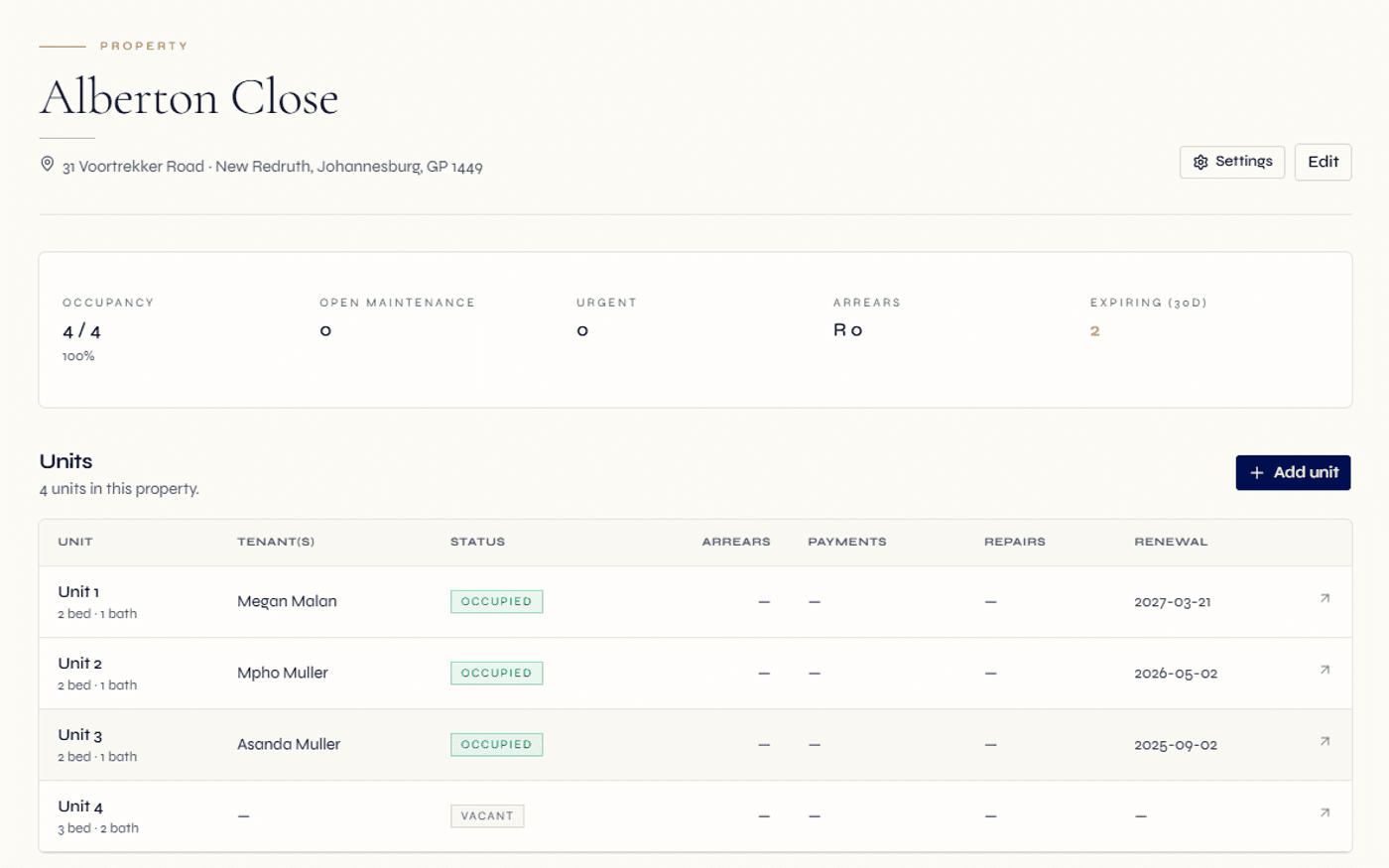
Notice-given, move-out and new-lease-start dates are captured against every unit, so time-to-let is derived, not guessed.
Empty units sit on the same property view as occupied ones — visible, not buried in a separate spreadsheet.
The empty unit flows straight into the applicant pipeline and converts to a new lease on the same record.
A vacant unit is the only line on your rent roll that costs you money instead of making it — yet it is usually the one nobody is watching.
Most property software is built around the active lease. It tells you who is paying, who is in arrears and whose contract is ending. What it rarely tells you, at a glance, is which units are empty right now, how long they have been empty, and what is stopping them from being re-let. That blind spot is expensive: a unit at R12 000 a month that sits empty for an extra six weeks is roughly R18 000 of rent that never arrives — and it leaves quietly, one day at a time.
Regalis treats the empty unit as a first-class thing to manage, not an absence to ignore. The same property record that shows occupied units shows the vacant ones beside them, with the dates that matter: when notice was given on the outgoing lease, when the tenant actually moved out, and when a new lease starts. From those dates the platform derives the void duration and the time-to-let — the two numbers that tell you whether your turnover is tight or whether units are slipping.
Crucially, vacancy management does not live on its own. It is the bridge between three things you already run — the lease that is ending, the turnover work that makes the unit rentable again, and the applicant pipeline that fills it. By stitching those together on one record, the gap between tenants stops being a black box and becomes a pipeline you can shorten.
Read the full guide
What an untracked vacancy costs you
- Nobody knows the true vacancy number — "a few units are empty" is not a figure you can act on or report to an owner.
- The clock starts late: marketing only begins after move-out, when it could have started the day notice was given weeks earlier.
- Turnover work and re-letting run on different tools, so a unit gets listed before it is actually ready — or sits ready and unlisted.
- Time-to-let is never measured, so there is no way to tell whether one unit, one property or one manager is consistently slow.
- Lost rent from voids is invisible. It never appears as a line item, so it is never managed down.
- The handover from "unit is empty" to "new applicant approved" is a manual email chain that drops units between the cracks.
What vacancy management gives you
- A live count of vacant units across the portfolio, broken down to the individual unit on each property.
- The clock starts at notice, not at move-out — so marketing and the applicant pipeline can begin in parallel with the wind-down.
- Make-ready work and re-letting share one record; a unit is only ready to market once its turnover work orders are closed.
- Time-to-let derived per unit, per property and across the portfolio, so slow re-lets stand out instead of hiding.
- Void duration is a number you can see and trend down month on month.
- The empty unit hands straight to the applicant pipeline and converts to a new lease — one record, end to end.
From notice given to keys handed over — one tracked path.
Notice starts the clock
When a lease moves into its ending state — notice given by either side, or a non-renewal at expiry — the unit is flagged as heading for vacancy with the effective date attached. The countdown to an empty unit begins here, not after the tenant has gone, so re-letting can run alongside the wind-down.
- Notice-given date captured on the lease
- Unit flagged as upcoming vacancy
- Marketing and applicant work can start in parallel
Move-out and make-ready
The outgoing tenant moves out and the move-out inspection records the unit's condition. Any remedial work becomes maintenance work orders against that unit — cleaning, paint, repairs — each with its own status. The unit is not marked ready to market until that turnover work is closed off.
- Move-out inspection captures condition
- Turnover work raised as unit work orders
- Ready-to-market gated on closed turnover
List and fill the unit
The ready unit is matched against candidates in the applicant pipeline. Applicants are screened with consent-based credit checks and affordability scoring, and compatibility is checked against the unit's own policy — pets, parking, occupants — so the right tenant reaches the front of the queue.
- Unit matched to applicants
- Consent-based screening and affordability scoring
- Unit-policy compatibility flags surfaced
Convert to a new lease and close the void
The approved applicant converts straight into a new lease on the same unit, with its own reference and digital signing. The new-lease-start date closes the void, the time-to-let is recorded against the unit, and your occupancy figure updates the moment the keys change hands.
- Applicant converts to a new lease on the unit
- Void closed, time-to-let recorded
- Occupancy updates immediately
Everything you need to see, shorten and report on the gap between tenants.
Vacant unit register
Every empty unit sits on the same property record as the occupied ones — visible at a glance, with the date it became available and how long it has been waiting.
Time-to-let measurement
Void duration and time-to-let derived from the notice, move-out and new-lease dates already on each unit — no separate tracker to keep updated.
Occupancy at a glance
Occupancy shown on the command centre and on each property, drilling from a portfolio-wide figure down to the individual unit that is empty.
Notice-to-re-let pipeline
A single tracked path from notice given, through move-out and make-ready, to a new lease — so a unit never falls silently between the stages.
Turnover work orders
Make-ready work between tenants — cleaning, paint, repairs — raised as maintenance work orders against the unit, gating it from going to market until done.
Move-out inspections
A move-out inspection captures the unit's condition at handover, feeding both the turnover work list and any deposit deductions on the closing lease.
Listing readiness
A unit is only flagged ready to market once its turnover work is closed, so you never advertise a unit that is not actually rentable.
Applicant hand-off
The ready unit flows straight into the applicant pipeline, where candidates are matched, screened and converted — closing the loop on one record.
Portfolio vacancy view
For managing agents, vacancy rolls up across the whole book; for a single landlord, across their own units — one consistent picture of what is empty and why.
Void cost awareness
Because the days-empty figure is tracked per unit, lost rent stops being invisible. The number you most want to shrink is finally on screen.
Renewal-first vacancy avoidance
The best vacancy is the one that never happens — expiring leases surface inside a configurable window so renewals are captured before a unit ever empties.
One operating record
Lease, turnover, applicant and new lease all live on the same unit, so the whole notice-to-re-let story reads in one place rather than across tools.
Between the lease that is ending and the application that fills it — vacancy management is the connective layer, not a parallel one.
Vacancy management deliberately reuses what you already run rather than duplicating it. The dates it depends on — notice given, move-out, new-lease-start — come straight from the lease lifecycle, so the void is measured from the same source of truth that runs your contracts. The make-ready work it gates on is ordinary maintenance against the unit. And the candidates it hands to are the same applicant pipeline your team already works.
That is the difference between a vacancy report and a vacancy workflow. A report tells you a unit is empty after the fact. A workflow starts the clock when notice is given, keeps the make-ready honest, and pushes the unit into the applicant pipeline the moment it is ready — turning a passive number into an active pipeline you can shorten. Lost rent from voids is, in the end, a rates-and-time problem, and the way to shrink it is to compress the time at every stage.
If you are running rentals at any scale, this is where margin quietly leaks. A handful of units empty a few weeks longer than they should be, across a year, is real money. Making the gap visible — and connecting it to renewals on one side and applications on the other — is the simplest lever most portfolios are not yet pulling.
Continue exploring how Regalis handles the rest of the rental operation.
Rental application & screening
The applicant pipeline a vacant unit hands to — consent-based TPN checks, affordability scoring and a structured applicant board.
Read moreLease renewal
Capture renewal intent before a lease ends — the best void is the one that never opens because the tenant stayed.
Read moreRental management
Where vacancy, leases, applications, arrears and trust accounting all run on one record for landlords and managing agents.
Read moreLease management
Lifecycle states, ECTA-aligned digital signing and termination workflows — the dates that vacancy tracking is derived from.
Read moreMaintenance coordination
The turnover work that has to close before a unit is ready to market again — raised as work orders against the unit.
Read moreTenant screening
Native TPN credit checks (distribution-partner onboarding in progress), affordability scoring and compatibility flags woven into the application record.
Read moreCommon questions
Common questions about vacancy management software.
What does vacancy management software actually track?+
It tracks the full life of an empty unit — the moment notice is given on an active lease, the day the outgoing tenant moves out, the make-ready and turnover work, the day the unit is ready to market, and the day a new lease starts. Each stage is dated, so you can see exactly how long a unit has been empty and where it is stuck. The vacant units sit alongside your occupied ones on the same property record, not in a separate spreadsheet.
How is this different from lease management or applications?+
Lease management runs the contract itself; applications and screening run the inbound candidate pipeline. Vacancy management is the layer between them — it watches the gap. It starts the clock when notice is given, surfaces the unit while it is empty, and hands it straight to the applicant pipeline so the void closes. It is the connective tissue that stops a notice-to-vacate from quietly turning into three months of lost rent.
How does Regalis measure time-to-let?+
Because lease lifecycle states already capture notice-given, move-out and new-lease-start dates against each unit, the platform can derive how long a unit was empty and how long it took to re-let from the day it became available. You see void duration per unit, an average across a property or portfolio, and which units are running over your target window — without rebuilding any of it by hand.
Can I see occupancy across a whole portfolio at once?+
Yes. The command centre and the property views show occupancy at a glance, and each property breaks down to its individual units. A managing agent firm sees firm-wide occupancy; a single landlord sees their own. Vacant units are visible rather than hidden, so the empty ones get attention instead of being forgotten between busy months.
Does it handle the turnover and make-ready work between tenants?+
Yes. A move-out inspection records the unit's condition, and any remedial work becomes maintenance work orders against that unit — paint, cleaning, repairs — with their own status. The unit is not marked ready to market until that turnover work is closed, so you never list a unit that is not actually rentable.
How does a vacant unit connect to new applicants?+
Once a unit is empty and ready, it flows into the applicant pipeline. Candidates are matched against the unit, screened with consent-based TPN checks (distribution-partner onboarding in progress) and affordability scoring, and the approved applicant converts straight into a new lease on that same unit. The notice-to-re-let chain stays on one record from end to end.
Does it help reduce rental voids?+
It is designed to. The cost of a void is simply rent multiplied by the days empty, so the levers are starting the marketing earlier (from notice, not from move-out), keeping turnover work tight, and closing the applicant pipeline faster. Vacancy management makes all three visible in one place so the days-empty number trends down rather than drifting.
Turn the gap between tenants
into a pipeline you can shorten.
Walk through vacant unit tracking, time-to-let measurement and the notice-to-re-let pipeline with someone from the team — and see how it hands straight to applications and renewals.